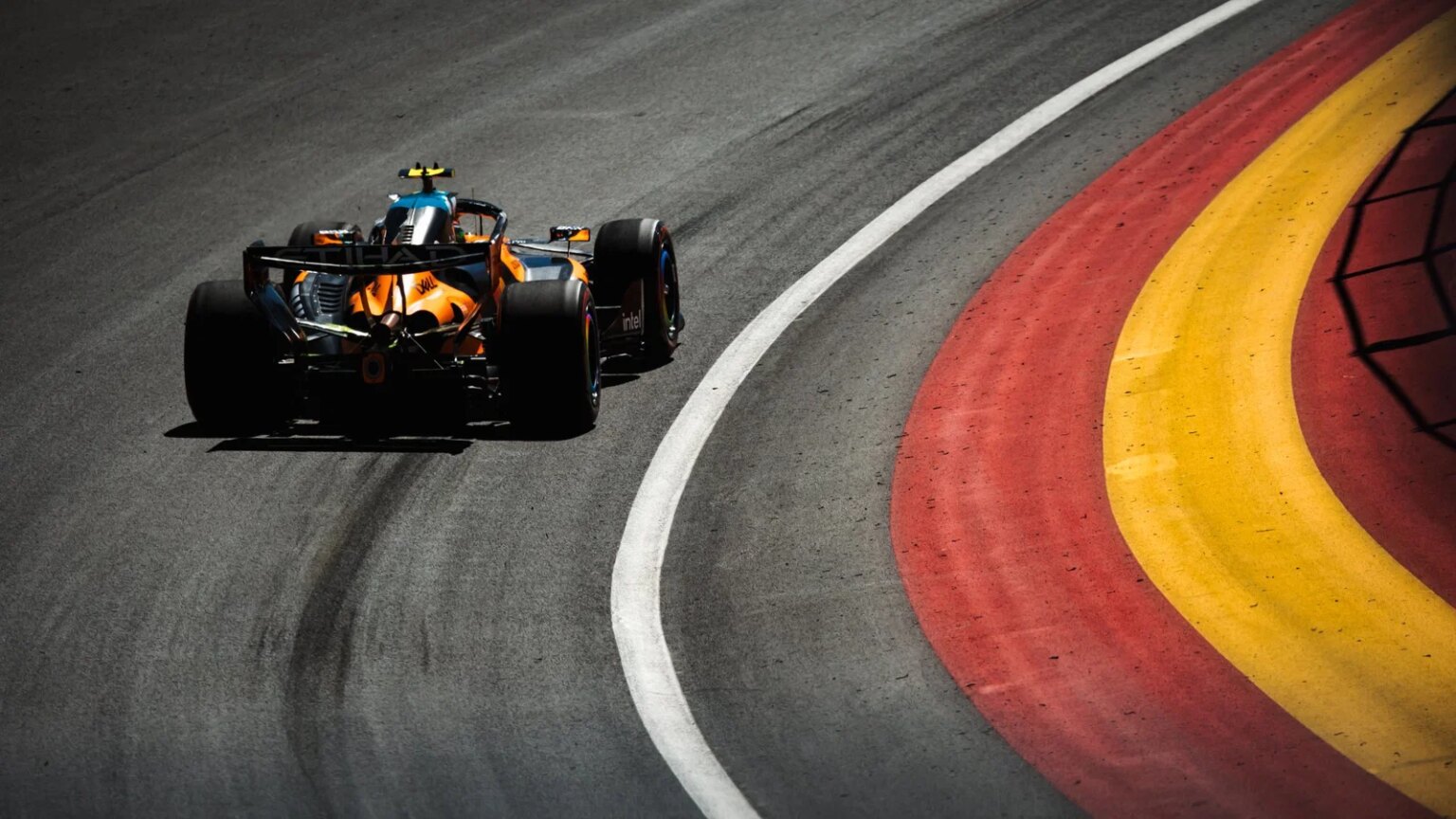
Formula 1 drivers got their first opportunity to drive the brand-new Madrid circuit during Friday’s practice sessions at the Spanish Grand Prix.
This newly constructed Madring is hosting its inaugural grand prix this weekend and is expected to challenge drivers with a mix of high-speed bends, unforgiving barriers, and tricky curved braking zones.
A recent Formula 3 test revealed the circuit’s complexity, with 19 flags displayed over two days at this Spanish venue.
F1 drivers spent two hours practicing on the street circuit Friday, offering a chance to form initial opinions about the track.
Riskier Than Monaco?
George Russell, who was fastest in the opening F1 practice session in Madrid, highlighted the circuit’s minimal margin for error.
The 28-year-old British driver even suggested that the Madring is more demanding than Monaco due to higher speeds.
“I’d say this track has less margin for mistakes because of the speed,” Russell said in Madrid. “In Monaco, the walls are closer, but since you’re driving slower, if you make a mistake, you don’t hit the wall as quickly and can sometimes recover. Here, there’s less room for error.
“There are many very fast corners, and the barriers almost seem to come at you as you rejoin the track. If you run wide and hit the wall, unlike Monaco, the wall isn’t at the same angle the car is going—it’s almost pushing against you.”
La Monumental: A Stunning Yet Challenging Corner
Madring has already drawn early comparisons with other F1 street circuits like Jeddah, Baku, Miami, and Sochi.
The standout corner is the impressive 24-degree, 500-meter banked Turn 12, dubbed La Monumental.
Drivers take roughly six seconds negotiating this landmark section, which quickly emerged as a major challenge during Friday’s practice.
Traffic was a notable problem in this blind corner, with drivers frequently encountering each other and causing near-misses.
Carlos Sainz narrowly avoided contact with Lewis Hamilton in FP1, while Fernando Alonso expressed frustration after being impeded by a slow Cadillac during FP2.
Turns 5, 7, and 17 were also identified as trouble spots, with Turn 17 proving problematic for Ferrari’s drivers, including Hamilton and Charles Leclerc, who both had several close calls near the barriers.
“It’s an extremely tough circuit,” said Hamilton. “Among all the new tracks I’ve raced on, this one and maybe Saudi Arabia are the most difficult for mastering the car and finding the ideal lines.”
Set-Up Challenges for Teams
The circuit’s hybrid design, mixing public streets with purpose-built segments, presents a dilemma for teams in dialing in car setups.
To meet the track’s demands, teams must find a balance, accepting compromises that may sacrifice performance in one area to gain advantage elsewhere.
Aston Martin’s chief trackside officer Mike Krack commented, “It’s a big compromise between the high-speed sections, needing softness for the kerbs, and stiffness for the banking. Now that we have data, there’s room to refine setups further.
“Every team will work in the simulator tonight to improve grip and get more familiar with the circuit.”
Is Madring a “Car Killer”?
Williams team principal James Vowles stirred discussion before the weekend by calling Madrid a “car killer,” and many expected a chaotic event with numerous red flags.
However, Friday’s activities were relatively calm, with just five red flags across six sessions involving F1, F2, and F3.
The most significant incident occurred in F2 practice when Tasanapol Inthraphuvasak had to evacuate his car after it caught fire following a crash into the wall at Turn 19.
F1 drivers remained incident-free in FP1 until Arvid Lindblad caused the first red flag after losing control at Turn 13 and smashing into the wall, damaging his suspension and front wing.
This crash underscored the circuit’s severity—small errors at such high speeds tend to have serious consequences.
Overtaking Likely to Be Difficult
A common early conclusion from drivers is that overtaking will be tough on the Madring, echoing concerns voiced even before the first lap.
Williams’ Alex Albon explained, “I wish the braking zones were different and less angled. With many fast corners linked together, defending is easy. You just position your car in the middle of the track, and it’s hard for anyone to pass.
“This means overtakes will more likely come from battery deployment rather than braking maneuvers. It’ll be a real challenge.”
At Friday’s end, Russell summarized the difficulty: “Overtaking will be very tough.”
Limited passing opportunities heighten the importance of securing a strong qualifying position ahead of Sunday’s race.
“Qualifying is definitely the key,” said Leclerc. “Even in FP2, when I tried to overtake, despite a considerable pace difference, it was extremely hard or impossible to pass.”
Fan Take:
This introduction of the Madring signals a bold new chapter for Formula 1 street circuits, combining breathtaking speed with intense technical demands. For racing fans, the track’s challenging layout promises thrilling qualifying battles and strategic races where precision and setup will be crucial, potentially redefining how drivers approach urban circuits in the future.
Source: www.crash.net