

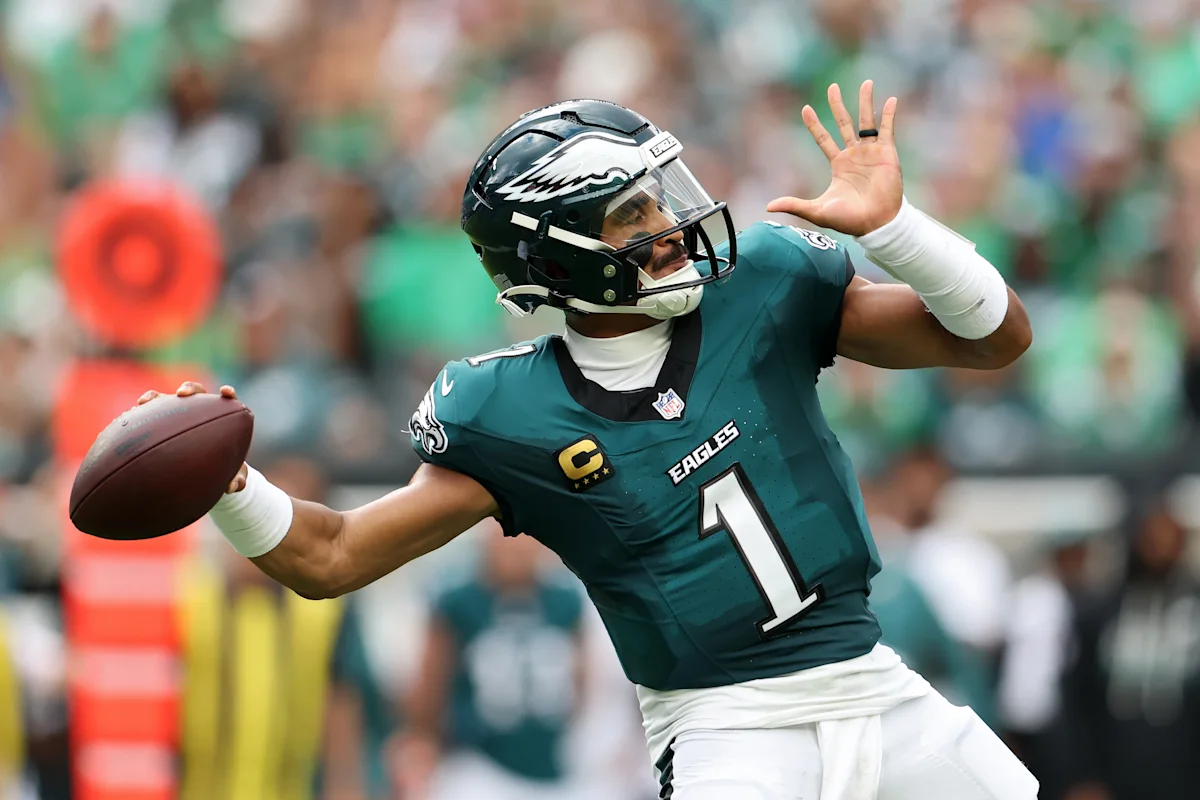
PHILADELPHIA — Criticism of Jalen Hurts’ willingness to change as a quarterback built up over the offseason, accumulating like traffic on I-95 heading to Lincoln Financial Field. An April 1 ESPN piece recounted Hurts’ role in a poorly executed “four verts” call that capped the Eagles’ disappointing 2025 season with a tame wild-card exit against the 49ers, and suggested he had resisted other offensive tweaks that could have broadened Philadelphia’s playbook.
Much of last year’s offensive heat was aimed at play-caller Kevin Patullo, but Hurts also faced scrutiny. He responded this offseason by embracing a new approach, and in Sunday’s 24-22 season opener against the Washington Commanders he showed what that looked like with Sean Mannion installed as offensive coordinator. Hurts passed for 203 yards and three touchdowns without a turnover, while the offense — still sorting things out — flashed the potential for big plays. The Commanders, who also have a revamped offense under David Blough, were imperfect opponents, but Philadelphia’s performance in other phases helped its offense weather mistakes.
The rushing attack was inconsistent; Washington recorded 10 tackles for loss and the run game often looked ineffective. Still, the game produced encouraging signs: Hurts’ three TD throws, Saquon Barkley’s explosive 42-yard run (notable given he had only four runs of 20+ yards all of last season) and the breakout showing by wide receiver Dontayvion Wicks. Barkley stressed that the offense isn’t finished and must keep trusting Mannion’s system while improving.
When it mattered late, the big plays arrived — a 22-yard Hurts scramble on third-and-18 set up a 43-yard catch-and-run touchdown by tight end Dallas Goedert in the fourth quarter, and defensive tackle Moro Ojomo halted Washington’s potential game-tying two-point try with 61 seconds remaining to seal the win.
Mannion, who has absorbed ideas from coaches such as Sean McVay and Kyle Shanahan, has installed an offense that emphasizes under-center looks, pre-snap motion and progression-based passing that requires timing and reads through routes over the middle. Hurts, previously criticized for avoiding throws to that area, executed several such plays Sunday: a 64-yard strike to Wicks in the second quarter that began from under center, and both of his scoring passes to Goedert came over the middle. That countered doubters who questioned his comfort in this style.
Mannion — a 2015 third-round pick who spent nine years as a backup and learned from a variety of coaching staffs with the Rams, Vikings and Seahawks — is in his third season as an NFL assistant and spent the last two years on Matt LaFleur’s Green Bay staff. He’s also Hurts’ seventh play-caller in seven pro seasons (the Eagles went through five different callers during Nick Sirianni’s tenure alone). While stability would benefit Hurts, Mannion must also prove he can sustain it; a Week 1 win is at least a positive start.
Chunk plays were decisive in what became a strategic battle against Washington’s first-year coordinator Daronte Jones, who used Brian Flores-style disguises. Sirianni noted that when the Eagles hit explosive plays — be it a Hurts scramble, a Barkley run or a deep pass — they turned those drives into points, which mattered for the game’s flow.
The deep shot to Wicks began from a 13-personnel look with three tight ends on the field, a formation that hinted at a run before Hurts faked a handoff and uncorked a precise throw over Washington cornerback Mike Sainristil into Wicks’ hands — the start of Wicks’ two-catch, 73-yard, one-TD breakout. Later, Mannion put Wicks in motion from right to left; when Sainristil followed, Wicks exploited inside leverage and finished with a 9-yard fade touchdown. The Eagles used a lot more pre-snap movement than they did a season ago (when Next Gen Stats showed they ran motion on one of the league’s fewest snaps), a tactic Wicks said helped reveal defensive coverage and create mismatches Mannion targeted.
Offensive lineman Tyler Steen and other teammates praised Hurts’ adaptability and Mannion’s play-calling, while players also acknowledged the need to keep building. Despite an imperfect ground game and some early miscues, the combination of Mannion’s system and Hurts’ execution produced enough explosive plays to lift the Eagles to victory.
Fan take: This game matters because it suggests Hurts can successfully operate in a more timing- and motion-oriented system, which could make the Eagles’ offense harder to defend if it’s sustained. If Mannion’s approach continues to produce big plays while fixing the running game, Philadelphia could become one of the league’s more dangerous and versatile offenses.
Source: sports.yahoo.com