
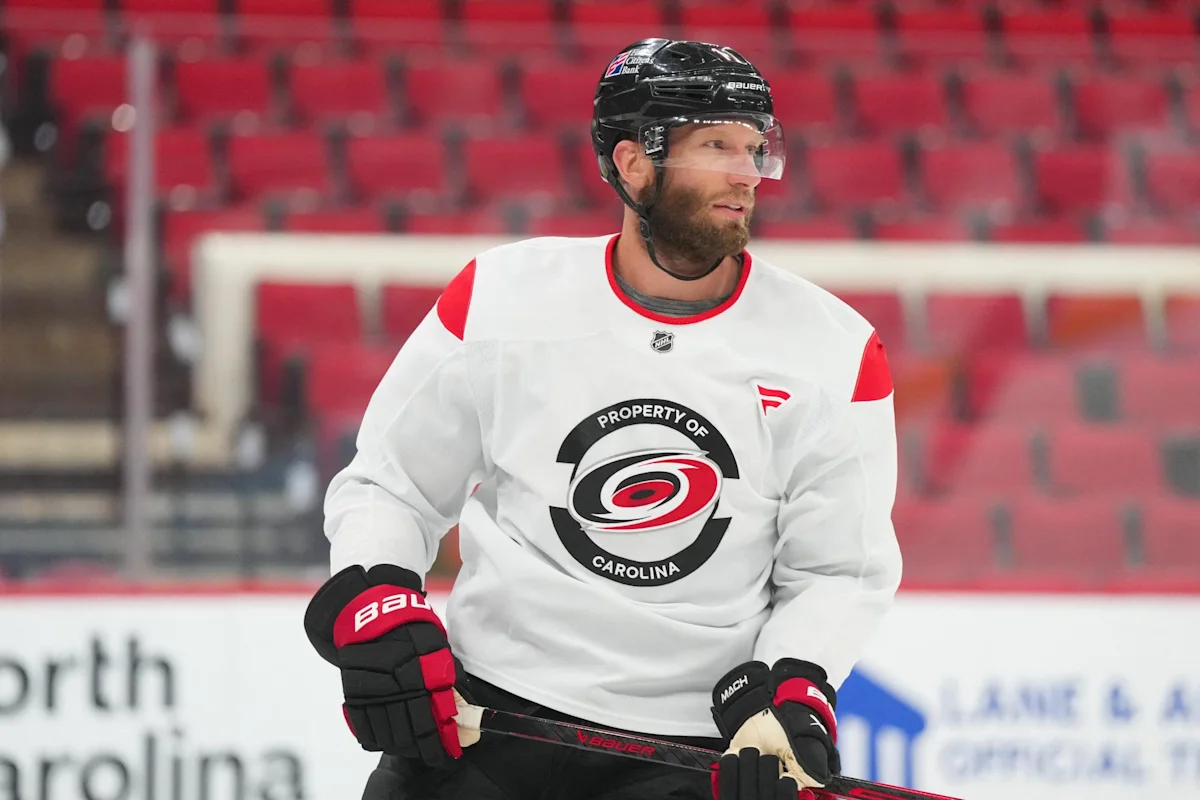
We’ve reached an exciting milestone, folks—less than two weeks until Opening Night. By the end of the weekend, we’ll see real NHL action with some players taking the ice, and soon after, we’ll be marveling at a new banner hanging in the Lenovo Center rafters—though recent promotional images and photo shoots suggest it might look different than expected. As the team kicks off camp Thursday, giving the media their first true chance to interact with players, here are a couple of key storylines to watch on the ice at the Wake Competition Center.
Alexander Nikishin’s Absence
It’s no surprise that Nikishin won’t be on the ice at the start of camp, as Pierre LeBrun indicated earlier this week. Without a contract, there’s little risk for him to get injured while waiting for negotiations. After his high-profile arrival in Russia, his debut in the 2025 playoffs, and a decent but not standout rookie season, negotiations have reached an impasse. Both sides understand the situation: Nikishin’s camp believes he’s worth more, citing recent contracts of similar young players, but the Hurricanes hold leverage—they can’t be signed by other teams, and Nikishin can’t seek arbitration without an earlier U.S. arrival. If he had come to the U.S. sooner, his bargaining position might be stronger; instead, the team is hesitant to commit significant funds to a player whose full potential hasn’t yet materialized.
Nikishin has expressed a desire to be traded, yet the Hurricanes still hold much of the power—knowing his value but also understanding he hasn’t definitively proven himself yet. His main leverage is the uncertainty of a future long-term deal with any new team, which depresses his trade value.
Once hockey starts, this situation won’t have much immediate impact. Despite Nikishin’s initial hype, the Hurricanes’ roster looks stronger than when he arrived, especially after acquiring K’Andre Miller last summer, which turned out to be a smart move. The team’s defense has improved, and several young defensemen and depth players will compete for spots. Ultimately, Nikishin’s potential move depends on future trades or developments; for now, his US arrival means he isn’t earning or contributing.
Roster Stability
Apart from Nikishin, the Hurricanes’ team appears quite stable. They’ve lost only Frederik Andersen from last year’s Stanley Cup squad, who is already injured in Edmonton. They’ve filled that gap with Pyotr Kochetkov, who’s returning fully healthy after winter surgery and is nearing the end of his contract, with free agency on the horizon—potentially leading him to test the market. Everyone else from their Stanley Cup-winning roster is back, which is reflected in the camp roster released recently.
The camp will separate players into two groups—one representing the defending champions, and the other containing those likely to start in Greensboro or Chicago. The main chance for these players to impress will be during the four pre-season games, where lines switch from minor/major league rosters to game-ready squads, offering clues about who might stand out.
Competing for Open Spots
Despite overall roster stability, at least one position is open—possibly two, depending on Nikishin’s situation. Seth Jarvis, who briefly participated in drills, is expected to miss the first couple of months recovering from shoulder surgery. His past performances in the Four Nations, Olympics, and Stanley Cup games earned him a spot, but now he needs to ensure he’s fully recovered for a deep postseason run.
This raises questions about how the lines will be reshuffled during his absence. Will the team promote Bradley Nadeau to fill in? Will they establish a enforcer-focused fourth line with Nicholas Deslauriers? Or will Jesperi Kotkaniemi get another chance to impress as they consider trading him? The lines are likely to be shuffled, especially since Jarvis was previously placed between Aho and Staal, and breaking up the Stankoven line may not happen immediately.
A Brief Lead-Up to the Season
The upcoming season kicks off with a condensed schedule—84 games instead of the usual length. The NHL reverted to a division-heavy format, playing each division four times, other divisions three, and cross-conference twice. This change came after players requested concessions, resulting in a shorter preseason, two fewer pre-season games, and notably, no longer including fitness tests—much to Coach Rod Brind’Amour’s dismay.
Given the shorter prep time, the Hurricanes could face challenges, especially after a late finish to last season and celebrations from their Stanley Cup victory. The reduced camp and pre-season could impact team readiness, and once the final pre-season game concludes on September 26th, the season begins just three days later on September 29th, promising a rapid build-up on social media.
Are you ready for hockey season to begin?
Source: sports.yahoo.com