

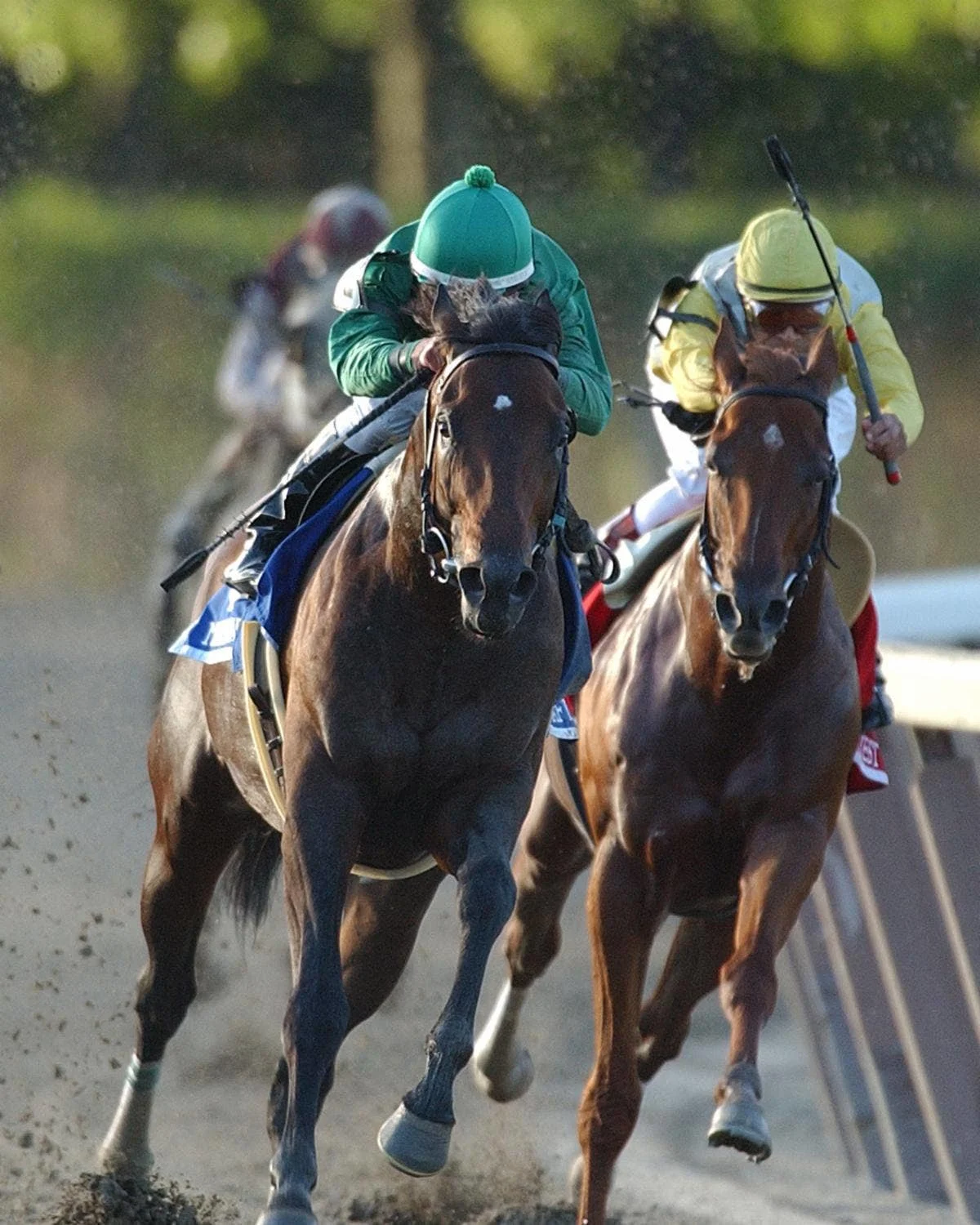
Before the race even began, trainer Neil Howard could already hear the whistles and cheers echoing around Belmont Park. The knowledgeable crowd, familiar with the prestigious stakes races that once filled the Breeders’ Cup preview days, sensed something extraordinary was about to happen. As the horses paraded for the 2003 Grade 1, $1 million Jockey Club Gold Cup—a 10-furlong race known for crowning top older horses—the fans expressed their admiration loudly for Mineshaft as he prepared near the grandstand.
Howard vividly recalls that moment: “When people were cheering and whistling for him during warm-ups, I glanced at my wife and couldn’t explain how we felt. It was like watching Scottie Scheffler approach the 18th green at the Masters. It truly struck a chord with me.” The applause peaked when Mineshaft, expertly ridden by Robby Albarado, powered through the stretch, leaving rivals far behind. Though Quest desperately fought to keep up, Mineshaft only needed a light encouragement to extend his lead, winning by an impressive 4 ¼ lengths.
Track announcer Tom Durkin declared him “routinely brilliant,” a fitting tribute to what Mineshaft consistently displayed at Belmont. His 2003 campaign, featuring seven wins from nine starts, earned him the Eclipse Awards for Horse of the Year and Champion Older Horse. Originally racing modestly on European turf under John Gosden’s guidance, Mineshaft was transferred to Howard’s stable in the fall of 2002, where he thrived on North American dirt, fully showcasing the remarkable talent inherited from his sire, the legendary A.P. Indy.
That year began with a narrow stakes victory at Fair Grounds and by Belmont’s fall meet, few questioned who was the standout older horse. Belmont fans had already witnessed Mineshaft defeat the reigning Breeders’ Cup Classic winner Volponi by 2 ¼ lengths in the Grade 1 Suburban Handicap in July. After a brief rest, Mineshaft dominated again in September’s Grade 1 Woodward Stakes, winning by over 4 lengths.
Having such a dominant horse, however, comes with immense expectations. Even the best can be undone by race-day factors, but Mineshaft’s team felt reassured despite his overwhelming 2-5 favoritism. Bill Farish of Lane’s End Farm, Mineshaft’s owner and breeder, said, “With a horse like Mineshaft controlling the pace, you just felt he was going to win. Something really unusual would have to happen for him to lose the Jockey Club Gold Cup.”
What the talented four-year-old may not have realized was the added pressure he carried on his shoulders. The Jockey Club Gold Cup was a highly prestigious race that had eluded Lane’s End’s trophy collection, especially stinging because Mineshaft’s sire, A.P. Indy, had only finished third there during his own Horse of the Year season in 1992. When Mineshaft arrived at Howard’s barn after seven European starts, winning the Jockey Club Gold Cup became a bold goal. Despite racing gods often disrupting plans, Mineshaft’s consistent excellence in North America made him undeterred by obstacles.
Farish noted, “The Jockey Club Gold Cup used to be the de facto Breeders’ Cup Classic before the Classic itself grew in importance. It was the race you had to win to be Champion Older Horse and Horse of the Year. With his family’s long ties to The Jockey Club, it was a prize my father always wanted to capture.”
From the moment he arrived at Churchill Downs in late 2002, Mineshaft made the difficult look easy. Calm and composed, he adjusted seamlessly after international travel and quarantine, even galloping through near tropical storm conditions to win the 2003 Pimlico Special Handicap. Howard consulted Gosden on how to handle Mineshaft, and the veteran European trainer’s advice was straightforward: “Just train him.” Mineshaft’s flawless demeanor and intelligence made an instant impression.
The 2003 Jockey Club Gold Cup field was small but competitive, including Dubai World Cup winner Moon Ballad and defending champion Evening Attire. Once the race started, Mineshaft stalked the early pace comfortably, with jockey Albarado urging him along at the five-furlong mark to challenge longshot Quest directly. Quest tried to respond, but Mineshaft surged ahead with ease and cruised to victory, becoming the first horse since Kelso in 1961 to win the Suburban, Woodward, and Jockey Club Gold Cup in the same year.
Howard reflected, “Good horses like Mineshaft are different—they breathe differently and think differently, like professional athletes. My wife and I feel so honored to have cared for him.” Mineshaft’s racing career ended shortly afterward with a minor ankle injury discovered in October. Transitioning to stud at Lane’s End alongside his sire, he commanded a $100,000 stud fee and despite the high bar set by A.P. Indy, sired multiple Grade 1 winners like Effinex and Dialed In.
Even into 2024, at the age of 27, Mineshaft remained a striking presence at Lane’s End with his legacy secure. That year, thanks in part to his son Senor Buscador’s victory in the $20 million Saudi Cup, he ranked third on the general sire list behind Into Mischief and Gun Runner. Bill Farish praised both his exceptional ability and his lasting impact as a sire and broodmare sire, noting, “He never required excuses—he had a high cruising speed and the talent to dominate.”
This year’s Jockey Club Gold Cup on Friday, September 18, marks the return of racing at Belmont Park following its extensive renovation. The 10-furlong race for three-year-olds and up, offering a “Win and You’re In” berth to the Breeders’ Cup Classic at Keeneland, will be Race 5 on a nine-race card, with first post at 1:30 p.m. Eastern. FOX will provide live coverage of the race between 3-4:30 p.m. Eastern as part of their Belmont Park Returns broadcast. For the full schedule, fans can visit the NYRA website.
Fan Take: Mineshaft’s 2003 Jockey Club Gold Cup victory remains a timeless example of equine greatness that still resonates with racing fans today. As Belmont Park reopens with a renewed spotlight on prestigious events like this, the race not only honors the past but also energizes the future of horse racing by connecting legendary performances to today’s rising stars.
Source: sports.yahoo.com