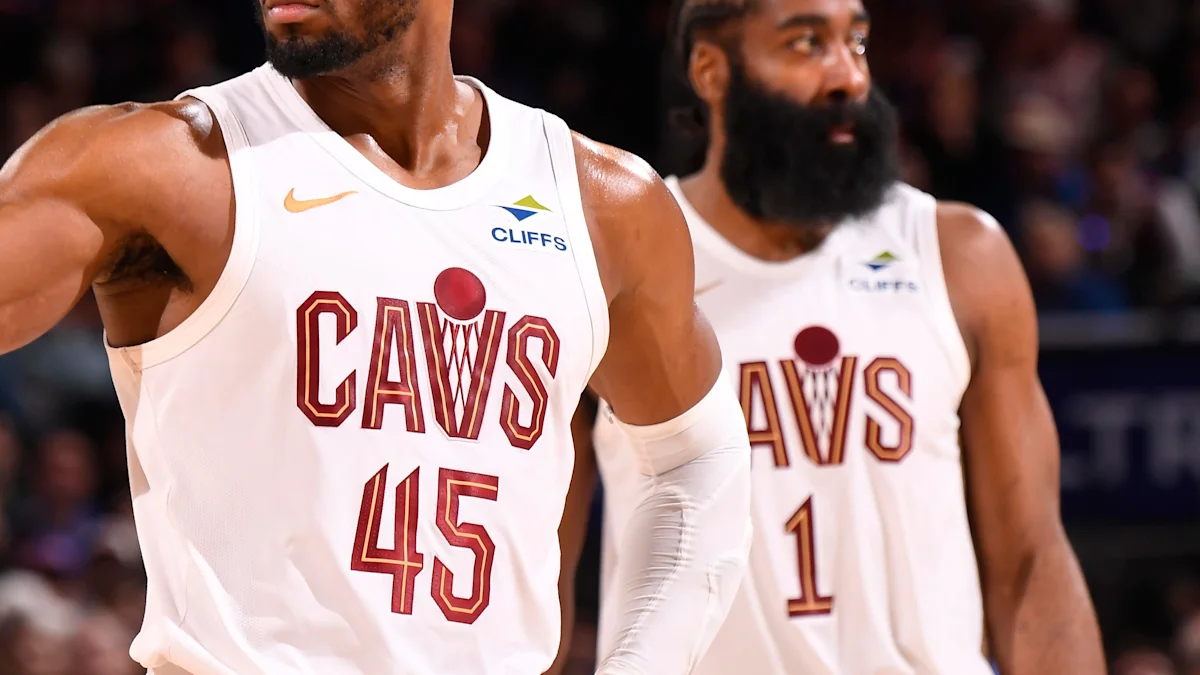
The Cleveland Cavaliers find themselves in a delicate situation. On the positive side, they just had their best postseason performance since acquiring Donovan Mitchell four years ago, reaching the Eastern Conference Finals for the first time since 2018. However, their harsh defeat by the New York Knicks revealed they are still far from being true championship contenders.
The offseason initially widened this divide. While teams like the Philadelphia 76ers, Toronto Raptors, Indiana Pacers, and Boston Celtics improved, the Cavaliers lost key players Dean Wade and Keon Ellis and failed in their pursuit of LeBron James. Their window for a title appeared to be closing before it really opened — until the front office got creative, engineering a five-team trade that sent Dennis Schroder, Max Strus, and future draft picks away to acquire Peyton Watson, arguably the best two-way wing/forward left at that point.
With this move, Cleveland fully committed. They traded Darius Garland for James Harden and promptly extended Harden’s contract, while also giving Donovan Mitchell a substantial extension. While they’ve used almost all their assets, the question remains: is it enough?
Everything this team’s success hinges on revolves around Watson. Drafted 30th overall by the Nuggets, Watson has long been viewed as a tantalizing defensive talent. Comparisons to prime Jonathan Isaac stem from his length, defensive instincts, and agility. His block rate ranking in the 93rd percentile during his first three years—despite not playing center and guarding tough perimeter matchups—speaks to his defensive upside.
In the 2024-25 season, Watson began showing promise offensively, and last year, thanks to injuries and his growth, he really came into his own. In January alone, over 15 games, he averaged 21.9 points, 5.5 rebounds, 3 assists, 1 steal, and 1.5 blocks per game on an impressive 59.6% true shooting. To put that in context, since 2014-15, only a handful of under-24 players have matched those numbers over 15 games, with most of them eventually becoming All-Stars.
This is a small and somewhat selective sample, and injuries prevented us from seeing how he’d perform in the playoffs, where he averaged just 14.2 minutes per game with limited offensive impact. His January scoring isn’t necessary for Cleveland — he’s expected to be a third option behind Harden and Mitchell and soak up minutes when one or both are off the court.
One key question remains: how reliable a shooter is Watson? Last year, he hit 41.1% from three on 3.6 attempts per game, a notable jump from his prior three seasons’ 32.8% on 1.8 attempts. Which stretch accurately reflects his current shooting ability? The skeptic would still label him below average, but if Watson can sustain his improved shooting, his spacing, secondary playmaking, and defensive versatility would make him by far the best fifth starter Cleveland has seen in years.
Looking at the core group, Jarrett Allen remains extremely consistent and projected for another top-10 center campaign in 2026-27. Harden is steady but will be 37, making his durability and effectiveness less certain. Meaningful declines there would increase the pressure on Watson’s independent scoring.
Evan Mobley must return to his 2024-25 form—when he ranked 12th in the NBA for Estimated Plus-Minus—for the Cavaliers to maximize their talent. Mobley slipped to 59th last season, potentially due to early-season injury challenges and inconsistent aggression. Some nights, he imposes himself with powerful drives and dunks; other nights, he drifts passively, hurting floor spacing. Mitchell could also improve his playmaking and playoff consistency, but at age 30, his style and physical toll suggest he’s unlikely to evolve dramatically.
To assemble this strong starting lineup, Cleveland weakened its depth. Jaylon Tyson showed significant improvement in his second season, but further growth will be critical. Sharpshooter Sam Merrill will remain a key offensive asset despite defensive shortcomings. Beyond them, the bench features players like Craig Porter Jr., Nae’Qwan Tomlin, Mario Hezonja, Thomas Bryant, Tyrese Proctor, and Maleek Thomas, with hopes that one or two might exceed expectations. Staying healthy will be vital.
Currently, FanDuel ranks the Cavaliers as the sixth most likely team to win the Eastern Conference with +900 odds (10%), though this feels a bit low. The Knicks and Raptors seem a cut above the rest, but Cleveland now belongs in the same tier as the 76ers, Celtics, and Pacers, with perhaps the strongest starting five in that group.
Last year’s Cavaliers ranked 6th overall in offensive rating and 15th defensively. Watson’s addition strengthens their frontcourt, and while losing a reliable shooter like Max Strus is a setback, the enhanced versatility Watson brings, coupled with having Harden for a full season and Tyson’s continued progress, should keep them competitive on offense. This blend gives them a legitimate chance to rank among the league’s top 10 units on both ends — a status few Eastern teams beyond the Knicks and Raptors can claim, perhaps only the Celtics.
The Cavaliers are no longer the dominant 64-win team of 2024-25 nor last year’s favored Eastern contender. Still, the hope is that Watson will become the best wing they’ve had since LeBron’s tenure. If this gamble pays off, with the Big Four staying healthy, role players stepping up, and no major injuries, this could be the most complete Cavaliers squad yet. If not, a major roster overhaul may be necessary. In any case, this season will be the true test of Cleveland’s championship ambitions.
Fan Take: This news is crucial for basketball fans because it highlights the high-stakes gamble Cleveland is making to ascend in a competitive Eastern Conference. Peyton Watson’s development and the Cavaliers’ ability to integrate their star players could reshape the balance of power and spark a new era of excitement in the league.
Source: sports.yahoo.com