
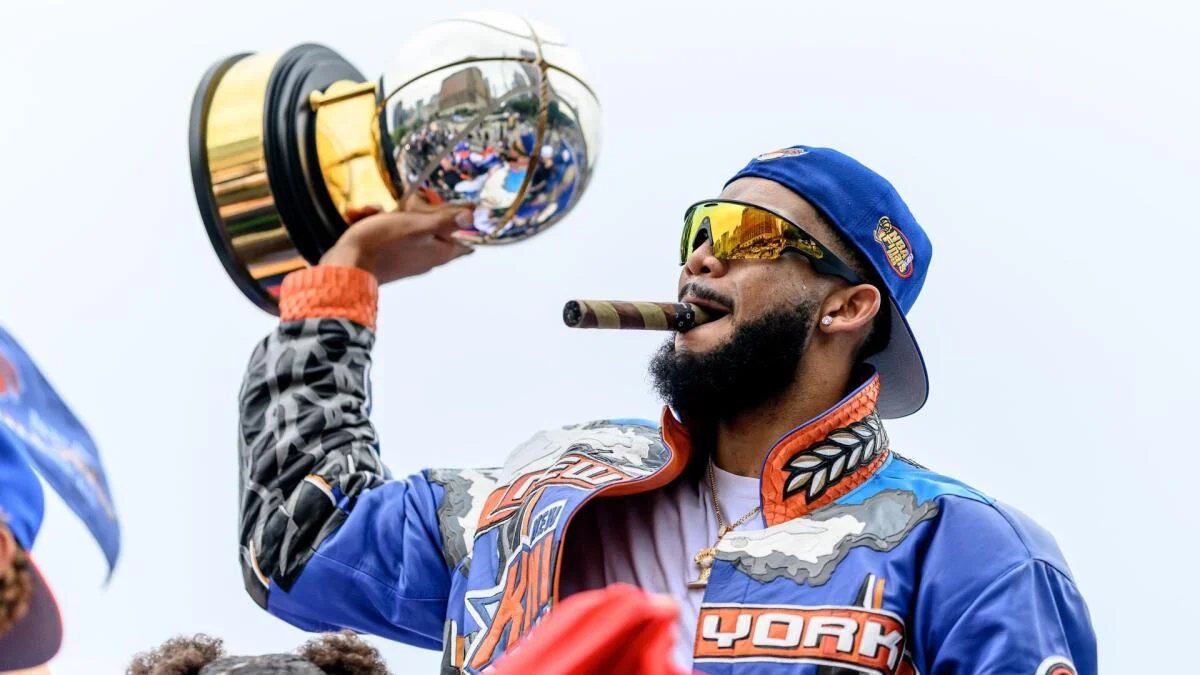
The New York Knicks enter the 2026-27 NBA season as reigning champions, but the latest collective bargaining agreement has brought uncertainty about how long this championship core can stay intact. Knicks owner James Dolan dampened the championship excitement by signaling that the team would not exceed the salary cap’s second apron to retain their key players. This philosophy led to the departure of Mitchell Robinson, who signed with rival Boston Celtics in free agency.
While Robinson’s exit is significant, the bigger challenge lies with Karl-Anthony Towns. This summer, Towns became eligible for a four-year max extension exceeding $272 million, but negotiations have stalled, suggesting the Knicks are not offering the full max figure. According to ESPN’s Shams Charania, talks between Towns and the Knicks have become stagnant, with little progress expected before training camp begins next week. Although the discussions remain polite, no clear signs suggest a deal is imminent, and Towns is entering the final guaranteed year of his current contract.
Towns has a $61 million player option for next season but is likely to decline it and test unrestricted free agency if an extension isn’t struck by June 30. Fortunately for the Knicks, Towns has demonstrated resilience by tuning out distractions; despite earlier trade rumors linking him to Giannis Antetokounmpo, he emerged as arguably the team’s top performer during last postseason’s title run. Last season, Towns averaged 20.1 points and 11.9 rebounds per game, shooting efficiently (50.1/36.8/85.8), and he improved even further in the playoffs with shooting splits of 55.1/45.6/90.9. However, failing to secure his extension adds uncertainty to the Knicks’ pursuit of back-to-back championships.
If Dolan sticks to his no-second apron policy, change seems inevitable for the Knicks. Even if Towns signs an extension, players like Jalen Brunson, OG Anunoby, and Josh Hart—all of whom are eligible for new contracts—will further strain the Knicks’ salary cap. Unless significant financial sacrifices are made, keeping the entire championship core together under the apron will be nearly impossible.
Sources from SNY reveal the Knicks have proposed an annual deal in the $45 million to $50 million range for Towns—well below his $68 million max figure. Brunson previously accepted a big pay cut to help assemble this championship team, and the organization will likely expect similar sacrifices from others. However, convincing multiple players to take less money to avoid second-apron penalties, which the team could accept as a consequence to keep the group united, will be a tough challenge.
The Knicks’ championship ended over five decades of frustration in New York, but the window to replicate that success with the current roster may close sooner than many hoped. Towns’ contract extension will be the first major piece to fall, but even if resolved quickly, the Knicks face a daunting task balancing their loyal core with stringent financial limits.
Fan Take: This contract saga is crucial because it highlights the growing tension between team success and salary cap restrictions that impact how long championship teams can stay together. For basketball fans, it raises questions about the evolving nature of team-building and the sacrifices players and organizations must make to sustain championship contention in the modern NBA.
Source: www.cbssports.com