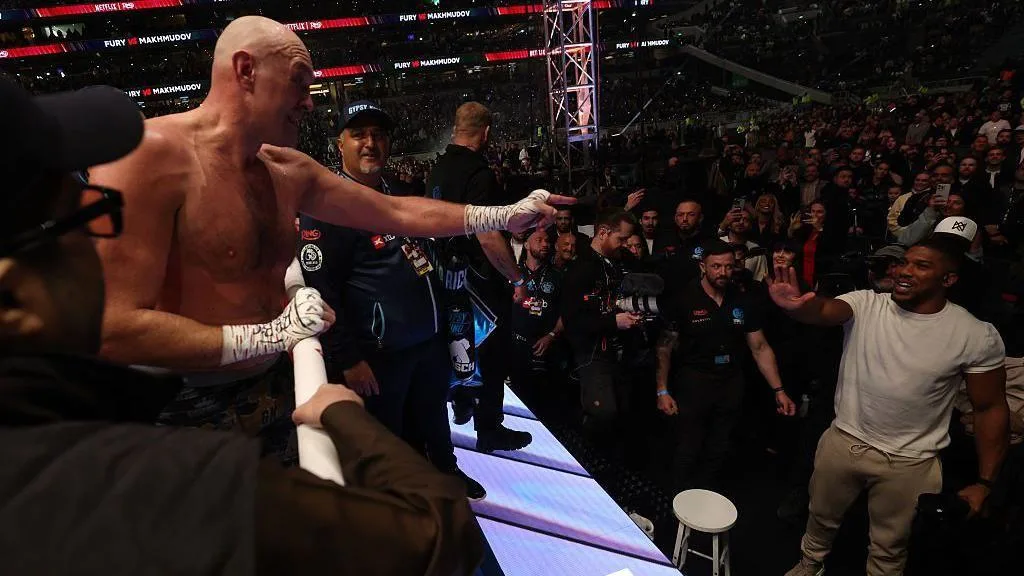
Following a decade marked by deadlocked talks, public disputes, and numerous setbacks, Tyson Fury and Anthony Joshua are finally set to face off in the ring on December 11 at Cardiff’s Principality Stadium.
BBC Sport reports that the WBA ‘Super’ heavyweight title is likely to be contested, though the governing body has yet to confirm this.
This bout offers both former champions the opportunity to reclaim a version of the heavyweight title; however, the Fury-Joshua matchup has always transcended just the championships.
While the fight is happening later than many hoped, with both fighters nearing the end of their primes, it had long seemed that this major British heavyweight rivalry would remain an unfulfilled “what if” story.
Thursday’s announcement of an 80,000-seat event, to be broadcast worldwide via Netflix, did more than just set a date and location.
It revealed the complex mix of competing interests, egos, and power struggles that delayed one of boxing’s most anticipated clashes.
How compromise finally made the fight happen
In an interview with BBC Sport, Fury’s promoter Frank Warren emphasized the importance of compromise throughout negotiations.
“Everyone had to give a little,” said Warren. “Tyson really bent. He didn’t dig his heels in. He said, ‘Fine, wherever they want it, I’ll go. If they want New York, okay. If they want the UK, I just want the fight.’”
Though the fighters had agreed to the bout, the venue was a major sticking point.
Warren explained that Netflix preferred New York, while Joshua, 36, was adamant about fighting in the UK. Each side credits themselves with securing the final decision.
Joshua’s promoter Eddie Hearn called the movement to keep the fight in Britain a “two-man crusade,” saying, “AJ turned down money to keep it in the UK. I couldn’t face people if I had helped push this fight to the US.”
According to Hearn, Joshua insisted on contractual protections for a UK matchup and remained steadfast despite pressure, citing strong public support in Britain as a key influence.
Warren, however, believes Fury, 38, could have fought for his own preferences but accepted the UK venue to ensure the fight would happen.
The power struggle and Dana White side story
One of the biggest off-ring dramas has been the battle for control over the fight’s promotion.
Saudi boxing influencer Turki Alalshikh, who announced the fight, previously insisted only he would confirm the bout.
“For 15 years no one could make this fight happen,” he stated. “Back in April, I said any announcement would come from me. I can now confirm Fury vs Joshua will take place in the UK, as promised to British boxing fans. The time for talk is over.”
Dana White’s role has added intrigue.
The UFC chief, partnered with Alalshikh through Zuffa Boxing, featured prominently in the announcement. Netflix described it as a collaboration involving White and Alalshikh’s The Ring, with Hearn and Warren notably absent.
Hearn had claimed White wouldn’t be involved, while Warren said both fighters’ contracts excluded him as well.
Nonetheless, Warren acknowledged White helped secure the Netflix deal but doubts fans care much about the behind-the-scenes promotional politics.
“Whether he is front and center or not, I’m not sure,” Warren admitted.
Wednesday’s press conference in London is expected to clarify White’s prominence and how he and Hearn appear on stage after months of back-and-forth.
Ringwalk timing and what’s next for the winner
Even the choice of Cardiff as the venue has competing narratives.
Hearn publicly advocated for the Principality Stadium recently, while Warren noted that Queensberry Promotions and Saudi events company Sela worked quietly with the stadium and local officials for months.
With its retractable roof, the stadium suits a December event, and there is precedent for late-night fights there.
Joe Calzaghe’s 2007 win over Mikkel Kessler was held under a closed roof, starting after 01:00 GMT to accommodate US viewers. Fury-Joshua is expected to follow a similar schedule.
Netflix controls the exact ringwalk time; Hearn believes it will be between 01:00 and 01:30 GMT, though Warren dismissed any notion of a 4 a.m. start.
“If it were in America, viewers might watch it at 5 a.m.,” Warren said. “This is a compromise and a major event.”
Hearn confirmed there is no rematch clause: “We’re aiming for a win that leaves no need to watch this fight again.”
Warren anticipates the victor can continue chasing further world titles, but the loser’s path might end in Cardiff.
This matchup has long been defined by reasons it never materialized, but in just over eleven weeks, negotiations and rival claims will be replaced by one final showdown: Tyson Fury and Anthony Joshua, at last, sharing the ring.
Fan Take:
This fight marks a monumental moment for boxing fans, bringing closure to years of anticipation and debate. Beyond the heavyweight belts, Fury vs Joshua represents the resurgence of British boxing on the global stage and could set the tone for the sport’s future in an era hungry for iconic rivalries.
Source: sports.yahoo.com