

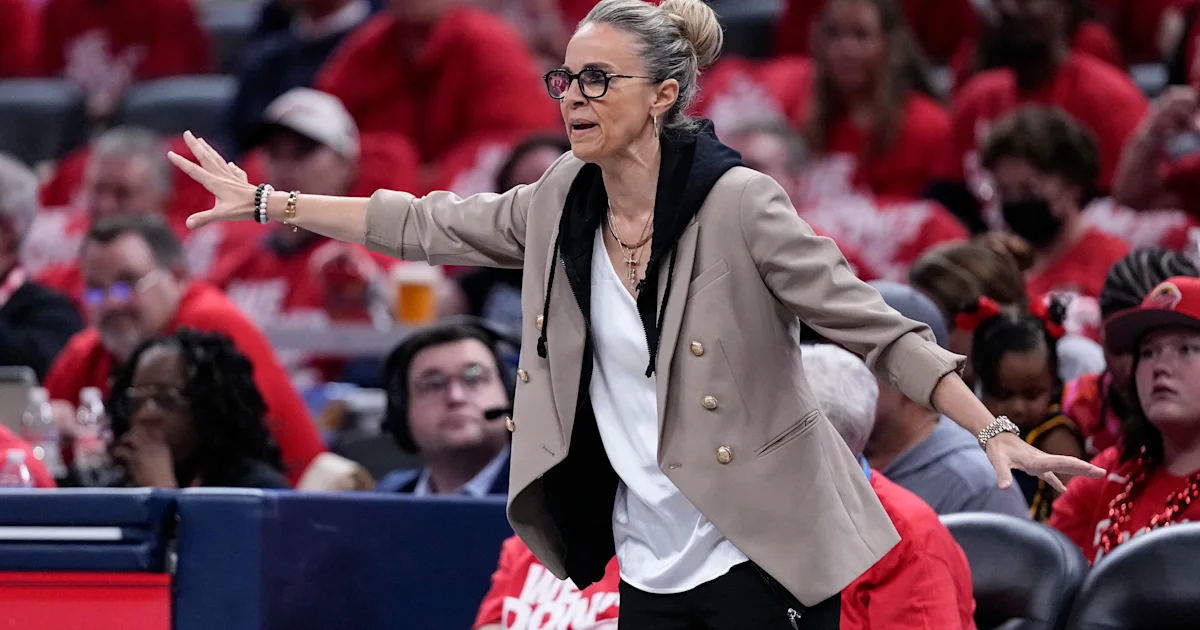
INDIANAPOLIS — It’s commonly assumed that in a winner-take-all Game 3 scenario of the WNBA playoffs, the home team holds the edge as the series returns to Las Vegas for the top-seeded Aces after the Indiana Fever’s win on their home court. However, Aces head coach Becky Hammon disagrees, suggesting that the high stakes and pressure of a Game 3 effectively level the playing field, making home-court advantage less significant.
The Aces and Fever, each victorious on their home turf so far, will face off Thursday at 9 p.m. ET on USA Network for a spot in the semifinals. This year marks the second season using the 1-1-1 first-round format after the league abandoned the 2-1 format that was in place for three seasons. Previously, from 2016 to 2021, the playoffs had single-elimination rounds and automatic semifinal berths for the top two seeds. A memorable moment, the 2019 “Hamby Heave” by an Aces player, helped spark calls for a format change.
Fever coach Stephanie White described the current arrangement as “the best of the worst-case scenarios,” reflecting the league’s ongoing struggle to find the ideal playoff structure. The Fever and Aces each won their previous Game 3 encounters leading to a semifinals showdown last season, with Indiana winning on the road despite having secured home court.
Hammon expressed a preference for returning to the 2-1 format, where higher seeds get two home games to close out the series, though that system faced criticism for giving the lower seed home court in the decisive matchup. Notably, in those years, higher seeds often won on the road in Game 3, with many series ending in sweeps. Additionally, the older format sometimes denied playoff teams the chance to host a game despite strong regular-season attendance, illustrated by the Fever leading the league in 2024 crowd sizes but not hosting any playoff games during Caitlin Clark’s rookie season.
Looking ahead, the league might consider reverting to a conference-based postseason as it expands to 18 teams by 2030. This could reduce extensive travel demands, exemplified by recent first-round matchups like Phoenix vs. New York, which involved grueling cross-country trips within a compressed timeframe. The current 1-1-1 series schedule requires tough travel between games on short rest, as seen in the Aces and Fever’s recent flights.
Hammon’s strongest wish is for a move to a best-of-five series, which she believes better ensures the superior team advances and delivers a higher-quality playoff experience for players and fans alike. While three-game series can create thrilling moments, she compared them to the unpredictability of NCAA tournament games where pressure can lead to unexpected results. The semifinals already feature a five-game format with a 2-2-1 home-court distribution favoring higher seeds, and the WNBA Finals now follow a seven-game series mirroring other major U.S. sports.
The gap between the top seed and the eighth seed has narrowed—the 2024 season saw only seven wins difference between Minnesota and New York, the smallest since the eight-team playoff format began. Minnesota’s early exit after losing to New York fueled calls to expand the postseason. With playoff parity increasing and three new teams on the horizon, expansion of the playoff series is expected to be a key topic in coming offseasons.
Hammon also noted that a longer postseason format would not only be fairer competitively but would boost ticket sales and other revenue streams thanks to more home games for all playoff participants. Broadcast partners are likely to welcome additional postseason coverage as viewership grows, making more games a lucrative prospect.
Viewership has been strong this season, with WNBA regular-season games on ESPN averaging 1.24 million viewers—higher than the channel’s MLB game averages and significantly beating NHL games outside Peacock broadcasts. The opener of the Aces-Fever series drew a record 2.1 million viewers on ABC, despite competing with NFL Sunday, and Game 3 is expected to deliver impressive ratings even against “Thursday Night Football.”
This matchup highlights the league’s top-scoring offenses and features three MVP contenders—A’ja Wilson, Caitlin Clark, and Kelsey Mitchell—who are major fan draws. The series also carries some tension from last year’s semifinals, with on-court jabs and some subtle showdowns in announcing the visiting rosters. Physicality and officiating will be crucial factors in this deciding game.
Clark anticipates a tougher, more physical Game 3 and stressed the importance of playing aggressively without relying on calls from referees. The intensity boiled over Tuesday night when Wilson confronted a Fever fan courtside after a loss marked by Indiana’s physical play. The Fever themselves experienced an internal battle after their Game 1 defeat.
With so much on the line, Game 3’s outcome is anyone’s guess.
Fan Take: This Game 3 not only highlights the fierce competition between two of the WNBA’s best teams but also underscores ongoing debates about playoff formats that impact fairness and fan engagement. Expanding to longer series could elevate the league’s profile and deliver more meaningful, high-stakes basketball to loyal followers and new audiences alike.
Source: sports.yahoo.com