

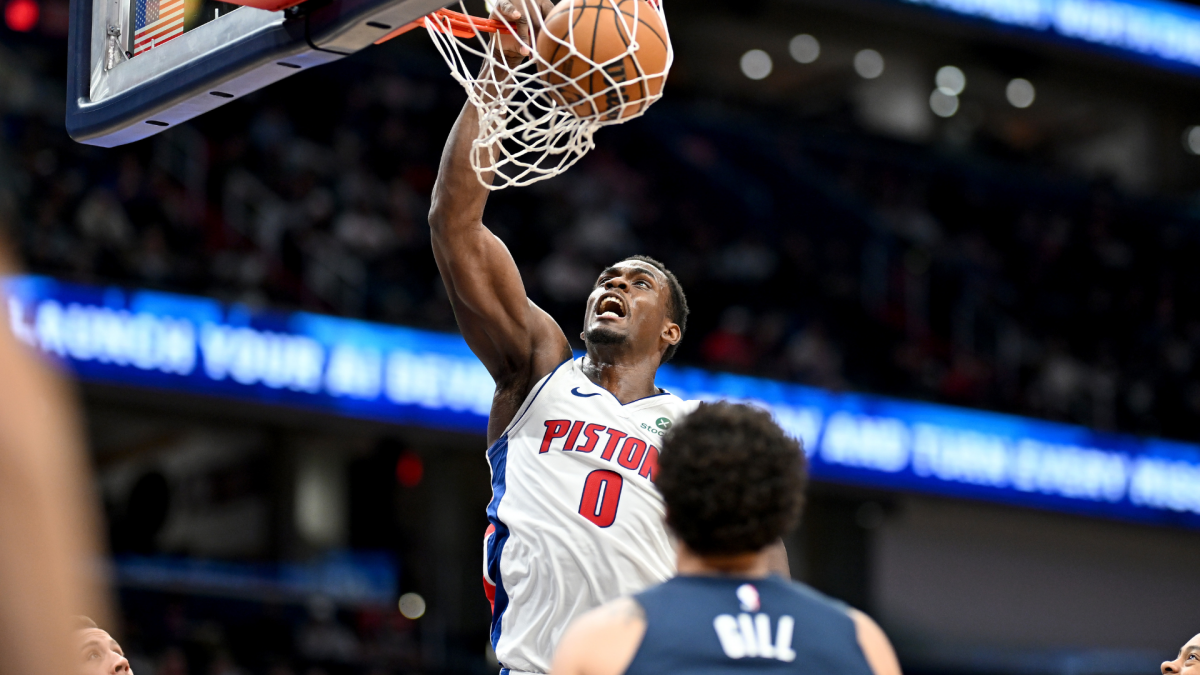
Jalen Duren and the Detroit Pistons have finally ended one of the longest restricted free agency negotiations in NBA history. Just about 90 minutes before the qualifying offer deadline on Thursday, Duren agreed to a five-year, $200 million contract extension that will keep him with Detroit through the 2030-31 season. After missing media day and the initial days of practice, Duren is now expected to join the team for training camp.
With the deal settled, let’s break down the outcome for both Duren and the Pistons.
Duren’s Grade: B
Because he made an All-NBA Team last season, Duren qualified for a Rose Rule max contract starting at 30% of the salary cap, potentially worth $287 million total. In past eras, a contract like that for a promising 22-year-old would have been a no-brainer, and Duren seemed to expect such a deal this offseason. However, the market has changed and negotiations have become tougher.
Duren’s disappointing playoff performance hurt his case. Had he excelled and helped the Pistons reach the conference finals, he may have warranted a max or near-max deal. Instead, he struggled, partly because opponents exploited weaknesses—like Ausar Thompson’s inability to shoot—which reduced Duren’s effectiveness in his primary pick-and-roll game alongside Cade Cunningham. His defense and rebounding also declined during the postseason, underlining a drop-off from his regular season form. Compared to Cleveland’s third-string center Paul Reed, Duren’s scoring advantage was minimal despite much more playing time.
The Pistons capitalized on his postseason struggles, initially offering between $180 and $190 million with conditions on his weight. Ultimately, they raised the offer to $200 million and removed the weight clause, a win in the negotiation for Duren’s camp, even if the deal wasn’t exactly what he wanted. Crossing the $200 million mark was crucial—it prevented Duren from risking injury or decline by accepting a qualifying offer and hoping to sign elsewhere next offseason, which would likely have netted less money.
Duren’s contract pays around $40 million annually and, if structured with maximum raises, starts at roughly 21% of the cap. This is comparable to Alperen Sengun’s contract, who, like Duren, is an athletic and versatile big man but with different strengths. Both are the highest-paid non-max centers, though they haven’t reached the elite levels of salary earned by guys like Joel Embiid or Nikola Jokić. Though not exactly his desired max contract, Duren secured a solid deal that protects him financially and rewards his potential.
Pistons’ Grade: C+
Detroit made a fundamental negotiating error by bidding against itself. The weight clause seemed odd given Duren’s known fitness, and the team arguably didn’t need to increase their offer beyond the initial $180-190 million, especially since there was no serious competition from other teams. The Sacramento Kings lacked cap space, and the Lakers opted to sign Walker Kessler instead.
Duren’s main leverage was the qualifying offer, which posed a risk of losing him for nothing, but almost no restricted free agent takes the qualifying offer due to the injury and performance risks. Historical examples show that betting on oneself by rejecting extensions rarely pays off. Duren’s camp successfully used this threat to secure a better deal, but the Pistons lost the chance to get more surplus value.
Detroit’s roster strategy is unique, with Thompson and Duren forming a strong defensive front but lacking outside shooting. Their playoff struggles highlighted how crucial additional offensive firepower will be, likely requiring big investments elsewhere. While Detroit controls its draft picks and can pursue other creators, the extra millions committed to Duren may influence their ability to build depth, especially for key bench roles.
If Duren and Thompson’s partnership falters again in the playoffs, this contract might be seen as overpriced. Centers typically command top salaries if they provide elite rim-protection, shooting, or playmaking—traits Duren doesn’t fully offer. The Pistons get numerous benefits from Duren’s athleticism and defense but must compensate elsewhere offensively.
Overall, Duren’s deal is fair, reflecting both his potential upside and postseason risks. Yet, the Pistons had the upper hand and could have negotiated a more favorable contract rather than settling for something merely reasonable.
Fan Take: This contract extension is a pivotal moment for the Pistons’ young core and sets the tone for their future roster construction. For basketball fans, Duren’s deal highlights the evolving financial landscape for emerging stars and underscores the growing importance of balanced skill sets—particularly in the NBA’s modern, three-point-heavy style of play.
Source: www.cbssports.com