

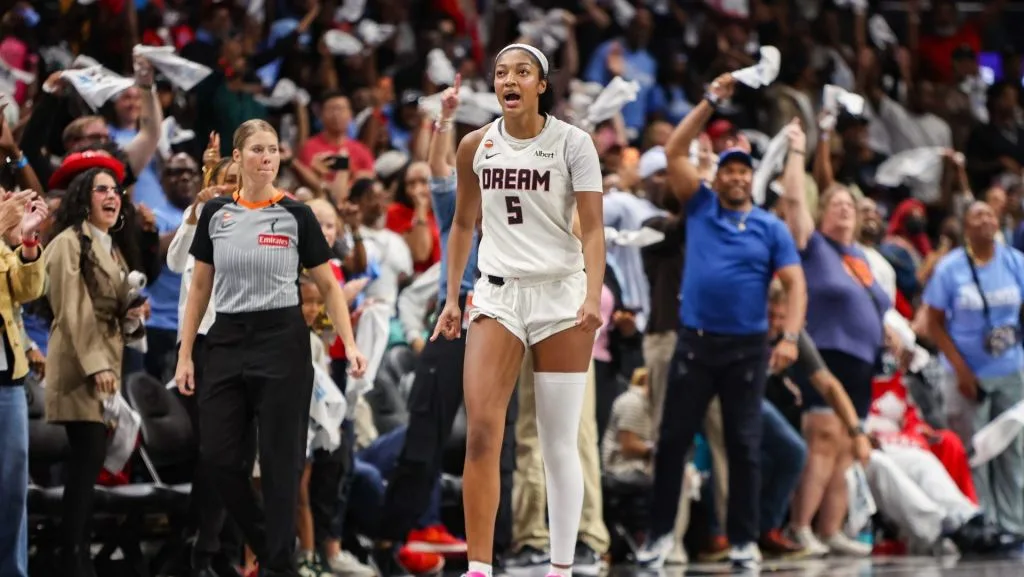
The limited seating for Atlanta Dream’s home playoff games at State Farm Arena is due to the quick turnaround time for selling WNBA playoff tickets, according to a team spokesperson speaking with Front Office Sports. The spokesperson explained that given the tight schedule, the team chose to open only the lower bowl and focus on selling those tickets.
State Farm Arena, owned by the Atlanta Fulton County Recreation Authority and operated by the NBA’s Hawks, typically accommodates around 17,000 fans for basketball games, with the lower bowl seating approximately 8,800. For their first two home playoff games, the Dream reported attendance exceeding 9,700, explaining to FOS that they unlocked part of the upper section after selling out the lower bowl.
The decision to limit access to the upper section caught attention when journalist Christine Brennan questioned why the Dream restricted seating for Game 1 of their second-round series versus the New York Liberty. The Dream had announced in late August that they would hold their first- and second-round playoff games at State Farm Arena rather than the 3,500-seat Gateway Center, where they usually play. Tickets went on sale starting September 1, but specific game dates were unknown until playoff seedings were finalized. The team’s August statement noted that the venue was subject to change.
The Dream secured home court advantage for the first playoff round on September 23, just before the season ended, and learned their first-round opponent (the Washington Mystics) the next day. The WNBA released the full first-round schedule on September 25, merely two days before the Dream hosted Game 1. Atlanta swept the Mystics in that round and moved on to face the Liberty in the semifinals. Tickets for Game 2 of the second round remain limited to the lower bowl, while the upper level is reserved for other upcoming events like a Hawks preseason game and a concert.
During the regular season, the Dream have played eight games at State Farm Arena, six of them in the regular season. They sold out the full arena for five of those six regular-season games, notably against the Fever, Las Vegas Aces, and Chicago Sky. Their average attendance of 6,928 fans per game marked the largest increase in the WNBA, driven mainly by raising the number of games held at the larger venue from one to six.
Here are the Dream’s reported attendance figures for games this season at State Farm Arena:
- May 17 vs. Las Vegas Aces: 17,044
- June 20 vs. Indiana Fever: 17,044
- June 22 vs. Toronto Tempo: 9,685
- August 3 vs. Las Vegas Aces: 17,044
- August 16 vs. Indiana Fever: 17,099 (including standing-room-only)
- September 19 vs. Chicago Sky: 17,099 (including standing-room-only)
- September 22 vs. Washington Mystics (Playoffs, Round 1): 9,766
- October 4 vs. New York Liberty (Playoffs, Round 2): 9,745
Regarding matchups, Indiana Fever drew the largest average road attendance this year, playing before roughly 15,100 fans across 22 away games—about 2,000 more than the next highest team, Dallas Wings. Some franchises without NBA-sized arenas, such as the Sky, Wings, and Tempo, moved games against the Fever to larger venues to meet demand. The Las Vegas Aces also attract strong interest in Atlanta, partly because MVP A’ja Wilson played college basketball nearby. The Dream anticipated greater attendance for games against major opponents, including the Chicago Sky where star Angel Reese now plays.
As the Dream currently lead 1–0 in their best-of-five semifinals against the Liberty, they have not yet announced where future home games would take place if they advance to the WNBA Finals. The team would not have home court advantage there, meaning potential home games on October 22, 24, and 29. However, State Farm Arena already has a concert and Hawks games scheduled on those dates. The team said they are finalizing venue details and will share updates promptly if they move forward.
Unlike many WNBA teams, Atlanta’s ownership does not hold stakes in other major sports franchises, relying on coordination with the Hawks to use State Farm Arena. Last year, Dream president Morgan Shaw Parker told FOS their lease at Gateway Center was annual, and the team was searching for a permanent home. The spokesperson confirmed the team is still working on logistics but is in talks to increase the number of games played at State Farm Arena beyond six annually.
Fan Take:
This update highlights the challenges WNBA teams face in balancing fan demand with venue logistics, especially during rapid playoff scheduling. For fans, expanding access to larger arenas like State Farm Arena is a crucial step in growing the sport’s visibility and creating memorable playoff atmospheres.
Source: sports.yahoo.com