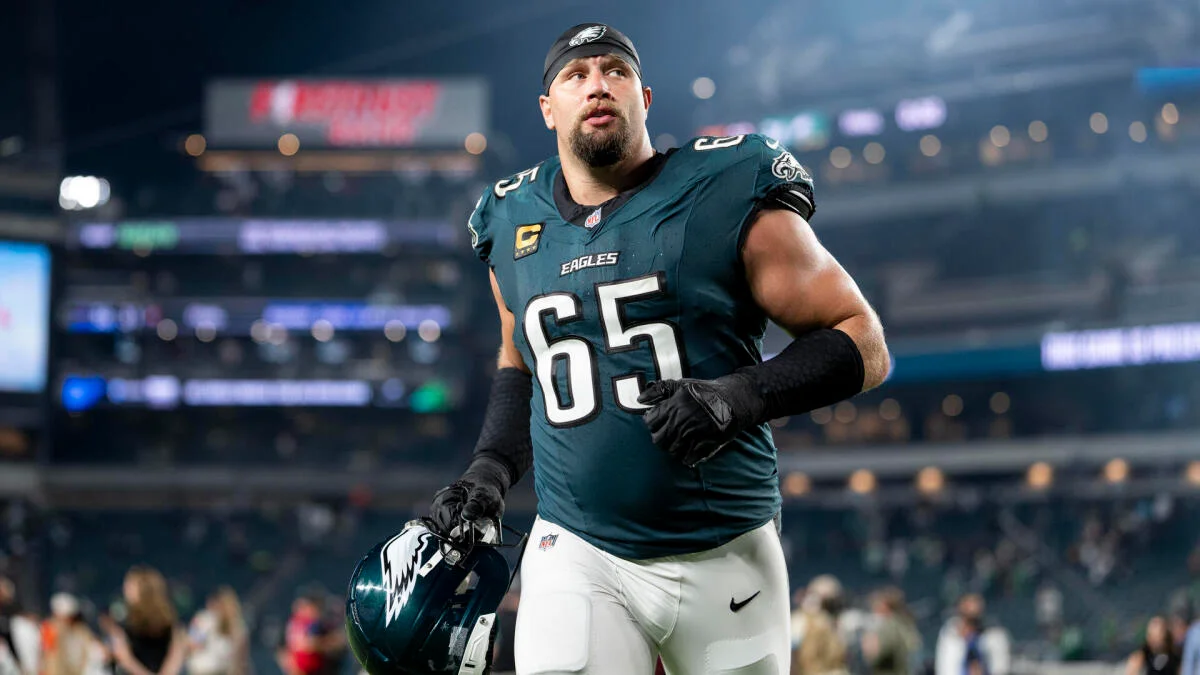
Lane Johnson, a six-time Pro Bowler at offensive tackle for the Philadelphia Eagles, announced Tuesday that he is retiring from the NFL effective immediately.
Johnson had been listed inactive for the Eagles’ Week 4 game for “personal reasons” and was a surprise scratch two days before making this decision. In his retirement statement, he said prioritizing his mental health is essential right now.
He has been candid in recent years about long-running mental health challenges, including anxiety he traced back to his freshman year of college in 2008. Johnson also missed multiple training camp practices earlier this year for personal reasons and had indicated in August that 2026 was likely to be his final season.
A season-ending injury in 2025, sustained after 10 games, had already prompted speculation about how long he would continue playing, even though he signed an extension in May 2025 that would have kept him with Philadelphia through 2027.
Johnson retires as one of the premier offensive linemen of his era. The former No. 4 overall pick from Oklahoma spent his entire career in Philadelphia (2013 through the third game of the 2026 season), won two Super Bowls, earned five All-Pro selections and was a constant presence on the Eagles’ line.
His on-field value was clear in advanced metrics: with Johnson on the field the Eagles averaged 0.04 EPA per play (third-best in the league), while their mark without him was -0.05 EPA per play (among the league’s worst). He also set an extraordinary streak from Week 11 of 2020 to Week 9 of 2023, going 1,405 consecutive pass-blocking snaps without allowing a sack and 961 snaps without a knockdown.
Johnson will be eligible for the Pro Football Hall of Fame in five years and figures to be a strong candidate when he is on the ballot.
Fan Take: This is a significant loss for the Eagles and the league — Johnson was not just a dominant right tackle but a stabilizing force for an elite offense. His retirement underscores the growing recognition of mental health in pro sports and could help push teams and the NFL to prioritize player well-being more visibly.
Source: www.cbssports.com