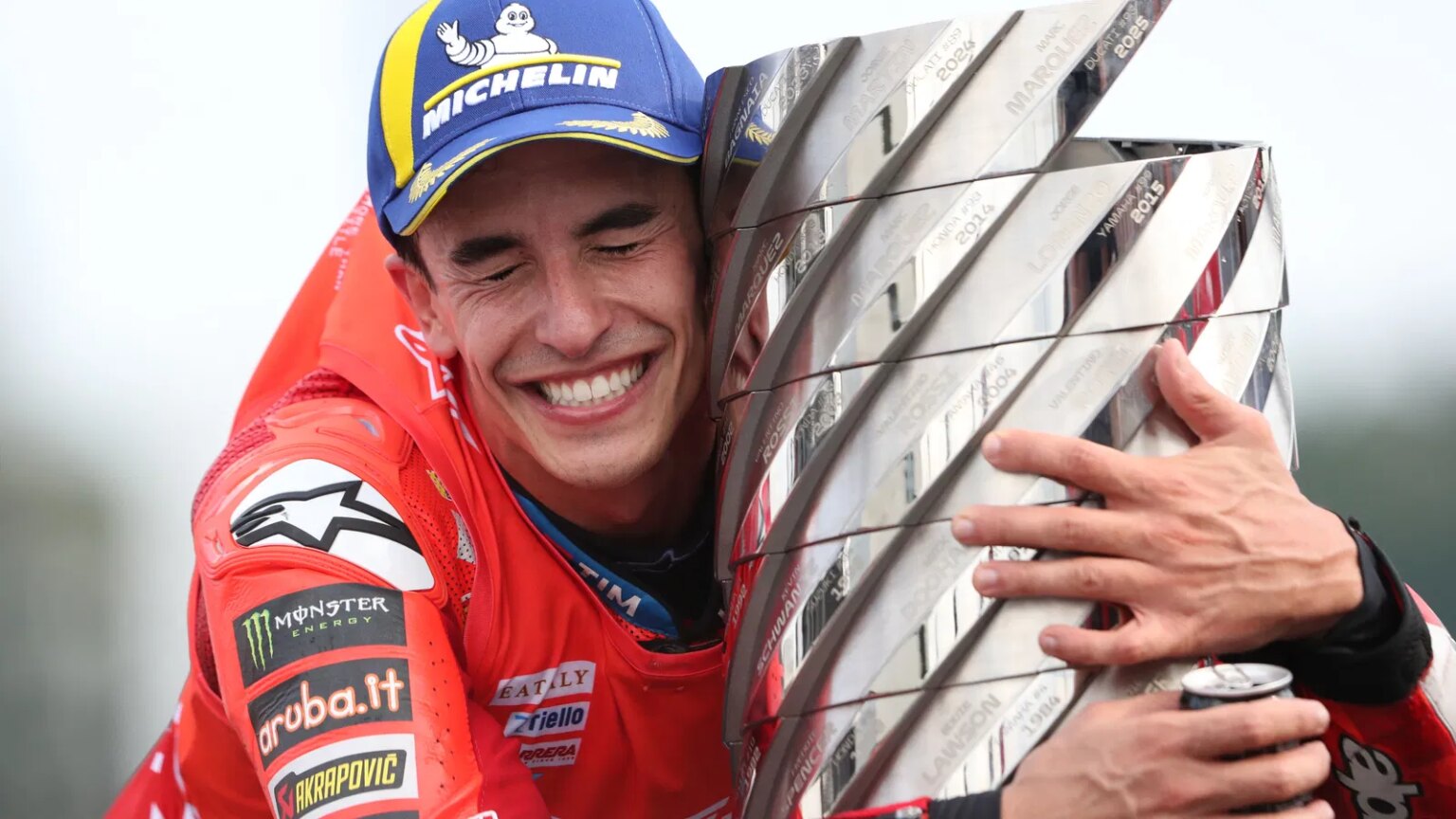
Marc Márquez’s performance in the 2025 season was exceptional, finishing with a 78-point lead despite missing the last four races due to an injury sustained in a crash with Marco Bezzecchi at the Indonesian Grand Prix. His dominance not only showed his incredible skill but also left fans wondering how the final race might have ended had he been able to compete.
Following a tough recovery from a serious arm injury in 2020, Márquez accomplished his dream of winning again—this time surpassing his previous best while riding a factory Ducati. He won 11 Grand Prix races, 14 sprint events, and scored a remarkable 37 points during a seven-race streak from Aragon to Hungary, demonstrating unmatched consistency and superiority in the sprint era. For comparison, Pecco Bagnaia also won 11 Grand Prix races in 2024 but fell short of claiming a third world championship by 10 points.
Márquez’s dominance was compounded by difficulties faced by his competitors, including Bagnaia and Fabio Di Giannantonio, who struggled with the newer GP25 model. This raises questions about Ducati’s current hierarchy, as Márquez seemed to avoid the issues plaguing other riders with the GP25, echoing his past ability to outperform teammates on Honda bikes.
These uncertainties will likely only be resolved after the early rounds of the 2026 season. However, with Márquez fully recovered, Ducati’s reign seems secure for now.
By any measure, Márquez was the clear world champion in 2025, scoring 545 points over 18 rounds. He outperformed his brother Alex Marquez in both the Grand Prix (355 to 309 points) and sprint competitions (190 to 158 points). Recent seasons have seen intense MotoGP rivalries where Márquez wasn’t a contender, making his 2025 dominance a bitter reality for riders planning their strategies for 2026.
Considering a hypothetical 2025 without Márquez alter the championship results: Ducati would still come out on top. Alex Marquez’s solid early-season form would elevate him to at least second in the championship, and without Marc stealing the spotlight, much of the season’s acclaim would go to the Gresini rider. Alex’s wins in GP24 would jump from three to eight, raising his Sunday wins from 309 to 344, still behind Marc’s 355 Grand Prix victories.
Alex excelled particularly in sprints where he claimed 13 wins, increasing his points tally to 191 and finishing the season with 535 points, enough to secure a world title. Marco Bezzecchi would rise to second in the Aprilia rankings with improved performances mid-season, doubling his Grand Prix wins to six and adding four sprint victories, though still 134 points behind Alex.
KTM’s Pedro Acosta would take third in this scenario with 351 points and gain his first wins in both sprint (Brno) and Grand Prix (Hungary). Pecco Bagnaia, despite Marc’s absence, would still finish outside the top three with 336 points, winning an additional Grand Prix but no more sprint titles.
Other highlights include sprint victories for Fabio Di Giannantonio in Hungary and Fabio Quartararo at Barcelona, as well as Fermin Aldeguer’s first win coming in Austria instead of Indonesia.
A notable takeaway is that Ducati’s older GP24 bike outperformed the newer GP25, with 10 total wins versus 3 wins for the GP25, prompting questions about Ducati’s next steps—whether they will continue refining the GP26 or reconsider relying on the GP24 model.
Fan Take: This analysis underscores Márquez’s extraordinary influence on the sport and Ducati’s dominance, highlighting that even without him, Ducati remains a force to be reckoned with. For racing fans, it sets up an exciting 2026 season where Márquez’s comeback and Ducati’s ongoing developments could reshape MotoGP’s competitive landscape.