
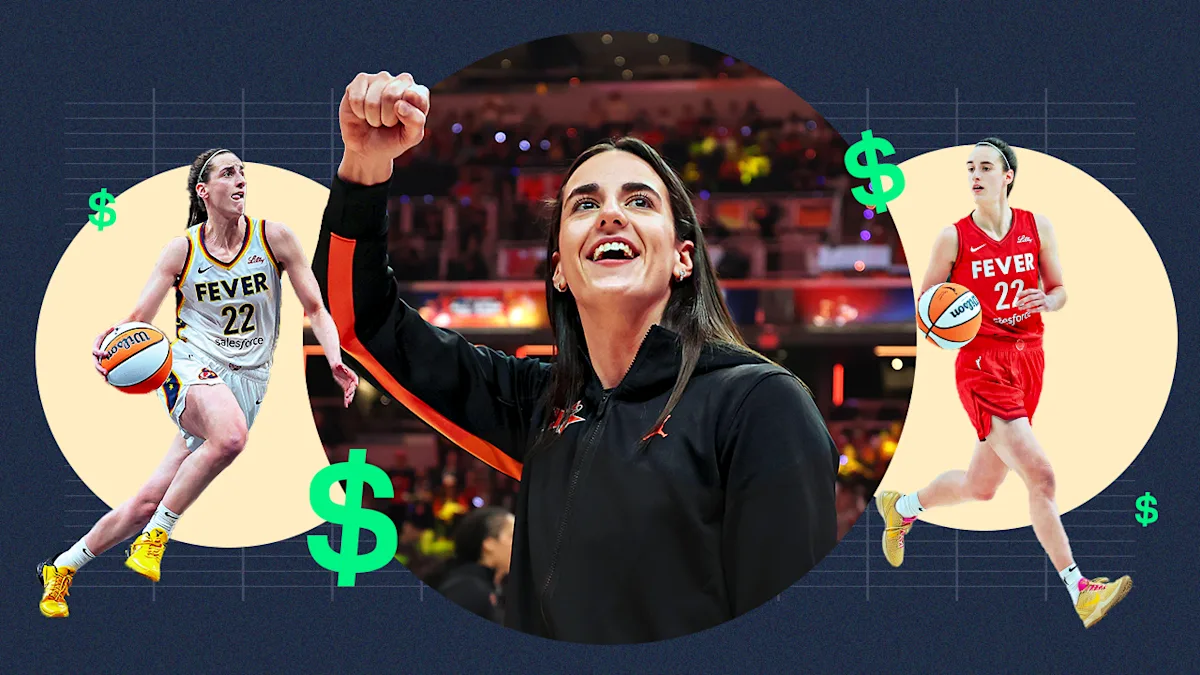
Caitlin Clark experienced a challenging season on the court during the 2025 WNBA regular season, playing only 30% of the Indiana Fever’s games due to multiple injuries. However, off the court, she thrived financially, with her endorsement deals pushing her total earnings to an estimated $16.1 million, breaking her own WNBA earnings record set the previous year.
Her income mainly came from endorsements, which accounted for $16 million, while her WNBA salary and bonuses amounted to $114,000. In percentage terms, 99.3% of her earnings were from sponsorships, with just 0.7% from her playing salary.
Clark ranked sixth among the highest-paid female athletes in 2025, climbing four places from her $11.1 million in 2024. That year marked her first full season with sponsorships after being drafted first overall by the Fever. She added new deals with Ascension St. Vincent and Stanley to her existing partnerships with major brands like Gatorade, State Farm, Wilson, and Nike. Nike named her their newest signature athlete in August, unveiling plans for a sportswear line and signature sneakers debuting in 2026. Clark was the only WNBA player to rank in the top 15 for earnings, placing ahead of New York Liberty’s Sabrina Ionescu.
The WNBA is negotiating a new collective bargaining agreement (CBA) to significantly raise player salaries in line with growing league revenues and franchise values, though the final details are still being worked out. Clark’s Fever salary drew attention nationwide when she was drafted, reflecting the league’s record-breaking ratings, revenue, and fan engagement. Her rookie salary was $76,535, increasing to $78,066 in 2025 as part of a four-year, $338,056 contract.
Clark also received over $100,000 in bonuses, including three playing bonuses and a Commissioner’s Cup bonus of $30,000 from the Fever’s midseason win, surpassing typical playoff earnings. The WNBA Finals expanded to a best-of-seven format in 2025, raising prize money. The Fever reached the semifinals but lost to the Las Vegas Aces without Clark, with each player earning $3,435. Clark also earned a $2,575 bonus for being voted into the All-Star Game.
WNBA players earn additional performance and marketing bonuses through programs like the Player Marketing Agreement (PMA), which can pay up to $250,000 to players acting as league brand ambassadors. Introduced in 2022, PMA participation may vary based on a player’s existing endorsements or off-court income. The CBA also includes a Team Marketing Agreement (TMA), which pays players up to $4,000 weekly, with teams able to allocate $150,000 annually to player marketing.
Clark isn’t alone in earning more from endorsements than from salaries. Among the top 15 highest-paid female athletes in 2025, only 30% of their income came from salaries and prize money. For comparison, 72% of the top 15 highest-paid male athletes earned most of their income from team sports salaries. Gymnast Simone Biles made $11 million entirely from competition earnings, while freeskier Eileen Gu earned just 0.1% of her $22 million on the slopes. Tennis icon Venus Williams earned 2.1% of her $10.2 million from playing.
Fan Take: Caitlin Clark’s off-court success illustrates the growing financial opportunities for WNBA players beyond their salaries, highlighting the expanding marketability and influence of women’s basketball. This trend signals a positive shift for the sport, promising increased visibility, greater investment, and stronger fan engagement in the years ahead.