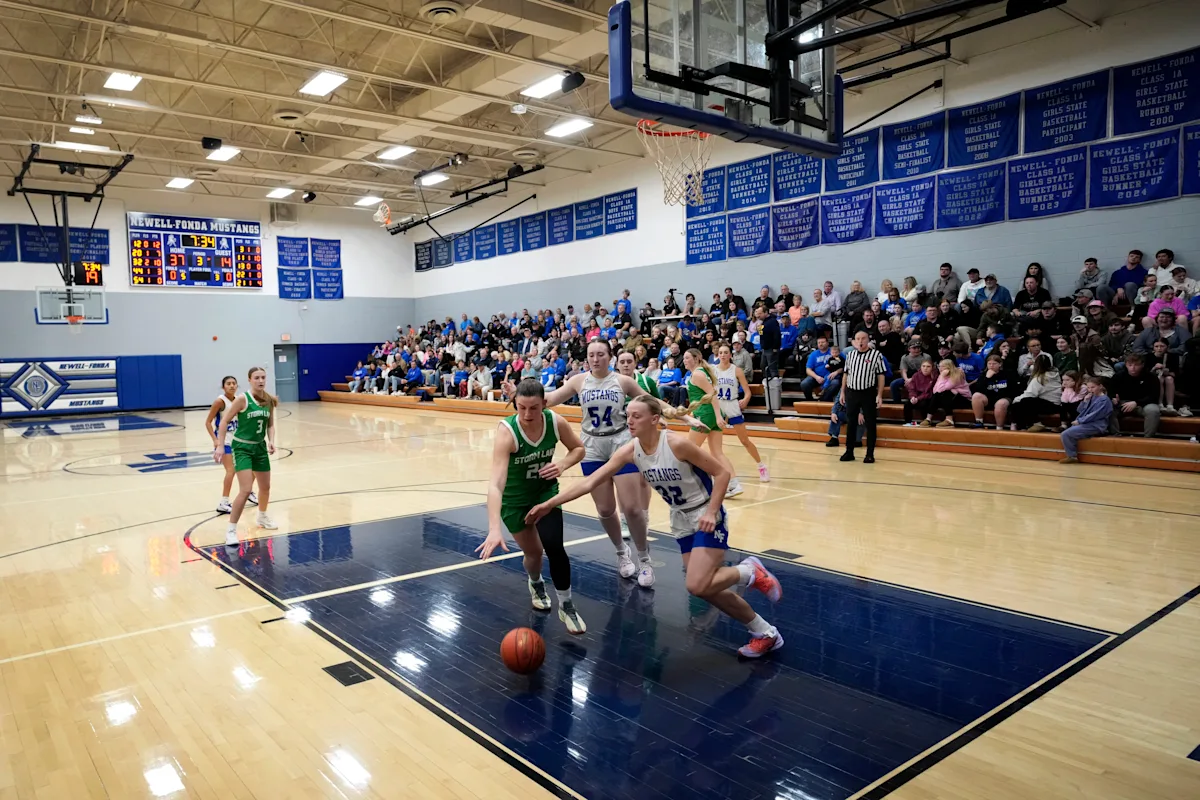
In Newell and Fonda, Iowa, the streets may seem quiet with many closed storefronts and empty buildings reflecting rural decline, but their community spirit thrives strongly in the Newell-Fonda High School gymnasium. Here, about 1,450 residents from the towns and nearby farms gather in blue to passionately support their renowned girls’ basketball team, the Mustangs.
The Mustangs stand out as a rarity, with 21 of the school’s 71 girls from grades 9 to 12 participating on varsity or junior varsity teams, defying the national downward trend in girls’ basketball participation despite rising popularity at the collegiate and professional levels. Coach Dick Jungers notes that unlike past teams, many current programs struggle even to field a few skilled players, reflecting a nationwide dip in interest as kids pursue other activities.
Iowa’s decline is particularly steep given its deep history in girls’ basketball, beginning with the state’s first girls’ tournament in 1920 played under the 6-on-6 format and producing stars like Caitlin Clark. Some schools have had to shut down or shrink their programs due to low participation, leading to junior varsity games that often last only two quarters because JV players frequently move up to varsity games.
Nonetheless, basketball remains a cultural cornerstone in Newell and Fonda. Since Jody Maske drove the team to multiple state tournaments in the late ’90s and early 2000s, and with Jungers’ record-breaking 527-83 coaching career, the Mustangs have consistently been a powerhouse, especially in Iowa’s smallest classification (1A). They have secured three consecutive state titles from 2019 to 2021 and have appeared in seven of the last eight state finals.
Currently, the Mustangs boast a 14-1 record, averaging 34 points per game, and dominating many opponents by halftime. They are ranked number one after defeating Council Bluffs St. Albert, last season’s state final rival. Longtime fan Jim Gary, 89, remarks on the strong community desire to win that keeps the excitement alive.
Despite the local success, girls’ basketball participation nationwide is declining—from 451,600 players in 2000 to an estimated 356,240 in 2025—with volleyball surpassing basketball as the top girls’ team sport due to a 29% increase in participation. States including Kansas, Louisiana, North Dakota, Indiana, and Iowa see the sharpest declines, with Iowa alone losing 38% of participants since 2000.
While elite club basketball still provides a pipeline for college and professional players, high school programs grapple with competition from club volleyball and the rise of women’s wrestling, which became an official Iowa sport in 2022-2023 and has quickly attracted thousands of participants. Coaches claim basketball skills are more difficult to develop and that the sport’s physical nature can deter some girls, leading to dropout as early as junior high.
Innovative approaches are being explored, like Dowling Catholic coach Kristin Meyer’s suggestion to use 3-on-3 games in elementary schools to keep kids engaged and improve skills, alongside increasing female coaching presence to better connect with young players. At Newell-Fonda, the basketball journey often begins as early as second grade, reflecting the sport’s deep roots and broad appeal within the community.
Families and former players remain heavily involved, coaching youth teams, organizing fundraisers, and volunteering, ensuring basketball’s tradition passes through generations. Andrea Vanderhoff, a former player and current coach, emphasizes that basketball is accessible and inclusive, an activity everyone wants to join.
The Mustangs’ recent 70-33 win over a much larger Storm Lake team highlighted their skill, chemistry, and high-energy, fast-paced offense. The community rallies around the team with pregame dinners and packed gymnasiums, including standing-room-only attendance and thousands tuning in via live stream.
Interestingly, the towns don’t advertise their state championship wins on road signs, confident in their reputation’s reach. As Marie Breon, a longtime supporter and 1956 graduate, jokingly says, “Everyone knows about us.”
Fan Take:
This story is crucial for basketball fans because it showcases how small-town programs with rich traditions can defy national trends of declining participation and remain beacons of community pride and athletic excellence. The resilience of teams like the Newell-Fonda Mustangs highlights the need to nurture grassroots basketball to sustain the sport’s future, especially as it faces stiff competition from other growing youth sports.