

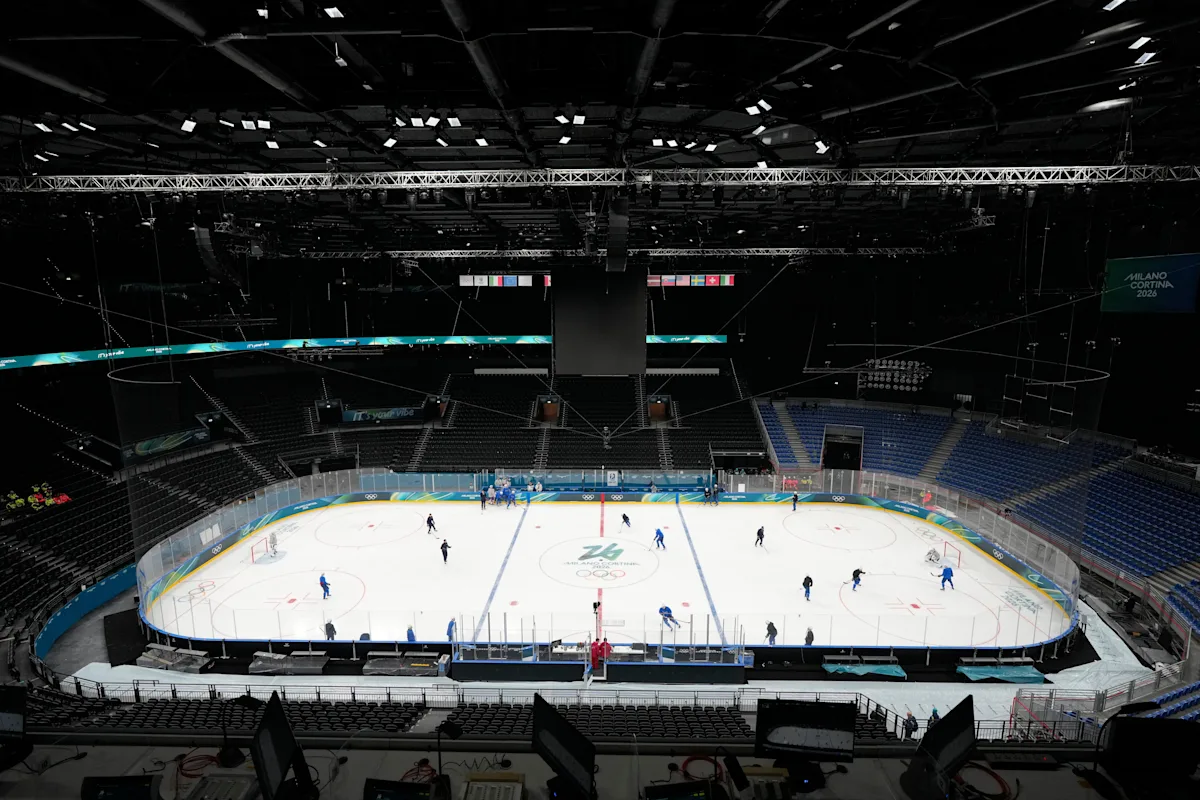
Workers dressed in helmets and orange safety vests were busy behind the scenes Wednesday inside the newly constructed main hockey arena for the Milan-Cortina Winter Olympics. Near the entrance, a pile of broken Corona Zero beverage boxes remained outside a concession stand, close to a worker on a scissor lift installing pipes. Meanwhile, on the other side of Milan, a second, makeshift rink was assembled with a network of supporting pillars and temporary walkways, all enclosed by large black curtains to help with insulation.
Although the final touches are still being added to the arenas, construction delays are unlikely to prevent the commencement of the women’s hockey tournament, which has made considerable progress recently, starting on Thursday. The men’s tournament, featuring NHL players returning after their absence since 2014, is also on schedule.
Veronica Mühlhofer, the Arena Manager at Milan Santa Giulia Ice Hockey Arena, expressed pride in the team’s efforts: “What everyone has achieved is incredible.” She mentioned that although there are still some cleaning and finishing tasks before the first game, which is set for Thursday, the team is in the final stages. “Every time I drop the puck, I feel a huge sense of relief,” she added.
Construction issues had been a concern for several years, continuing into late January. NHL Commissioner Gary Bettman had voiced concerns starting in 2023, but arrangements were made to send players to the 2026 and 2030 Olympics. Recent test events involving league officials provided hope that the venues would be ready in time for the men’s games beginning next Wednesday. Bettman confirmed last week that ongoing monitoring was reassuring, despite occasional worries—such as a muddy layer in the Zamboni tunnel just days earlier, which revealed some underlying challenges.
Ice technician Don Moffat recounted that the ice was finally painted on January 26 after days of careful preparation, including minimizing water application to ensure proper freezing. He tested the ice himself and was satisfied with its density and quality, noting that the gradual layering approach was vital.
When players take the ice, initial impressions vary. France’s team captain Pierre-Edouard Bellemare described the ice as feeling like skating on an indoor lake, while Swiss player Alina Müller remarked that the ice was somewhat softer than usual but acceptable as part of the pre-game preparation, especially since they trained there earlier in the week. Similarly, at the Milano Rho Arena, which hosts six men’s and 19 women’s games, U.S. captain Hilary Knight acknowledged that ice conditions differ from venue to venue and will be a challenge Olympic athletes must adapt to. Swiss coach Colin Muller noted that the ice was initially good during practice but became risky after snowfall, and he suggested that NHL players might be accustomed to such conditions due to their experience playing on varied surfaces.
French hockey player Joan Auvitu maintained a pragmatic view, saying that perfect ice does not really exist anywhere, especially in warm-weather markets. The Olympic rinks are slightly smaller than NHL standards—measuring 60 meters by 26 meters—compared to the NHL’s 200 by 85 feet, which results in a wider but shorter ice surface. Players such as Taylor Heise emphasized that they focus on the opportunities the size offers rather than the missing three feet, even though the neutral zone is somewhat limited and the corners more oval-shaped. Bellemare suggested this smaller ice might lead to a more aggressive style of play.
Most NHL stars are expected to arrive by Sunday, and their first impressions seem positive. Auvitu noted that the facilities aren’t finished yet but downplayed minor imperfections, asserting that no venue is perfect and what matters most is the opportunity to compete at the Olympics.
Fan Take: This story highlights the massive effort and adaptability required to host Olympic hockey amidst logistical hurdles. It reminds fans that behind the glamour are dedicated professionals ensuring the game goes on, and their resilience could lead to unexpectedly exciting, fast-paced hockey on these unique Olympic surfaces.