

Who is Caleb Durbin and where did he come from?
Caleb Durbin is an infielder who played collegiate baseball at Division III Washington University in St. Louis. He was picked in the 14th round of the 2021 MLB draft by the Atlanta Braves. After the 2022 season, he was traded from Atlanta to the New York Yankees for Lucas Luetsch. Following the 2024 season, he was sent to the Milwaukee Brewers as part of the Devin Williams trade. A year later, the Brewers traded him to the Boston Red Sox in exchange for pitchers Kyle Harrison and Shane Drohan, infielder David Hamilton, fellow infielders Anthony Siegler and Andrew Monesterio, plus the No. 67 competitive balance draft pick.
Is he a good player?
It depends on what you’re looking for. Durbin isn’t a classic power hitter, especially considering his relatively small stature at 5-foot-7 and 183 pounds — something Craig Breslow has emphasized as important for the team. Instead, Durbin brings solid all-around hitting skills, defensive versatility across multiple infield positions, and notable speed on the bases. In his rookie season, he posted a .256/.334/.387 slash line with 11 home runs and 18 stolen bases, finishing third in Rookie of the Year voting.
Durbin makes consistent contact at the plate; he was one of just five MLB players with a strikeout rate below 10% (9.9%), although his walk rate was lower at 5.9%. His fly ball pull rate stood at an above-average 20.4%, a positive sign for a right-handed hitter playing in Fenway Park, contributing both doubles and home runs.
Defensively, he played mostly third base, starting in 119 games, but saw limited time at second base, appearing only three times there for the Brewers in 2025. His defensive metrics at third base were solid, and he can fill in at shortstop if necessary. Given the Red Sox’s focus on ground-ball pitchers, Durbin should help strengthen the team’s infield defense in 2026.
Quick overview of his 2025 stats
In 136 games and 506 plate appearances, Durbin recorded a slash line of .256/.334/.387 with 11 home runs, 53 RBIs, 60 runs scored, 18 stolen bases in 24 attempts, a 5.9% walk rate, 9.9% strikeout rate, 105 weighted runs created plus (wRC+), and a 2.6 fWAR.
Highlights to watch
One of Durbin’s memorable moments came from his walk-off home run against the San Diego Padres on June 7 of last year. Walk-off homers are some of the most exciting plays in baseball, and Durbin gave fans something special in that game.
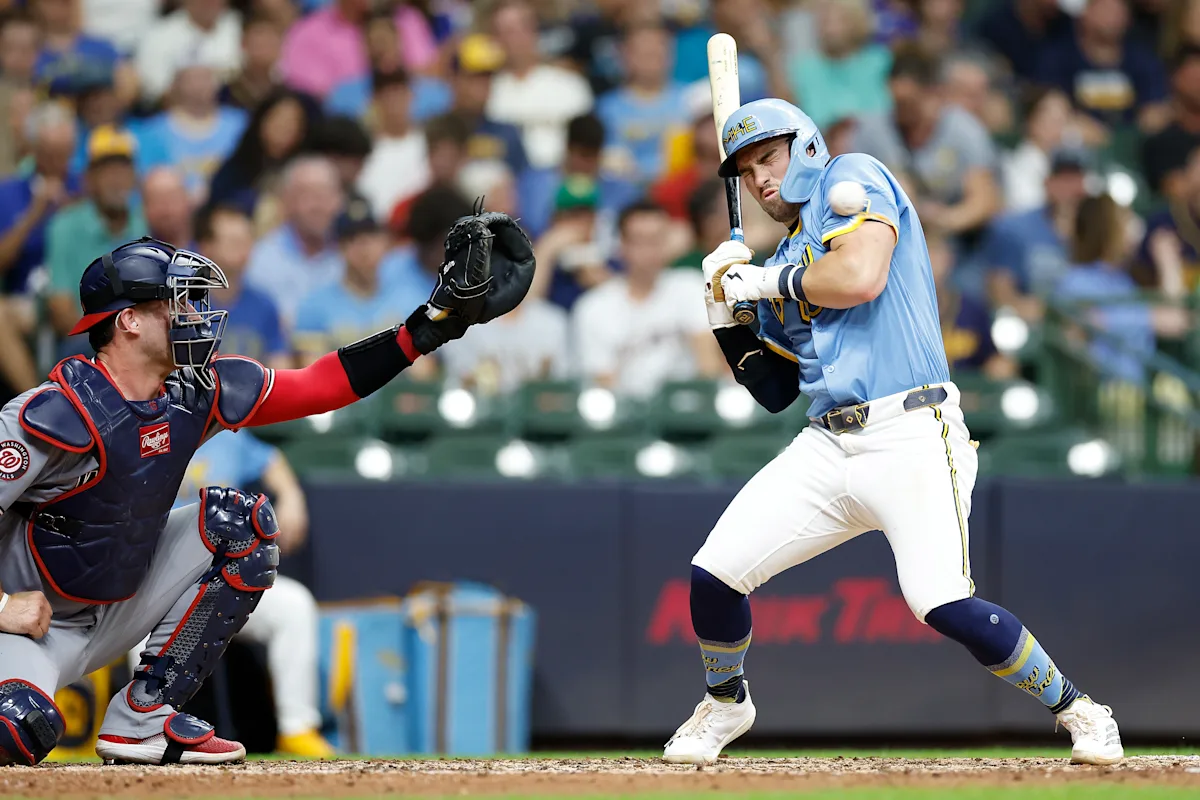
What about that photo where he gets hit by a pitch?
Durbin excels at getting hit by pitches — he led the National League with 24 hit-by-pitches (HBP) last season. Rather than being accidental, there’s a skill involved in this. He consistently posted double-digit HBPs during his three minor league seasons despite fewer plate appearances. This ability to get on base by taking a hit from the pitcher fits into a strategy the Red Sox seem to appreciate, as evidenced by acquiring top NL HBP leaders after Willson Contreras suffered 23 HBPs himself last year.
While Durbin’s 5.9% walk rate was low, his 4.7% HBP rate effectively boosts his overall walk-equivalent rate to 10.6%, exceeding his strikeout rate. League-wide in 2025, batters were hit by pitches only about 1.1% of the time, making Durbin’s rate more than four times higher than average.
What role will he play for the Red Sox in 2026?
Boston’s management and manager Alex Cora haven’t definitively assigned Durbin a specific infield spot yet. Likely, he will alternate between second and third base, with prospect Marcelo Mayer covering the other position. Mayer, standing 6-foot-3 with a stronger arm, seems better suited for third base, while Durbin, who played mostly second base earlier in his career, might primarily fill that role. On days when a left-handed pitcher starts, Romy Gonzalez may get preference at second, pushing Durbin to third. Current projections suggest Durbin will hit seventh in the lineup, positioned between catcher Carlos Narvaez and Mayer, at least against right-handed pitchers.
Fan Take: Caleb Durbin’s unique combination of contact hitting, defensive flexibility, and knack for getting on base through hits-by-pitch makes him an intriguing player for the Red Sox’s future. His story is a testament to how patience and a versatile skill set can carve out an important role in a major league lineup, something fans should watch closely as it could influence how teams value under-the-radar but impactful players moving forward.