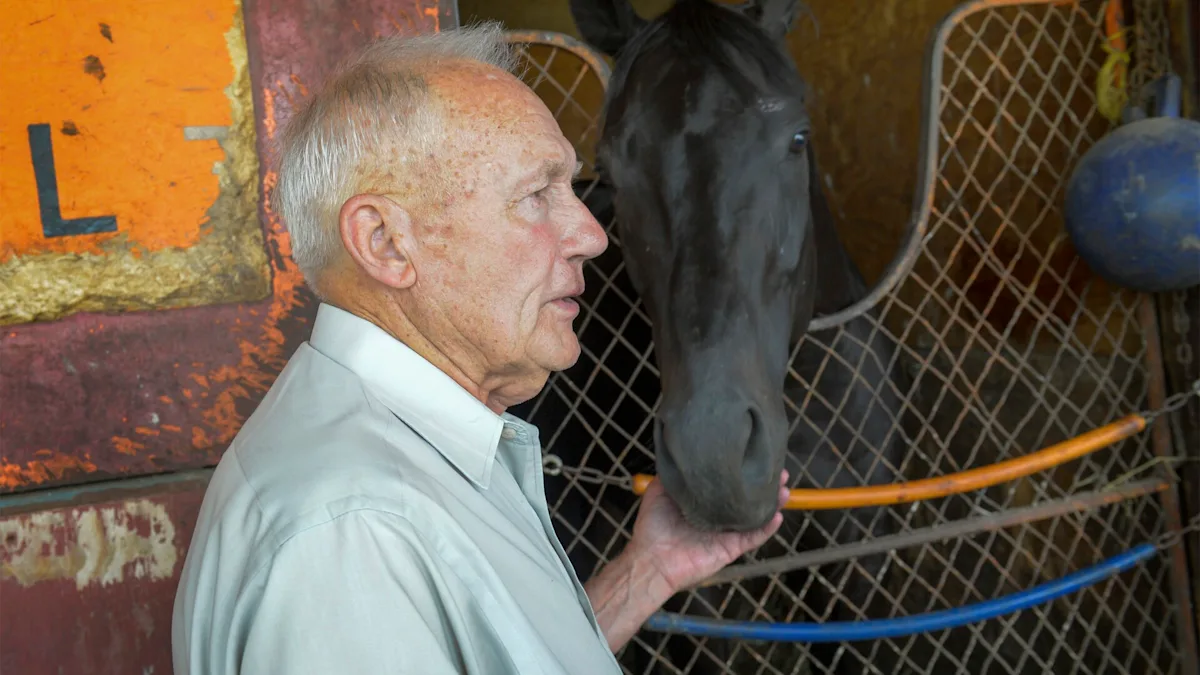
King Leatherberry, a Hall of Fame trainer celebrated as the “King of the Claimers” for his remarkable talent in transforming inexpensive horses into winners in lower-tier racing for over six decades, passed away Tuesday at the age of 92. According to the Maryland Jockey Club, his son, Taylor Leatherberry, confirmed his death at home, though the cause was not revealed.
Retiring in 2023, Leatherberry became only the third trainer ever to surpass 6,000 career wins, joining Dale Baird and Jack Van Berg. He finished with 6,508 victories and earned a purse total of $64,693,537, as recorded by Equibase. Throughout his career, he captured 52 training championships in Maryland—26 each at Pimlico and Laurel—and four titles at Delaware Park.
Taylor Leatherberry reflected on his father’s legacy, calling him “one of a kind” and saying, “No man was more deserving of that title than my dad.” Leatherberry was also part of Maryland racing’s famed “Big Four,” alongside fellow Hall of Famers Bud Delp, Richard Dutlow Sr., and John Tummaro Jr., who dominated Maryland racing in the 1960s and ’70s and helped advance thoroughbred training focused on speed and endurance.
Reflecting on the era in 2013, Leatherberry said, “The Big Four era was really fun. Competing against them pushed us all to become better trainers.” He led North American trainers in wins during 1977 and 1978, consistently winning over 300 races annually between 1975 and 1978. In 2015, he was honored as a first-ballot inductee into the National Museum of Racing Hall of Fame.
Leatherberry trained just one Kentucky Derby starter, I Am the Game, who finished 13th in 1985 but placed fourth in the Preakness Stakes the same year. This was among four horses he entered in the second leg of the Triple Crown throughout his career.
A Maryland native, Leatherberry earned his trainer’s license in 1958 and won his first race in 1959 at Sunland Park, now Tampa Bay Downs. He attributed his career choice to his father’s involvement in breeding and horse ownership, combined with a passion for betting. “I never seriously planned on this career. I just enjoyed it, and that’s probably why it worked out,” he said in 2013.
After graduating with a business administration degree from the University of Maryland, Leatherberry immersed himself in studying racetracks, performance stats, and the claiming game, buying horses at assigned prices in special races. Rather than working primarily in barns, he often managed operations from home, relying on a trusted staff to execute his decisions.
“In the early ’60s, claiming was a new way of owning horses, as people started treating it more like a business,” he told The Washington Post in 2005.
Among Leatherberry’s most outstanding horses was Ben’s Cat, whom he bred, owned, and trained. The gelding won 32 races, including 26 stakes, and earned over $2.6 million from 2010 to 2017. Ben’s Cat passed away in 2017 and was laid to rest near Laurel’s paddock. Leatherberry also trained Grade 1 winners Catatonic and Take Risks, and enjoyed notable success with Port Conway Lane, who raced from 1971 to 1983, winning 52 of 242 starts.
He is survived by his wife of 62 years, Linda, and their twin sons, Taylor and Todd.
Fan Take: King Leatherberry’s passing marks the end of an era for horse racing, as fans remember a figure who elevated the claiming game to an art form and inspired a generation of trainers. His legacy reminds the sport of the value of perseverance, innovation, and passion—qualities that are essential for horse racing’s future growth and excitement.