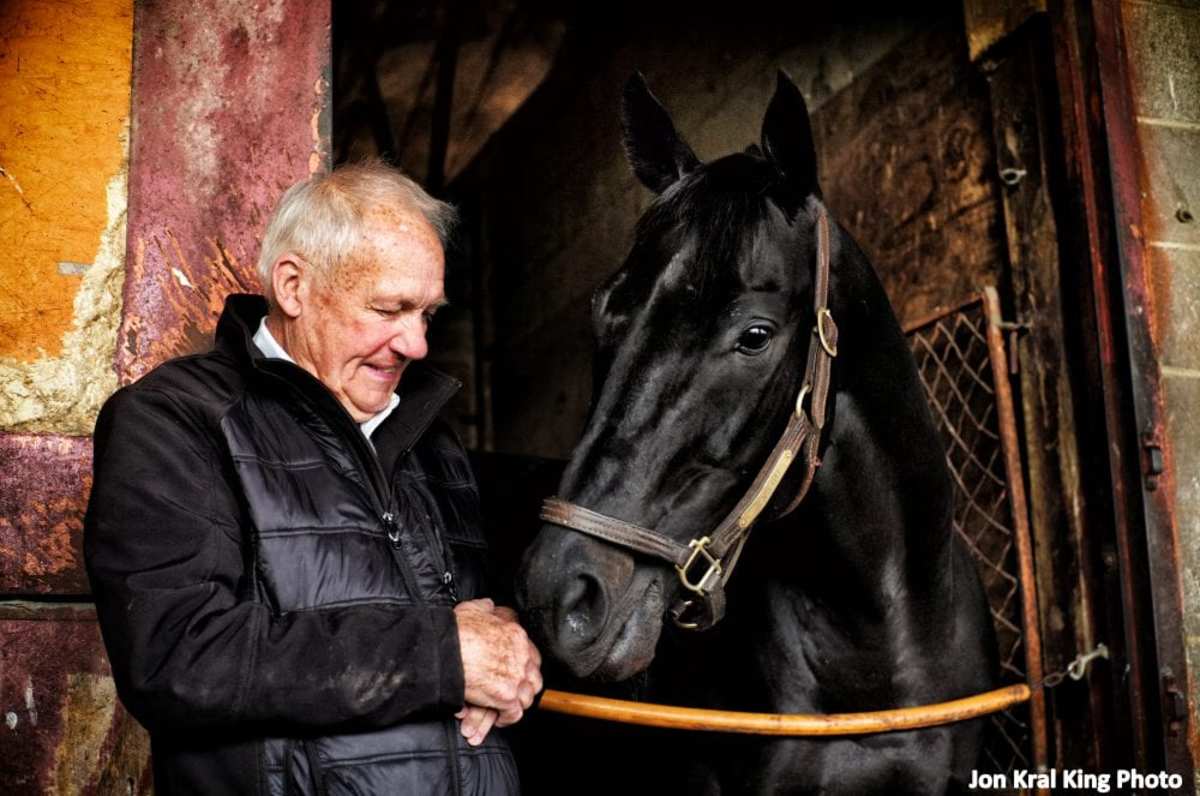
The Maryland Jockey Club expressed deep sorrow over the death of the esteemed Hall of Fame trainer King Leatherberry, who passed away at his home on Tuesday morning at 92 years old. Taylor Leatherberry, one of his twin sons, described him as truly unique, saying, “There was no man more deserving of the name than my father.”
Born on March 26, 1933, in Shadyside, Maryland, Leatherberry obtained his trainer’s license in 1958 and secured his first win in 1959 at Florida’s Sunshine Park with a horse named Mr. L, marking the start of an extraordinary career exceeding six decades. Throughout his lifetime, Leatherberry’s horses amassed 6,508 wins and earnings of $64,693,537. He captured 52 training championships across Maryland—26 at Pimlico and 26 at Laurel—and four meet titles at Delaware Park.
Leatherberry was North America’s leading trainer in wins in both 1977 and 1978, boasting over 300 victories annually from 1975 through 1978. He managed to hit 200 or more wins for 11 consecutive years and topped 100 wins for 26 straight years. Between 1975 and 1980, he ranked among the top three trainers in North America by annual wins and was in the top ten nationally for earnings on four occasions.
Reflecting on his early days, Leatherberry shared in a 1993 interview with Tom Atwell and the Daily Racing Form that he initially raced at smaller tracks like Sunshine Park, Scarborough Downs, and Thistle Down, unaware of the leading trainers. However, once he began competing alongside Bud Delp in Maryland, winning became a critical priority for him.
Leatherberry was based in Barn No. 1 at Laurel Park and was part of Maryland racing’s dominant “Big Four” during the 1970s, alongside Delp, Dick Dutlow Sr., and John Tummaro. Delp praised him in a 1993 Washington Post article, stating, “No one in the history of horse racing has done what he has done in the last 25 years, using top assistants and veterinarians to train horses perfectly.” Author Vinnie Perrone also described Leatherberry as the “King of Claimers,” highlighting his skill as a shrewd buyer and seller of thoroughbreds in lower-priced races.
Upon his retirement in 2023, Leatherberry had become only the third trainer in history to surpass 6,000 wins. After his 6,000th victory aboard Cherokee Sunrise at the Timonium State Fair, he humbly remarked on the milestone, acknowledging legendary trainers Dale Baird and Jack Van Berg as the only others with more wins.
Jack Mann, a Joe Hirsch Media Honorary Member of the National Museum of Horse Racing and Hall of Fame, once remarked in Mid-Atlantic Thoroughbred magazine that being a King Leatherberry meant embracing a distinctive, enjoyable approach to training that was unlike anyone else’s.
Among his notable horses were Katatonic, winner of the 1987 G1 Hempstead at Belmont, and Taking Risks, 1994 winner of the G1 Iselin at Monmouth. However, his most beloved horse was Ben’s Cat, a homebred that won 25 stakes races and earned over $2.6 million.
Leatherberry was inducted into the National Museum of Horse Racing’s Hall of Fame in 2015 and honored by the Anne Arundel County Hall of Fame. He received a Lifetime Achievement Award from the Maryland Athletic Hall of Fame in 2002 and served as president of the Maryland Horse Breeders Association and Maryland Million Company, as well as on the board at Timonium. Laurel Park commemorates his legacy annually with the King T. Leatherberry Stakes, a turf race for horses aged three and older, with the 2026 running scheduled for April 18.
Raised on a farm in Anne Arundel County, Leatherberry earned a business degree from the University of Maryland. He is survived by his wife of 62 years, Linda Marie Hebner Leatherberry, his twin sons Taylor and Todd, both 58, and his 18-year-old grandson Heavener.
This story originally appeared in the Paulick Report’s News section on February 10, 2026.
Fan Take: King Leatherberry’s legendary career exemplifies the dedication and skill that define the essence of horse racing. His impact on Maryland racing and beyond reminds fans how one trainer’s passion and innovation can shape the sport’s history and inspire future generations.