
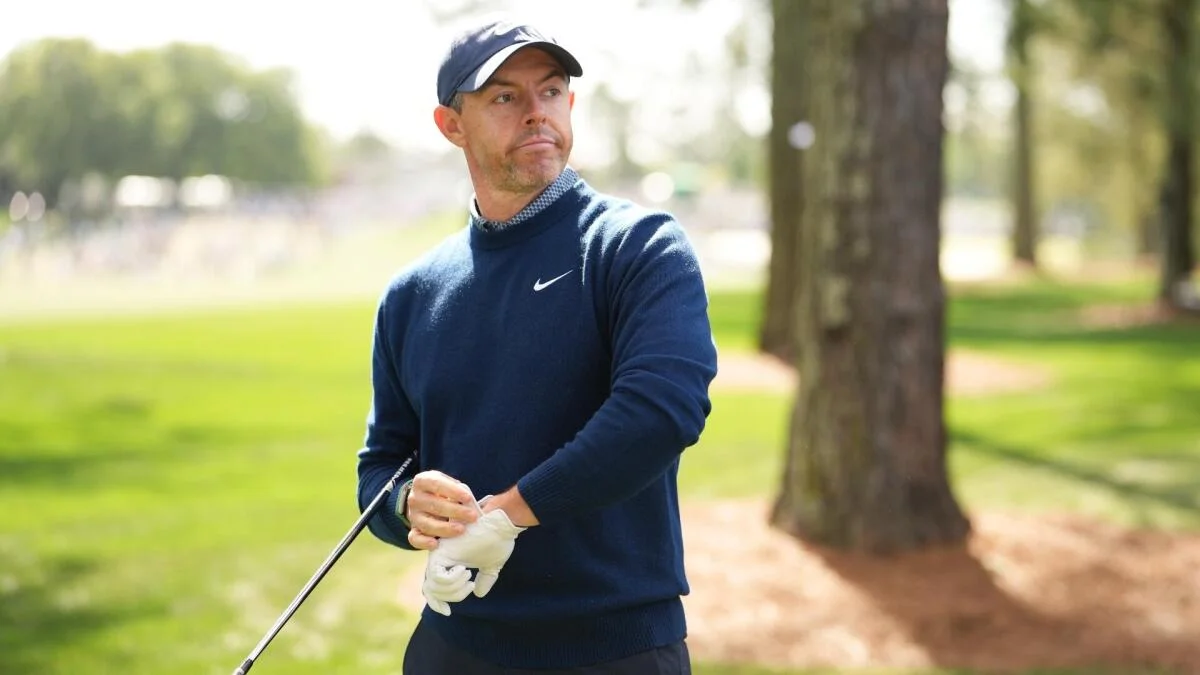
AUGUSTA, Ga. — After finally exorcising his demons at Augusta National, winning the green jacket and completing a career Grand Slam with a cathartic and thrilling victory at the 2025 Masters, Rory McIlroy arrived at his 2026 title defense looking visibly changed. Years of heartache have led McIlroy to prepare for the worst at the Masters, but he entered this season brimming with confidence, finally free of the burden of not winning a major tournament in more than a decade.
That was evident in McIlroy’s pre-tournament press conference on Tuesday, but it was hard to see how his newfound comfort would mesh with the rigor that Augusta National would present at 7,565 yards.
By the end of the first 18 holes as the defending Masters champion, McIlroy had a strong answer. His 5-under 67 tied him for a share of the clubhouse lead with Sam Burns.
After his round, with his green jacket already in his locker, McIlroy was asked if he felt calmer after his first tee shot, and he shook his head, explaining that his hands were shaking as well as he teed up the first ball of the tournament, and why that was a positive in the end.
“I was nervous, as I always am on the first tee,” he said. “It’s the first round of the major season and the first of the most important 16 rounds of the year. I’m grateful that I feel the same way I always have. I’d be concerned if I didn’t feel that way, because it definitely still means something to me.”
McIlroy said the difference was how he approached his level of play after a choppy start, hitting only one of his first six fairways, hitting even par for the first seven holes and spending time scrambling just to survive par. After limiting himself to one bogey on No. 3, McIlroy made his second birdie of the day on No. 8 and was on the right track again, posting five birdies in eight holes to move him to the top of the leaderboard.
“I didn’t hit the ball very well in the first seven holes, but here at times it was tentative and a little guided,” McIlroy said. “I just kept swinging, believing that eventually I would find it. Maybe it could have been a little different.”
McIlroy took advantage of Augusta National’s par-5s as usual, making birdies on all four and doing some major damage on a difficult day. He added birdies on Nos. 9 and 14 and came away with a 67, which might have been a 70 in his previous Masters.
What’s especially scary for the rest of the field is that McIlroy proved he has enough confidence to go through the round at 5 under, even with a B game. Scottie Scheffler’s dominant performance at Augusta National was just that, but McIlroy at the Masters is anything but typical.
The Northern Irishman has long felt he had to be perfect to win at Augusta National. That kind of thinking can lead to incomplete results in such rigorous testing in a game that never allows perfection to be achieved.
McIlroy is brimming with confidence in his first round wearing the green jacket. Rather than compound his mistakes on this course with self-imposed pressure, he can rely on the empirical evidence from 2025 that he has increased his confidence levels, especially in the face of adversity.
“Winning the Masters makes it easy to win the second one,” McIlroy said. “When you know you can go into the champion’s locker room, put on a green jacket and have a Coke Zero at the end of the day, it makes it easier to take that (difficult) swing and not have to worry about where it’s going to go.”
Part of that freedom comes from the physical changes he made to the game. In 2025, McIlroy made a conscious decision to become a better shotmaker, wanting to be able to drive the ball better, be more shapely, and be more creative on the course. It showed in him on some shots Thursday, especially when he was out of position early on.
On No. 5, he hooked his tee shot to the left, then hit a low hook that fell into the green, nearly rested on the ledge at the side of the hole, then rolled to the front edge, giving him an up-and-down on one of Augusta National’s most difficult holes.
Once he started finding it off the tee, he was able to attack golf courses that were growing harder and faster by the hour, with a stronger rolodex of shots to hit. On the 8th, he hit the 3-wood low and sent it pin-high to the back of the green, easily allowing a two-putt for birdie. On the 17th, he hit a wedge and stopped the hole high on the green, causing players to have cramps all day.
“I think that’s a big part of it…knowing that you can hit big shapes from right to left or left to right and get out of trouble if you need to,” McIlroy said. “As we talked about last year, playing a softer golf ball and playing that softer golf ball with more spin not only helps with that, but it also helps you stop the ball faster on the green because it’s inevitably going to be very hard and very fast.”
Augusta National has long been a course dominated by the game’s greatest shot shapers and makers. In the modern era, Tiger Woods, Phil Mickelson, Jordan Spieth and Scheffler are among the most creative players in the game, and each has enjoyed success at the Masters. Despite his immense talent, McIlroy needed to make it a real focus to add to his game, and equipment changes played a big role, resulting in his ability to hit all the shots this course demands.
After completing his career Grand Slam last April, many wondered if McIlroy would end up on a major tear in 2025, ending the question of when he would be in the winner’s circle again. That didn’t happen, but he did well at home at the British Open and at the Ryder Cup in the fall.
Perhaps that expectation was a year early.
With the match suited for Augusta National and the mental space cleared, McIlroy will be more dangerous than ever at the Masters. While this is an exciting proposition for patrons of the week, it’s a pretty scary concept for other competitors.