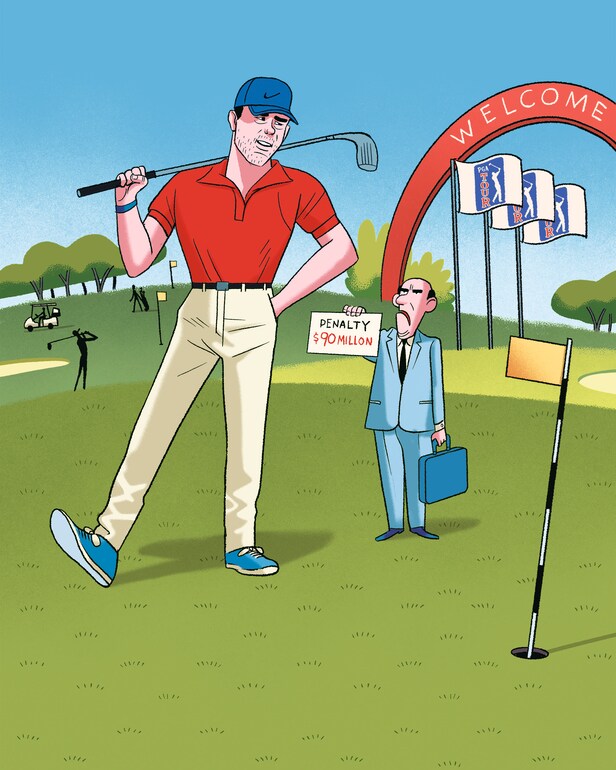
Reading the headlines when Brooks Koepka returned to the PGA Tour earlier this year, it appears the five-time major winner forfeited $90 million to return after three years at LIV Golf. Digging into the details reveals something even more interesting about a new addition to the PGA Tour’s retirement plan: equity grants. These are given to a select group of top players, and Koepka had to give up five years’ worth. Their growth is calculated in a steady but unspectacular manner. But this is not how private equity normally works, and certainly not how private investment in sports works. The fund is designed to achieve high growth despite high risk.
To be fair, the PGA Tour has had a very good retirement program for its players for decades. On paper, the new subsidies offer significant benefits, but it’s not at all clear what that upside will mean for recipients, from how much they’re worth to how recipients can cash out decades from now.
advertisement
symbolic value
/content/dam/images/golfdigest/fullset/2026/2/GD0626_FEAT_PENSION_02_rev.jpg
Koepka’s penalty was intended to send a message about the price players will pay for abandoning the PGA Tour. “I don’t think this is a question of the value of the equity subsidy,” said one longtime golf agent with deep loyalty to the PGA Tour. “Rather, it’s a message of what it can be. It’s symbolic.”
Koepka’s potential forfeiture of up to $23 million in 2026 FedEx Cup bonuses is open to speculation, but he would have to win the FedEx to earn the full amount and play really well to win most of it. Also, part of that headline number is FedEx’s contribution to player retirements. Outside of the top 50, the $23 million figure quickly shrinks in mid-season, as contributions drop below $200,000, and positions 101 through 125 on the points list bottom out at $100,000.
advertisement
The second part of his fine was a $5 million charitable contribution. Considering his accumulated assets and annual income, he should be fine. In terms of wealth, he said he has earned over $44 million on the PGA Tour and in 2023, LIV paid him over $100 million to come play.
The second issue is how charitable donations are treated as a deduction against annual income. If Mr. Koepka earns $5 million this year and contributes $5 million from his savings, his tax bill will effectively be zero. If he earns $2 million and donates $5 million, his taxes would be zero and the remaining $3 million would be carried forward into the future, reducing his taxes again.
But this is Part 3, which shines a light on the latest and brightest addition to the PGA Tour’s Retirement Match. The tour said that under that assumption, Koepka would lose between $51 million and $63 million in regular stock grants. This is a huge amount of money, but if the revenue projections are correct and there is a way for players to sell their grants, it will only become a huge amount in the future.
According to the tour’s own profit estimates, Koepka would earn far less today than those headline numbers, perhaps less than $9.3 million, if not less, based on current value. Here’s how it works:
advertisement
First, he was 35 years old when he was punished, so he will have to wait until he is 50 to cash in any grants he hasn’t received.
Second, and more importantly, the PGA Tour’s return assumptions on these grants must be correct. PGA Tour Enterprises assumes an annual return on grants of 10-12%, which is consistent with the Standard & Poor’s 500 return. That’s what the average weekend golfer should strive for.
However, this is a fairly low amount for this type of subsidy. Private equity is an investment in an entity, in this case a recalibrated PGA Tour, that can take years to materialize. As such, this investment is private and cannot be bought or sold at any time on the public market. It takes time to grow.
If the revenue projections are correct and there is a way for players to sell grants, there will only be tons of money to be made in the future.
Here’s the drawback. In addition to being volatile and illiquid, most private equity deals lose all their value or perform poorly. The most successful private equity managers plan to have one or two out of dozens of investments turn out to be big winners, making up for the great ideas that fail.
advertisement
While it may seem like Mr. Koepka is forfeiting the possibility of a future windfall, a lot of things have to go right for these grants to work. It goes without saying that tour sponsors, media partners and advertisers in particular pay a lot of money for PGA Tour merchandise.
Assuming everything happens as the tour predicts, $9.3 million invested today at that rate would be worth about $51 million in 15 years. This is called a present value calculation, and it takes today’s amount and applies a projected rate of return over a set number of years to find out what it’s worth. For a grant to have any value, there must be a way to sell or borrow the money backing it. The vesting of the subsidy will not begin until July 2028, so we are still considering how to sell it.
Frank Marzano, an advisor to many PGA Tour players, said, “I don’t think (equity grants) are worth it in terms of financial planning for retirement.” “We don’t have enough information to understand the benefits. There are vesting requirements, but there are also limitations.”
All in all, it’s hard to believe that a multi-billionaire like Koepka would lose sleep today over a $9 million penalty and a fully deductible $5 million charitable deduction, most of which will be donated to a foundation run by friends of the PGA Tour.
advertisement
Read more: How will private destination clubs survive the next recession?
It’s not a pension.

/content/dam/images/golfdigest/fullset/2026/2/GD0626_FEAT_PENSION_03_rev.jpg
New grants aside, the PGA Tour’s retirement plan is well established and solid. Rather than a pension plan where you receive a fixed amount at retirement until you die, this is an enhanced 401(k) plan where the amount you contribute is tax-free until withdrawn at retirement.
If you hear claims from golf fanatics that the PGA Tour owes Tiger and Phil hundreds of millions, that’s not true. Any retirement funds they earn are kept by administrators like Schwab, not by the tour itself.
“Even here (at PGA Tour headquarters), people call it a pension plan,” Jay Madara said before retiring as the tour’s chief financial officer in March. “This is an IRS-approved defined contribution plan.”
advertisement
This means the tour will be independent in any investment decisions players make with funds in their retirement accounts. (For players below a certain amount, Schwab holds all assets. If the retirement balance exceeds $5 million, there are other options.)
It also means that the tour cannot in any way restrict withdrawal from these plans by former members who are performing elsewhere. So Phil Mickelson could have been collecting his PGA Tour retirement winnings while teeing up at LIV Golf.
“The traditional PGA Tour retirement plan is a plan that really benefits players,” Marzano said. “If you can build a long career on the PGA Tour, it will pay off over time.”
Chris Gotterup said this after winning the 2026 Sony Open. At a press conference in January, he said that the waiver that comes with the win would keep him on tour for five years, making him eligible for severance pay.
advertisement
The PGA Tour retirement plan is actually four separate plans. There are general retirement plans that all tour participants can join, the Cut Maid Plan, the FedEx Cup Plan (a plan in which the company invests retirement funds), and the newly introduced stock plan.
Each plan works differently. A typical retirement plan is similar to the typical 401(k) plan owned by the average Joe. The FedEx Cup plan is on a sliding scale. As part of the FedEx Cup, a portion of the bonus pool will be donated to players’ accounts. Last year’s FedEx Cup winner Tommy Fleetwood became the 50th player to win $1 million. Then, everyone between the ages of 51 and 125 received $100,000 in their retirement plans.
A lot of things have to go right for these grants to work, but there’s no question that tour sponsors, media partners and advertisers in particular are paying a lot of money.
When it comes to cutback plans, a player like Bo Hosler, who finished 104th on the 2025 FedEx Cup points list, would probably care more about the plan than Scottie Scheffler. That’s because a cap on contribution means a player at the bottom of the PGA Tour rankings has more significance than a player at the top. At the end of the season, the tour basically looks at how many cuts were made that year and pays a fixed amount for each cut. Now, one cut costs about 50,000 yen. Scottie Scheffler, who made 20 haircuts in 2025 for $5,000 each, earned an additional $100,000 last year.
Therein lies the friction. For a full-time American worker, putting $100,000 into a retirement plan would be a significant boost, but for someone like Scheffler, who has earned $27 million in 20 tournaments, the benefits can be easily overlooked. Meanwhile, Hosler’s winnings were $1.53 million. He competed in 29 events and made 21 cuts, so he received $105,000, a more meaningful amount when compared to his on-course earnings.
advertisement
“We have earmarked $15 million in tour funding for the reduction program in 2025 and 2026,” Madara said. “Everyone who takes a reduction on Friday will be given a one-credit contribution to the plan. At the end of the year, we will determine how many reductions people have made and pay them out.”
Like most things related to retirement, it’s not that simple. PGA Tour members must play in at least 15 official events, while members with veteran status (made 150 cuts during their career) must play in at least five official events. There are also elevators after the milestone markers, depending on the number of years you played and the number of years you were cut.
By this calculation, a player of Hosler’s rank could have put away $228,500 tax-free for retirement last year based on a cut plan, FedEx Cup contributions and a tour-sponsored 401(k) capped at the IRS limit for his age. That’s quite a benefit.
It’s difficult to accurately predict the balance of an individual player’s retirement account, so we asked a major brokerage firm to model the retirement of the average tour player. The assumptions used in the calculation are: The player stayed on tour for 10 years, making 10 to 12 cuts each year. This is average. $60,000 was contributed each year to the abatement plan, with a rate of return of 7% and an inflation rate of 3%. After 10 years of playing, this theoretical player had $754,674 left in his account. Without further contributions, he would have $2.55 million when he began withdrawing his retirement funds after 25 years.
advertisement
Golf Digest Details

golf digest logo How are indoor clubs benefiting from the golf boom?

golf digest logo Welcome to the most exclusive golf trip

golf digest logo The Undercover Pro: An Insider’s Perspective on Poker Games on Tour
waiting game

/content/dam/images/golfdigest/fullset/2026/2/GD0626_FEAT_PENSION_04_rev.jpg
There are a lot of unknowns about the new PGA Tour equity subsidy, but it’s not unusual. Private equity, by definition, is not publicly traded. It is always expected that such investments will grow exponentially.
“Equity grants can help increase people’s net worth, but the amount varies by player,” said Mason Champion, a financial advisor and member of Morgan Stanley’s global sports and entertainment practice. “Large established companies may be exposed to the risks of equity subsidies, i.e. illiquidity and volatility, and subsidies may become a legacy for their families.”
advertisement
Players who haven’t won on tour in decades may need to think differently. “For new and promising players, these grants represent a larger portion of their net worth and total asset allocation and carry the risk of illiquidity,” he said.
What this means is that if stock grants significantly exceed the liquid assets someone has, players may not be able to access the retirement funds they think they have.
Also, no one knows how much a given grant will be worth in 10, 15, or 20 years. Since there is currently no secondary market, it remains an open question what kind of market exists to sell the subsidies and to whom.
There is a risk that players may not have access to the retirement they think they have.
Currently, players who receive the first grant will own half the value in four years, three-quarters in six years, and the full amount in eight years. Champion, who is also a member of the PGA of America, said it frankly. “Vesting does not imply liquidity, and the means to sell equity grants is also unclear.”
advertisement
Some players are already skeptical. “The players have shown their support publicly,” he said. “They are informally considering the impact of illiquidity and the dilution impact if more subsidies are given.”
Champion advises players on the PGA Tour to discount the value of the grants significantly and consider the risk more like pure speculation. When it comes to retirement planning, we would like players to assume the value of the grant is much lower and instead focus on other retirement options.
More: How golf companies that manufacture in the U.S. can survive
A new era of investment
These are difficult times for retirement investing. It wasn’t always like this. When the PGA Tour developed its retirement plan under commissioner Dean Beaman in the 1980s, it was the beginning of the greatest bull market in history, but no one recognized it at first. The stock market crash began in 1982 and continued until 2008, with falls and spikes. This sustained rise has made passive investors rich simply by owning blue-chip companies.
advertisement
Investors today are looking for a variety of asset classes that have lower volatility than stocks and bonds and grow at a rate that allows their investments to compound. In this environment, tour players have a huge advantage if they understand their abilities and risks.
The retirement benefit system is performance-based. This allows players to contribute from their weekly check as if they were a traditional office worker, with a reduction that allows them to contribute to the tour.
The equity grants given to players on the PGA Tour offer all the possibilities of a private equity investment that could someday become a fortune, or worthless.
At the end of the day, players should consider their retirement savings along with their other investments with the same focus they bring to their golf swing.
advertisement
This is a good lesson for the rest of us.
Golf Digest Details

voice LIV golf is dying. the damage is permanent

golf digest logo It’s already time to start preserving modern courses

golf digest logo Like it or not, Jim Furyk was the perfect choice to be the 2027 U.S. Ryder Cup captain. The reason is as follows