
Welcome to Inside the Suns, an in-depth exploration of the current Phoenix Suns team. Here, the Fantable—a group of optimistic Suns fans—share their insights on the latest challenges and developments surrounding the team.
Fantable Questions of the Week
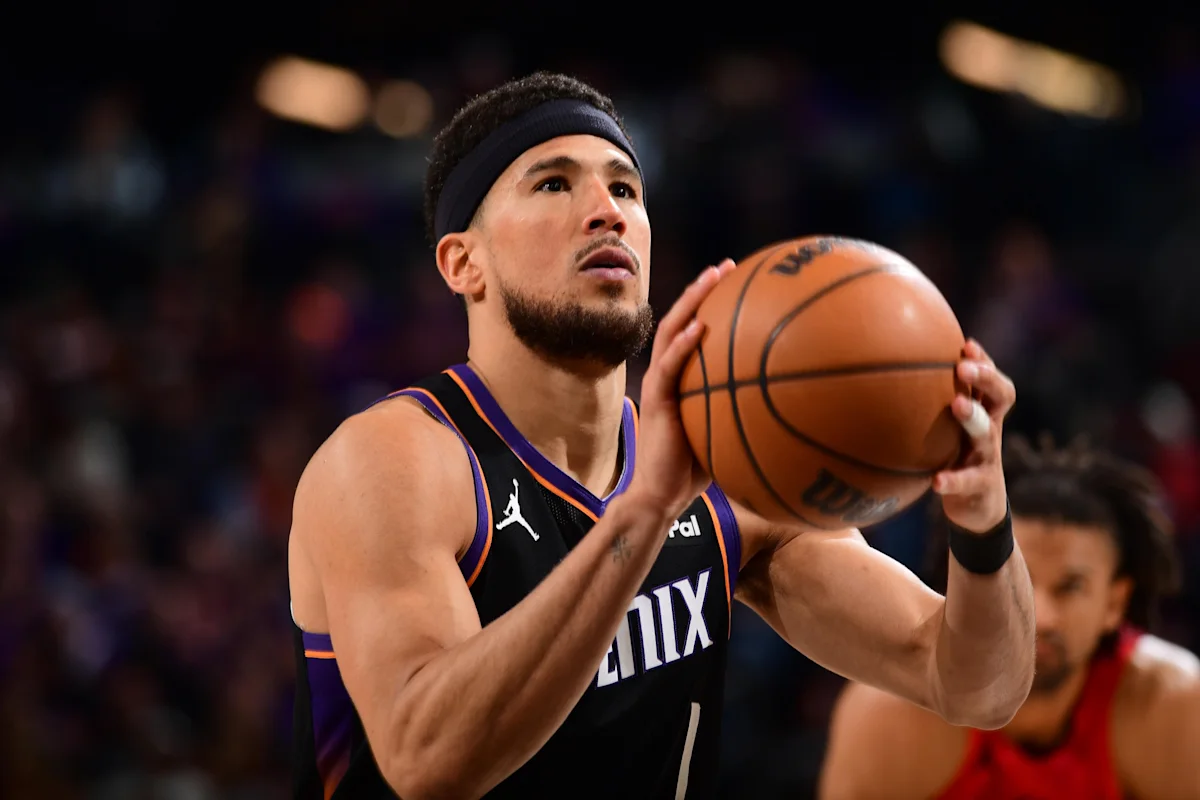
Q1: Last season, Devin Booker’s shooting was among his lowest points (.507 effective FG%), and his three-point shooting (33.0%) ranked as his second worst. How critical is it for him to exceed his career averages in these areas during the 2026-27 season?
GuarGuar: Last year was definitely a down year for Book’s shooting. His strong free throw frequency and accuracy helped keep him fairly efficient. However, his inconsistency from three-point range is a problem—especially on off-the-dribble attempts, where he struggles more than catch-and-shoot looks. I think his shooting mechanics have shifted slightly since he entered the league, possibly to boost midrange scoring, but that has cost him three-point consistency. He needs to regain confidence beyond the arc, and I believe he will.
zenzino: It’s extremely important. Suns owner Mat Ishbia has repeatedly expressed full support for Booker, so the team should be built around him rather than forcing him to adjust to new teammates. Booker spent much of last season focusing on involving others, which was necessary, but not his most effective role. The offense should revolve around getting Booker open shots and using his ability to draw defenders to create opportunities for teammates. I’d like to see Booker take a more aggressive offensive role while being selective with threes—he doesn’t need to shoot a high volume, and maintaining around 28 points and 6 assists per game would be ideal. Personally, I hope he silences the false narratives claiming he’s declining.
Ashton: This question might feel loaded because any true Suns fan knows it’s an issue. Thinking contrarily, I view Booker’s three-point shooting as a “nice-to-have” rather than a “must-have.” He was never a high-volume three-point shooter and often teams target him defensively, as seen in the Thunder playoff sweep. Booker shoulders many responsibilities—scoring, defending, playmaking, leadership—and improving his three-point shooting is helpful but not critical within the current coaching strategy. For me, playmaking remains the top priority, and I’m looking for the “Olympic Booker” this season.
Rod: Reaching career averages in these shooting metrics would be acceptable but not ideal. Booker doesn’t need to carry the team solo but must lead by example on the court with efficient play. The team’s supporting cast this season looks stronger and deeper than in recent years, which should help. I believe Ighodaro starting in place of the injured Mark Williams could allow Booker to focus more on scoring rather than facilitating, creating a better balance offensive-wise.
Q2: The Suns ranked 28th in free throw attempts last season (20.3 per game). Do you expect them to get to the line more frequently in 2026-27?
GuarGuar: Losing Royce and Grayson, who didn’t draw many fouls, could improve the team’s free throw rate this year. Also, the addition of Bridges, who plays aggressively and attacks the rim, should help. Brooks is aggressive but needs to improve in drawing fouls too. Last season, Booker was basically the main player getting fouled.
zenzino: I hope so. Booker’s free-throw attempts rose by nearly two per game, placing him fifth in the league, and I expect him to maintain that physicality. Green’s numbers might rebound if he stays healthy and aggressive, and Bridges could also increase his attempts if he focuses on attacking the basket more. Historically, however, the Suns haven’t had favorable calls at the line, so I’m cautiously optimistic.
Ashton: I don’t think it will increase. Without a dominant frontline to draw fouls and with a lineup reliant on midrange shots, free throw attempts will likely stay low. Booker’s outspoken nature and Brooks’ tendency for technical fouls might hurt their standing with referees. Also, the team’s temperament toward officials could play a role—there’s a long-standing sense that the Suns don’t get favorable calls, partly due to how players engage with refs.
Rod: I expect an increase in free throw attempts this season, though I won’t guess by how much. The team looks poised to attack the basket more often, which usually leads to more trips to the line compared to three-point-heavy teams. I’m not advocating for seeking fouls at the expense of good shots, but a balanced approach that averages league-level free throws would please me.
Q3: Will Koa Peat get more playing time with the main team this year compared to what Maluach and Fleming had in their rookie seasons?
GuarGuar: I doubt Peat will play more than Fleming and Maluach did last year. He’s behind Fleming, Bridges, and potentially Oso on the power forward depth chart. They seem focused on developing him in the G League until spring; however, compared to last year, Peat looks more polished early on.
zenzino: Before the Bridges trade, I would have said yes, but now I’m uncertain. He’s very young, only a year removed from college, and the team has three power forwards, so there’s room to be patient. Unlike Maluach and Fleming, Peat already comes with an NBA-ready body. I expect him to dominate in the G League and possibly earn big team minutes later. With Mark Williams out injured, small ball might be even more common, which could open playing time for Peat as a small-ball big.
Ashton: I usually won’t answer this due to ties to college bias, but I want Peat to get all the minutes he can grab. Whether starting or coming off the bench, he should showcase his ability, especially at getting to the line and shooting free throws. Realistically, though, Fleming and KM need their development time, so Peat might spend significant time in the G League this season.
Rod: It would surprise me if Peat logged more minutes than last year’s rookies, but it wouldn’t shock me either. Maluach and Fleming weren’t quite ready last season, and Peat still has to prove himself in training camp and preseason. Fleming seems like the primary backup at power forward, with Peat behind him; Fleming offers 3&D skills, Peat is more of a driving attacker. Defensive ability and fit will determine minutes, and while I hope for a breakthrough, I’m cautious.
A big thank you to all our Fantable members for their thorough contributions this week!
Suns Trivia & History
On September 12, 2005, the Suns signed Eddie House, an Arizona State University standout, to a one-year contract. House appeared in 81 games off the bench, averaging 9.8 points and 38.9% from three-point range in 17.5 minutes. The Suns finished the 2005-06 season 54-28, making it to the Western Conference Finals before losing to Dallas.
Curtis Perry, a key player in the Suns’ 1975-76 NBA Finals run, retired on September 13, 1978, after four seasons with Phoenix. He peaked in 1974-75 with averages of 13.4 points and 11.9 rebounds per game—the latter the 5th highest single-season rebounding average in Suns history. His career average of 9.49 rebounds per game ranks 7th all-time for the Suns.
On September 16, 1974, the Suns acquired Curtis Perry, Dennis Awtrey, Nate Hawthorne, and a 1976 first-round pick (Adrian Dantley) from New Orleans Jazz in exchange for Neal Walk and a 1975 second-round pick. Neal Walk, the Suns’ first-ever draft pick (2nd overall in 1969), averaged 14.7 points and 8.9 rebounds over five seasons. He has the second highest single-season rebounds per game (12.42 in 1973) after Paul Silas and once outscored Kareem Abdul-Jabbar 42-27 in a 1972 game.
Later in life, Walk battled a benign spinal tumor that left him wheelchair-bound. He played wheelchair basketball competitively, earned the “Wheelchair Athlete of the Year” honor from President George H.W. Bush in 1990, and worked for the Suns’ Community Affairs department before passing away in 2015.
On September 16, 1994, the Suns signed power forward Wayman Tisdale to a one-year, $850,000 deal on the same day the NBA approved Danny Manning’s $1 million contract, making Phoenix possibly the deepest team in the league at that time.
Important Upcoming Dates
- Sept. 28 – Media Day
- Sept. 29 – Training Camp Opens
- Oct. 5 – Preseason @ Pistons, 4:00 PM
- Oct. 7 – Preseason @ Bulls, 5:00 PM
- Oct. 10 – Preseason vs. Spurs, 7:00 PM (ESPN2)
- Oct. 14 – Preseason @ Spurs, 5:00 PM
- Oct. 16 – Preseason vs. Jazz, 7:00 PM
- Oct. 20 – Start of 2026-27 NBA Season
- Dec. 15 – Earliest trade date for most newly signed players
- Jan. 5 – 10-day contracts can be signed
- Jan. 10 – All NBA contracts guaranteed for rest of season
- Jan. 15 – All signed players eligible for trade
- Feb. 11 – Trade Deadline
- Feb. 19-21 – NBA All-Star Weekend 2027
Fan Take:
This detailed look at the Suns’ current state reveals how critical player development and strategic adjustments will be for their future success. Basketball fans should watch closely as Phoenix balances evolving player roles, shoots for efficiency, and navigates a competitive league landscape—all factors that could influence league-wide trends in team building and playing style.
Source: sports.yahoo.com