

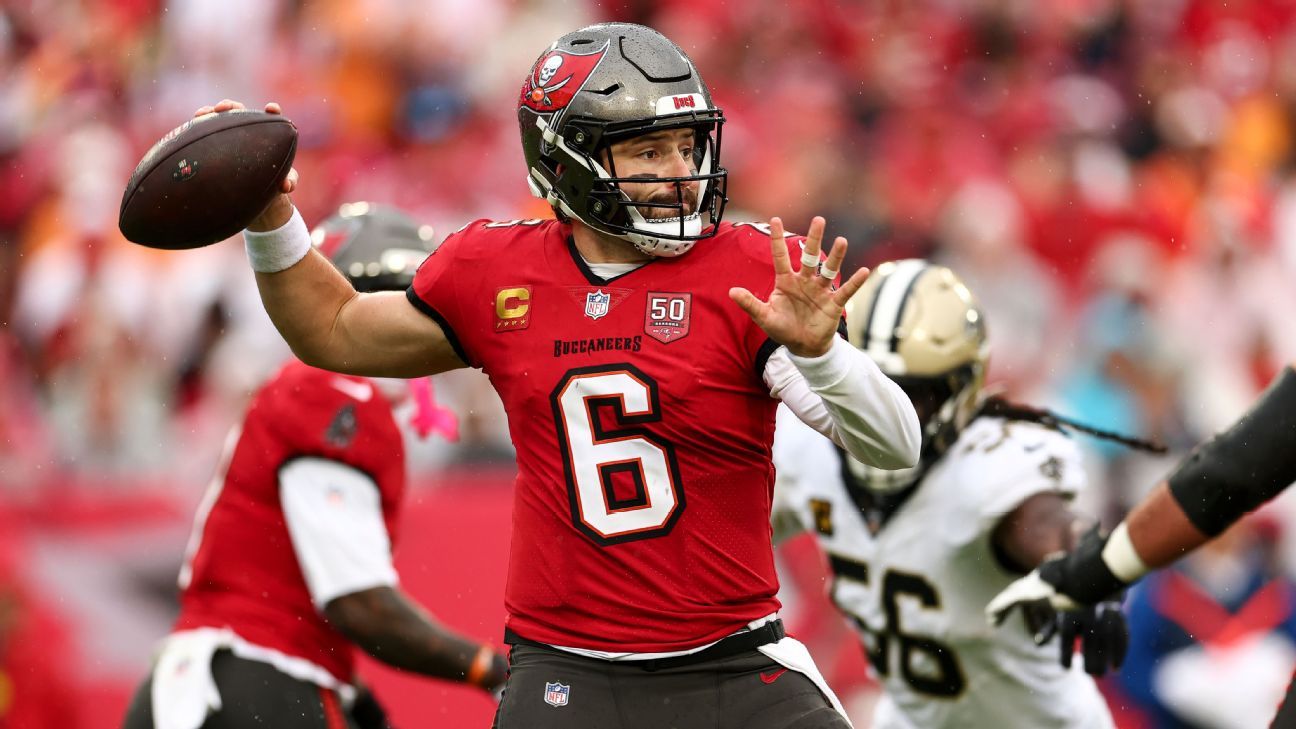
Fifty-five million a year for Baker Mayfield — really?
Sort of. The Buccaneers gave Mayfield a new contract this week that looks huge on paper, but the details make it a classic NFL “both sides can sell it as a win” deal. Mayfield was already set to earn $27 million in 2026; under the revised contract he’ll make $37 million that year, then $50 million in both 2027 and 2028, and $55 million in 2029. That’s four years and $192 million total, which averages $48 million per year across those four seasons. But the amount of truly new money added to what he was already owed is $165 million over three extra years — which translates to a $55 million-per-year average on that new portion. Hence why the player’s camp and the Bucs can both claim success.
And this deal doesn’t just help Mayfield and Tampa Bay — it benefits any quarterback who will be negotiating extensions over the next year. Mayfield has rebuilt his career in Tampa: since arriving he’s averaged 32 TD passes and 4,079 yards per season, and helped the Bucs win two NFC South titles in three years. Still, a $55 million-per-year figure now slots him into a tie with five others for the league’s third-highest QB salary average. Dak Prescott sits at $60 million, while Patrick Mahomes’ most-recent new-money average was $64 million — and Mahomes remains in a class by himself given his two MVPs, three Super Bowls and dominant playoff record.
The five earning $55 million alongside Mayfield are Matthew Stafford, Joe Burrow, Josh Allen, Jordan Love and Trevor Lawrence. Mayfield’s on-field résumé — two Pro Bowls, a top-11 MVP finish as his best result — aligns him more with the latter names in that group than with the first three, but his contract still raises the bar. Unlike some who signed in a frenzied market, Mayfield struck this deal during a relatively quiet stretch for top-end QB extensions, which makes its signaling effect even more meaningful.
Why this matters: many quarterbacks who consider themselves “very good” and who are approaching or eligible for extensions in the next 12 months can point to Mayfield’s deal and push for $55M-plus — and several could try to nudge into the $60M-per-year tier next offseason. Below is a roundup of signal-callers to watch and whether they’re likely to clear what we can call the “Baker Line” ($55M).
Lamar Jackson (Ravens) — Jackson has two years left on his current contract and is scheduled at $52M for both 2026 and 2027. The Ravens tried to start extension talks this offseason without success. His deal contains protections that prevent Baltimore from tagging him in 2028 and also gives him a no-trade clause, giving Jackson huge leverage. Is he over the Baker Line? Yes — with two MVPs and elite upside, he has the strongest case to command $60M+ if he stays healthy and dominates over the next couple seasons.
Drake Maye (Patriots) — Eligible for an extension after Year 3, Maye finished second in MVP voting and led New England to the Super Bowl in Year 2, so he’d have the credentials for a $55M-type deal if negotiations were permitted earlier. The Patriots hold a fifth-year option for 2028, which gives them breathing room. Is he over the Baker Line? Probably — unless he regresses or suffers a major injury.
Jayden Daniels (Commanders), Bo Nix (Broncos) and Caleb Williams (Bears) — These 2024 first-rounders have shown the kind of upside their teams wanted when they drafted them. Daniels won Offensive Rookie of the Year and reached the NFC title game in Year 1 before injuries hit Year 2; Nix helped Denver to an AFC title but missed the game with an ankle break; Williams underwhelmed early but surged after the Bears hired Ben Johnson. Teams can likely pick up fifth-year options if extensions aren’t agreed to. Are they over the Baker Line? It depends on Year 3 performance — if they improve, they should reach it; if they regress, they won’t.
C.J. Stroud (Texans) — The Texans picked up his fifth-year option but haven’t extended him yet. He was Offensive Rookie of the Year in 2023 and has had postseason appearances each season, though his playoff performance last year hurt Houston’s Super Bowl chances. Stroud is taking a cautious approach by waiting until next spring when he can re-enter talks after another season. Is he over the Baker Line? Not yet, but he’s betting he’ll prove he belongs above it.
Bryce Young (Panthers) — Drafted ahead of Stroud in 2024, Young struggled early, was benched, then rebounded late and led Carolina to an NFC South title and a playoff appearance. No extension was reached this offseason; the Panthers picked up his fifth-year option. Is he over the Baker Line? No — he’d need a breakthrough season to get there.
Jalen Hurts (Eagles) — Hurts signed his extension the same year as Jackson’s and has since become a Super Bowl champion and MVP. He has three years left on his deal at $51.5M per year, with full guarantees for this season and partial guarantees next year. The Eagles revamped their offense and moved on from A.J. Brown in the offseason, putting pressure on Hurts to adapt and perform. Is he over the Baker Line? Yes — his resume justifies it, and if he thrives in the new scheme he could be in line for $60M+ territory in a renegotiation; if not, the team may reconsider.
Sam Darnold (Seahawks) — Darnold signed a three-year, $100.5M deal as a free agent in 2025 after helping the Vikings to a 14-3 season. He led Seattle to a 14-3 record and a Super Bowl title in his first year there. Seattle hasn’t offered an extension yet; his contract includes some guarantees this season and non-guaranteed money in 2027 that becomes partially guaranteed under certain roster conditions. Is he over the Baker Line? Likely yes in terms of bargaining leverage — he has a Super Bowl and strong recent accomplishments that can be used to argue for parity with Mayfield’s new deal.
Jared Goff (Lions) — Goff’s extension in 2024 added roughly $53M per year in new money (just below the Baker Line). He’s been to a Super Bowl previously and helped the Lions contend, and his contract runs through 2028 with significant earnings scheduled. Is he over the Baker Line? He’s probably right at or slightly above it, but much will depend on the Lions’ performance and how the front office views the team’s championship window.
Kyler Murray (Vikings) — Murray’s situation is unique: he was released by Arizona, enabling Minnesota to sign him at the veteran minimum while Arizona still covered the bulk of his guaranteed money. His deal bars the Vikings from using the franchise or transition tags next spring, giving him major leverage if he plays well. Is he over the Baker Line? Not now — but that tag clause could let him vault past $55M (and even Prescott’s $60M) if he has a big season and reaches free agency.
Fan take: This Mayfield extension recalibrates the upper end of QB pay and gives many quarterbacks legitimate leverage heading into 2027 negotiations — fans should expect a flurry of high-profile extensions or holdout-style bargaining over the next year. Ultimately, escalating QB salaries will shape roster building across the league and could determine which teams invest in superstars versus spreading money around to build deeper rosters.
Source: www.espn.com