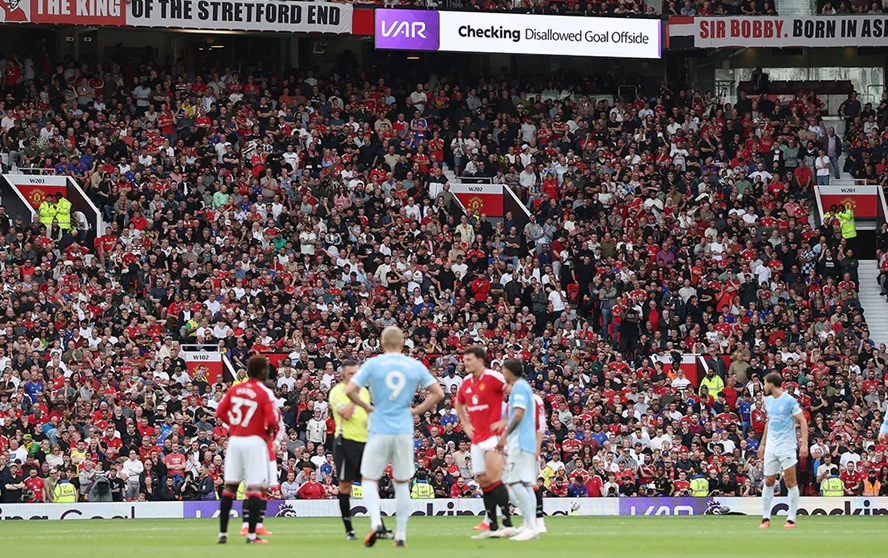
Manchester City’s 1-0 win over Manchester United was determined by a goal that the refereeing body of the Premier League later conceded should have been disallowed.
This distinction is important. It wasn’t just a matter of subjective opinions between rival supporters; officials reviewed the play, made a decision, and subsequently recognized that it was incorrect—a situation that is far from unique.
For a league that prides itself on being the best in the world, this issue is troubling.
What Actually Happened?
The pivotal moment transpired in the 60th minute.
With no score on the board and Manchester City down to ten players after Phil Foden’s dismissal in the first half, a cross made its way into the penalty area and found Erling Haaland, who scored from the back post.
The goal was initially ruled out for offside, but VAR reviewed the incident. The first part of the review was accurate; Haaland was onside due to a defender’s leg keeping him in play.
The controversy arose with Enzo Fernandez.
The City midfielder was in an offside position and made a clear attempt to head the ball. Although he didn’t make contact, the ball eventually reached Haaland.
VAR decided that since Fernandez didn’t touch the ball, he wasn’t interfering with play and thus, the goal was valid. This interpretation ignited a wave of justified outrage.
Why the Decision Was Wrong
The critical point wasn’t whether Fernandez touched the ball, but whether he affected an opponent.
By diving for the ball from an offside position, Fernandez made Lisandro Martinez react to his action, prompting Martinez to adjust his defensive stance. According to IFAB’s offside regulations, a player should be penalized for interfering with an opponent when their actions significantly affect that opponent.
The logic is quite straightforward: Fernandez attempted to play the ball, Martinez was impacted, and thus Fernandez interfered with play from an offside position; the goal should not have counted.
Even former City players voiced concerns about the decision post-match, with both Joe Hart and Micah Richards agreeing that Fernandez’s actions directly influenced the defender, warranting the goal’s disallowance.
The Apology Came Quickly
To their credit, the governing body didn’t defend the ruling endlessly.
Shortly after the match concluded, Pro Ref, responsible for officiating in the Premier League, reached out to Manchester United and acknowledged it as an “error of judgment.” The statement was notably candid.
They recognized that VAR failed to consider the potential impact of Fernandez’s position and should have suggested an on-field review.
This means that the officials reviewed the play but still arrived at the wrong conclusion, which is what should concern everyone involved.
The Officials Punished
An apology was not enough. A mistake of this nature during the Manchester derby has consequences.
As a result of the backlash, VAR official Matt Donohue was sidelined from match duties until after the international break.
This was a significant move.
Typically, officiating bodies prefer internal reviews and less publicized measures rather than overt penalties. Removing a VAR official, even temporarily, sends a clear message that the mistake was deemed serious.
While the adequacy of the punishment can be debated, it reflects the authorities’ recognition of the gravity of the error.
Why This Is Bigger Than Manchester United
Manchester United fans will understandably focus on the immediate fallout: their team’s loss, the disallowed goal, and the points lost due to an acknowledged officiating blunder.
However, the broader issue transcends just one match. VAR was implemented specifically to eliminate such mistakes.
This system utilized multiple officials, various camera angles, and several minutes to evaluate the play—and yet it still fell short.
When fans hear that a referee missed a fleeting event in real time, there is some understanding. But when a team of officials reviews footage multiple times and still makes an incorrect call, trust in the entire system begins to wane.
A Threat to the League’s Credibility
The Premier League’s international popularity hinges on the perception of high standards, which encompass not only players and coaches but officiating as well.
The sport can endure mistakes, but it cannot survive if fans lose faith in the systems designed to rectify those errors.
This is why the incident in the Manchester derby carries significant weight. The officials had access to technology, ample time, and the necessary evidence—and still, they went astray.
The Verdict
Football fans do not seek perfection; they expect accountability and progress.
Admitting the mistake was essential, as was the temporary removal of the VAR official and the subsequent review.
Nonetheless, none of these actions alter the outcome: Manchester City received the goal, Manchester United lost, and the Premier League continues to face difficult questions about the reliability of a system put in place to avoid such controversies.
The most concerning aspect isn’t the mistake itself.
It’s that everyone knew a review was underway, had faith that VAR would arrive at the right decision, and later discovered that the review itself had been flawed.
This presents a far more significant issue than simply an incorrect call.
Fan Take: This incident resonates deeply with soccer fans as it highlights the overarching issue of officiating accuracy in the game. If the technologies and systems designed to ensure fairness continue to fail, it could undermine the integrity of competitions and diminish the joy of watching the sport.
Source: www.soccernews.com