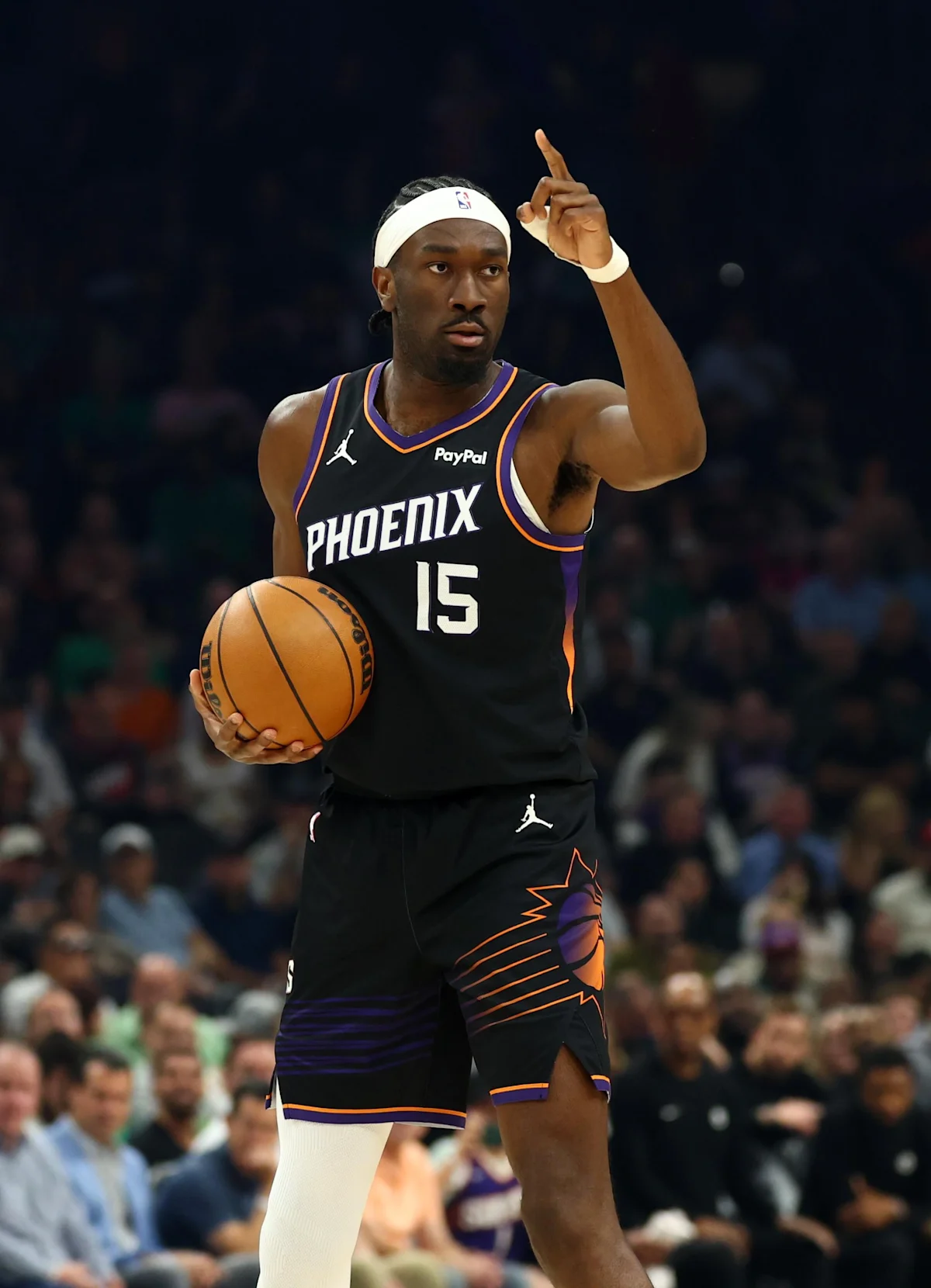
The Suns’ season has hit a snag with Mark Williams suffering a labrum tear during a recent scrimmage, potentially sidelining him until at least the All-Star break. This setback is far from ideal as Phoenix already faces financial constraints, carrying $23.2 million in dead cap space and sitting just $1.7 million below the second apron, which enforces a hard cap. Such limitations make it challenging to replace lost production and speed up the expected development timeline for promising talents like Khaman Maluach, who may now need to contribute meaningful minutes much sooner than planned.
Currently, Phoenix’s center rotation relies primarily on Maluach and third-year player Oso Ighodaro, with little depth behind them. Although Rasheer Fleming could fill in as a small-ball center, and two-way player CJ Huntley can be activated for up to 50 games, this ceiling likely aligns with the anticipated length of Williams’ absence. Therefore, relying on these internal options could suffice for the time being.
When examining the free-agent market for centers, options are quite limited and largely uninspiring. Former Suns such as Bismack Biyombo, Mason Plumlee, and Drew Eubanks are available but don’t offer much fresh value. Veterans like Dwight Powell are older, and while Xavier Tillman brings solid defense and screening ability, his 6’8″ height raises questions about his suitability as a traditional center, possibly making Fleming at small-ball five a better alternative.
Financially, adding a center through free agency may present more risk than reward, especially given the Suns’ tight cap situation. To create the necessary space for a new center, Phoenix would likely need to waive Jamaree Bouyea, whose $2.6 million salary for this season wouldn’t fully guarantee until January 10, 2027. Doing so would free up approximately $4.3 million, enabling the team to pursue another big man if needed.
Importantly, this decision doesn’t need to be rushed. The Suns can afford to wait until January, allowing time to evaluate Maluach, Ighodaro, Fleming, and Huntley’s contributions, as well as Williams’ rehabilitation progress. This thoughtful, patient approach leverages the developmental system Phoenix has built—its G League pipeline and two-way players exist precisely to handle situations like these.
Rather than scrambling for a quick fix on the free-agent scrap heap, the Suns should trust their player development and roster depth to reveal the best path forward. If additional help is necessary come January, the team can then make a calculated move. Until then, the focus should be on giving young players the chance to prove themselves and monitoring Williams’ recovery timeline.
Williams’ injury shifts the team’s current dynamics but doesn’t demand an immediate resolution. Phoenix’s investment in cultivating talent is now put to the test, with Maluach, Oso, and Huntley poised to step up. By January, the Suns will have a clearer picture of whether they need to seek an external addition or if the solution already lies within their roster.
Fan Take: This injury highlights the crucial role player development and roster flexibility play in a team’s success amid adversity. For basketball fans, it underscores how rebuilding and nurturing young talent can be just as vital as blockbuster signings in sustaining competitiveness.
Source: sports.yahoo.com