Each week five Yahoo rankers weigh in, and this column highlights five of the most debated names based on where experts diverge the most — I use coefficient of variation to pinpoint those disagreements. These rankings are fluid up until kickoff, so check our weekly rankings pages and the Sunday morning sit/start show for the most current updates.
These blurbs also appear in The Blueprint, my weekly rankings and analysis column: the RB edition publishes Wednesdays, while the WR and the QB/TE/K/DEF editions drop on Thursdays before Thursday Night Football.
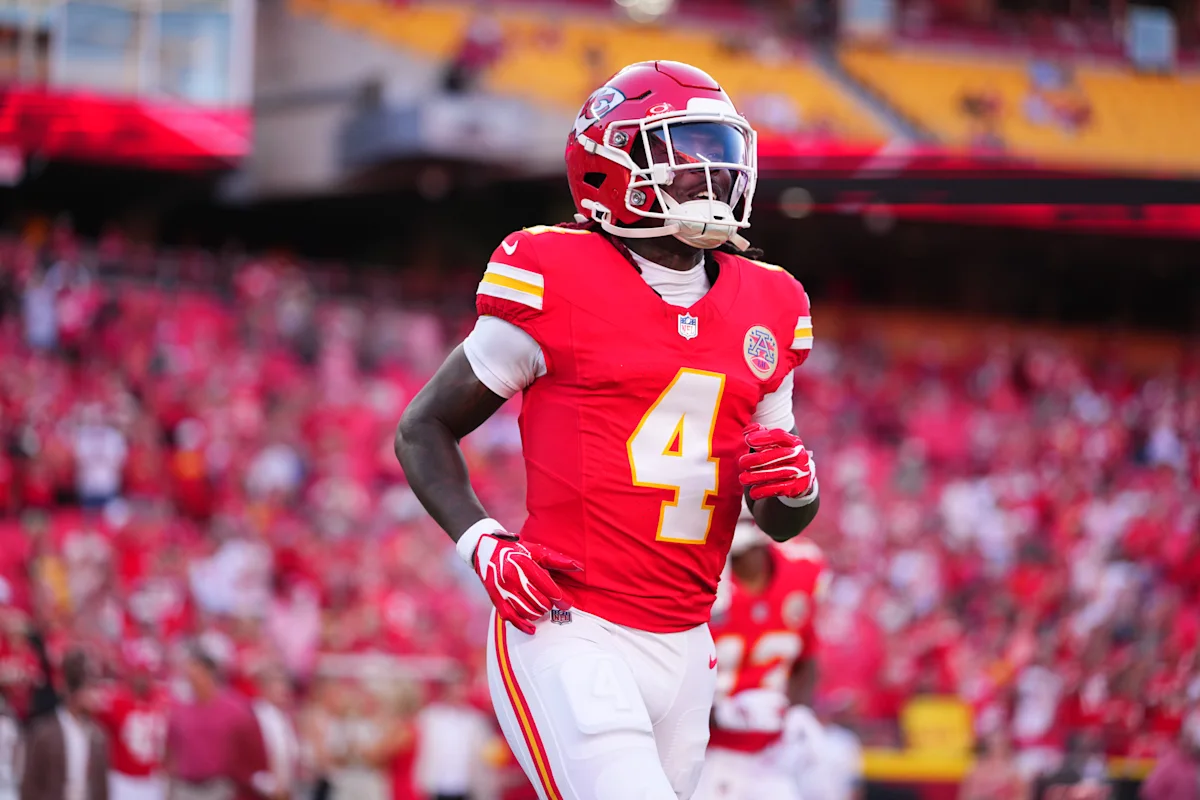
Rashee Rice, WR, Chiefs — 53.5 projected receiving yards
– Avg. positional rank: 20.6; Highest: 11; Lowest: 29; Range: 18
Rice scored a 13-yard TD on a screen in Week 1, shaking off two defenders, but outside of that play he managed just six yards on 26 non-screen routes. The Chiefs’ offense ran fewer neutral pass plays than its recent norm — about a 48% neutral pass rate in Week 1 versus roughly 58% across the prior three seasons — partly because Kenneth Walker dominated the game script; that reduction in passing volume hurts Rice’s PPR upside. The passing game stayed short and methodical, though, and Rice looked okay physically after a second knee procedure this offseason. His Week 1 box looks light: a 3.3 expected half-PPR points (WR88) and only an 8% target share, which is concerning for players who drafted him in the third round.
The Colts played a lot of man coverage (56%) in Week 1 — the matchup style that tends to limit Rice — and their rookie third-round CB Justin Walley returned from injury and struggled. The matchup on paper is reasonable, but Rice needs to prove he can be effective in man coverage. The Chiefs project for 26.5 points (sixth) at home.
Jeremiyah Love, RB, Cardinals
– Avg. positional rank: 23.6; Highest: 19; Lowest: 28; Range: 9
Love looked outstanding in his NFL debut despite limited practice time from a preseason ankle issue, displaying sudden cuts and burst that made him look like a future Pro Bowl-type runner. There’s a clear talent gap between him and Tyler Allgeier.
Initially Love played as the 1B behind Allgeier, who received the lone carry from inside the five, but that split should tighten and eventually flip the other way. The Cardinals’ offense looked competent rather than bottom-tier, which bodes well for Love’s longer-term role. He finished with 13.2 expected half-PPR points, profiling as a boom-or-bust RB2 for now; he’ll see more targets when games are close or when Arizona is trailing. Allgeier moved into a “close-out” role late in Week 1.
Aaron Jones Sr., RB, Vikings — 80.5 projected total yards
– Avg. positional rank: 24.2; Highest: 19; Lowest: 35; Range: 16
With Jordan Mason (finger) placed on IR, Jones becomes the clear lead back, with DeeJay Dallas (six snaps in Week 1) and sixth-round rookie Demond Claiborne (a healthy scratch Week 1) as secondary options. Jones is likeliest to get goal-line touches and the clock-killing carries late in games. Since 2024, in games Mason missed, Jones has graded out to roughly RB21 in half-PPR scoring on RB12 usage — a usable floor. The Vikings’ offensive line appears improved in 2026, and their upcoming month of opponents (Bears, Bucs, Dolphins, Saints) offers a window for Jones to emerge as an RB2.
Chicago’s defense has been vulnerable to the run — they allowed 131.1 rushing yards per game in 2025 (sixth-worst) and were torched in Week 1, which supports Jones’ short-term upside.
Rome Odunze, WR, Bears — 39.5 projected receiving yards
– Avg. positional rank: 27; Highest: 19; Lowest: 33; Range: 14
Odunze ran routes on just 53% of dropbacks in Week 1 after a week of limited practices with a calf issue, but he was off the injury report this week and should see increased playing time. In last season’s playoff game — shortly after his injury — he ran routes on 85% of dropbacks, which suggests 53% was a low-end outlier. When he’s near full-time, Odunze has graded out around WR32 while operating at WR15 usage in half-PPR scoring.
He’s been underperforming his usage and should be due for better returns in this offense. Matchups versus the Vikings have produced mixed outcomes — Odunze hasn’t topped 50 yards in four games against them — but Minnesota’s secondary looked shaky in Week 1 and the Bears project for 26.5 points (sixth), making me more bullish on Odunze than many are.
Matthew Golden, WR, Packers — 49.5 projected receiving yards
– Avg. positional rank: 30.6; Highest: 22; Lowest: 37; Range: 15
Golden is emerging as a sleeper. He ran a route on 92% of dropbacks and functioned as a more explosive complement to Romeo Doubs, finishing with a very strong Week 1 usage profile. His 29% target share last week is unlikely to be sustained, but even a regression still leaves room for significant production if Green Bay maintains a faster neutral pace (they were second in Week 1) and a healthier neutral pass rate (they were eighth in Week 1). Jordan Love looked sharp throwing the ball, which helps Golden’s case, though Green Bay’s offensive line remains a concern. Golden ranked as the team’s WR2 in usage last week.
The matchup is favorable: the Jets lack a proven top outside corner, and safety Minkah Fitzpatrick is listed on the injury report. The Packers project for about 24.0 points (13th), supporting Golden as a high-upside play.
Fan Take:
These early usage and health signals matter because they show which young players are earning real roles now, not just on paper — that can reshape fantasy drafts and fantasy-provider narratives for the season. For the NFL as a whole, seeing rookies and young breakouts seize meaningful snaps (or veterans step into more work) signals roster shifts that can influence team strategies and game plans throughout the year.
Source: sports.yahoo.com