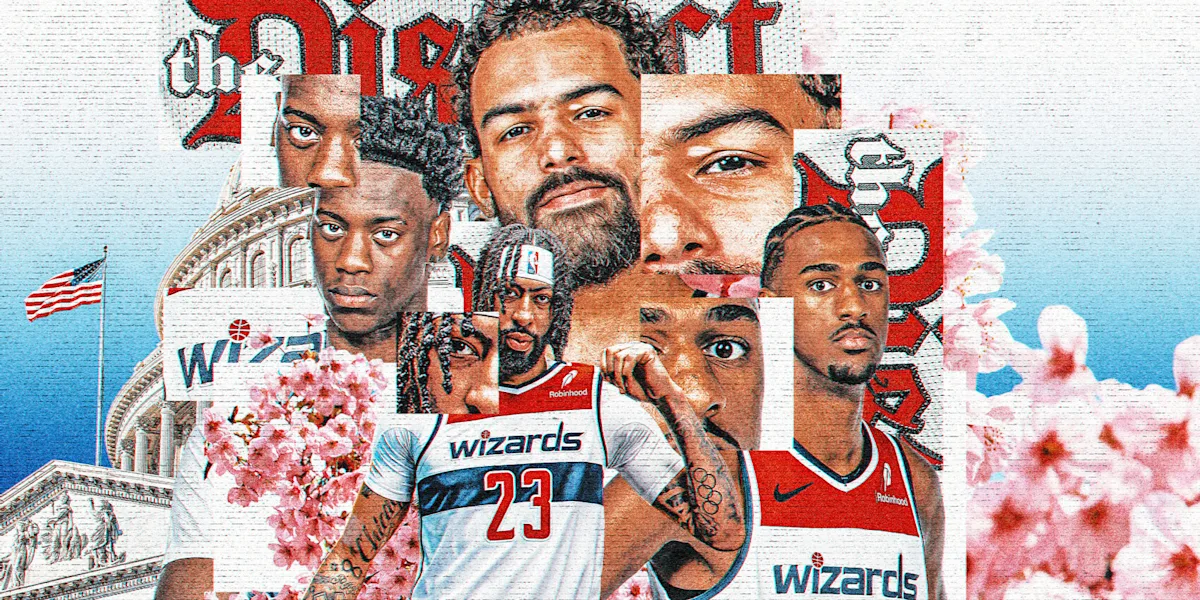
Over the past several seasons, the Washington Wizards focused on rebuilding by losing games, but now they’re aiming to both win and nurture young talent simultaneously. Their roster is a striking mix of youth and experience, as veterans like Trae Young, Anthony Davis, Khris Middleton, and Deandre Ayton join forces with promising youngsters still finding their footing. This dual approach creates a unique challenge, where the seasoned players could either speed up the development of the youthful core or hinder it—making Washington’s experiment one of the NBA’s most intriguing team projects.
The Wizards boast a deep pool of prospects drafted during a stretch when the team won only 50 games combined: AJ Dybantsa, Tre Johnson, Alex Sarr, Kyshawn George, Will Riley, and Bub Carrington. While the talent level is promising, managing so many players’ roles will be complex. Trae Young, acquired midseason from the Atlanta Hawks and rewarded with a significant four-year, $212 million contract extension despite playing only five games that period, holds a pivotal role in this balancing act.
Young has built his career as the focal point of his team’s offense, excelling in pick-and-roll situations and creating shots for teammates. A four-time All-Star, he led the Hawks to the Eastern Conference finals in 2021, though that marked the peak of their success amid coaching and roster changes until their eventual rebuild. Washington must avoid turning into another “Trae Young Show.” Even if the Young-Davis pick-and-roll becomes a reliable weapon, the offense needs to make space for young players to experiment, learn, and grow. Young’s adaptability and willingness to evolve will be crucial to the team’s future.
A key question is whether Trae can learn how to contribute off the ball. Early comparisons to Steph Curry and Damian Lillard were due in part to his ability to use screens and move without handling the ball, but in the NBA, this off-ball movement has been rare. Clips from his college days at Oklahoma reveal a player who actively ran screens and relocated to find open shots—skills that made him an attractive draft prospect. Yet, in the NBA, Young averages just 0.4 shots per game off off-ball screens, far below Curry and Lillard. While his efficiency in these spots is comparable to Lillard’s, he leans heavily on creating off the dribble, taking nearly four times as many pull-up threes as catch-and-shoot attempts despite better shooting accuracy in spot-up situations. For Washington’s sake, Young must become more versatile, incorporating off-ball playmaking into his game.
On the veteran front, the Wizards’ first overall pick, AJ Dybantsa, stands out. At 6-foot-9 with a proven scoring knack, Dybantsa averaged 25.5 points per game as a freshman and displays skills beyond scoring, such as passing—hinting at point forward potential. His development alongside Young will be especially critical. Dybantsa shouldn’t be relegated to a secondary role simply because Young currently runs the offense better. A harmonious balance could accelerate Washington’s journey toward consistent winning basketball.
Similarly, Khris Middleton should serve as a mentor rather than a minutes obstacle for emerging talents such as Tre Johnson, who showed impressive midrange shooting last season and could benefit from Middleton’s guidance extending his range and attacking angles. Kyshawn George, with his versatile skill set and impactful performances before an early-season injury, also deserves ample playing time to explore how his game translates on a winning team.
Anthony Davis is expected to bolster the frontcourt alongside Alex Sarr, providing size and experience that could enhance the Wizards’ defense—a sore spot for the franchise for over a decade. However, extension talks and health concerns linger, and questions remain about his durability and fit. The ideal scenario involves Davis anchoring the defense while Young shares offensive responsibilities, allowing the young players freedom to grow. Conversely, injuries or distractions could stifle progress, forcing Young to dominate touches and limiting the younger players’ development.
The Wizards’ attempt to concurrently compete and cultivate their young core makes them one of the NBA’s most unpredictable and exciting teams. For the first time in years, watching Washington offers genuine intrigue and stakes.
Fan Take: This pivotal phase for the Wizards matters because it challenges the conventional rebuilding timeline, blending immediate competitiveness with player development. If successful, it could inspire a new model for NBA teams to cultivate stars while staying relevant, ultimately enriching the sport’s competitive landscape.
Source: sports.yahoo.com