
Week 2 is over — and it brought surprise outcomes (Raiders beating the Chargers, Browns beating the Bucs) and major injuries (Commanders QB Jayden Daniels, Giants QB Jaxson Dart). Week 3 is shaping up as another uncertain slate.
Each Tuesday during the NFL season I’ll offer seven quick thoughts that sit somewhere between prediction and reaction. These aren’t full forecasts or definitive conclusions from last week’s games; those come later. Instead, they’re tentative ideas that might prove true but probably need a few more games to confirm. At the end I’ll drop a few shorter, half-formed impressions I can’t stop thinking about.
This week I’m focused on a recently signed high-priced QB contract that already looks shaky, one AFC contender I’m worried about and a couple I’m not. Here are seven things I’m thinking heading into Week 3.
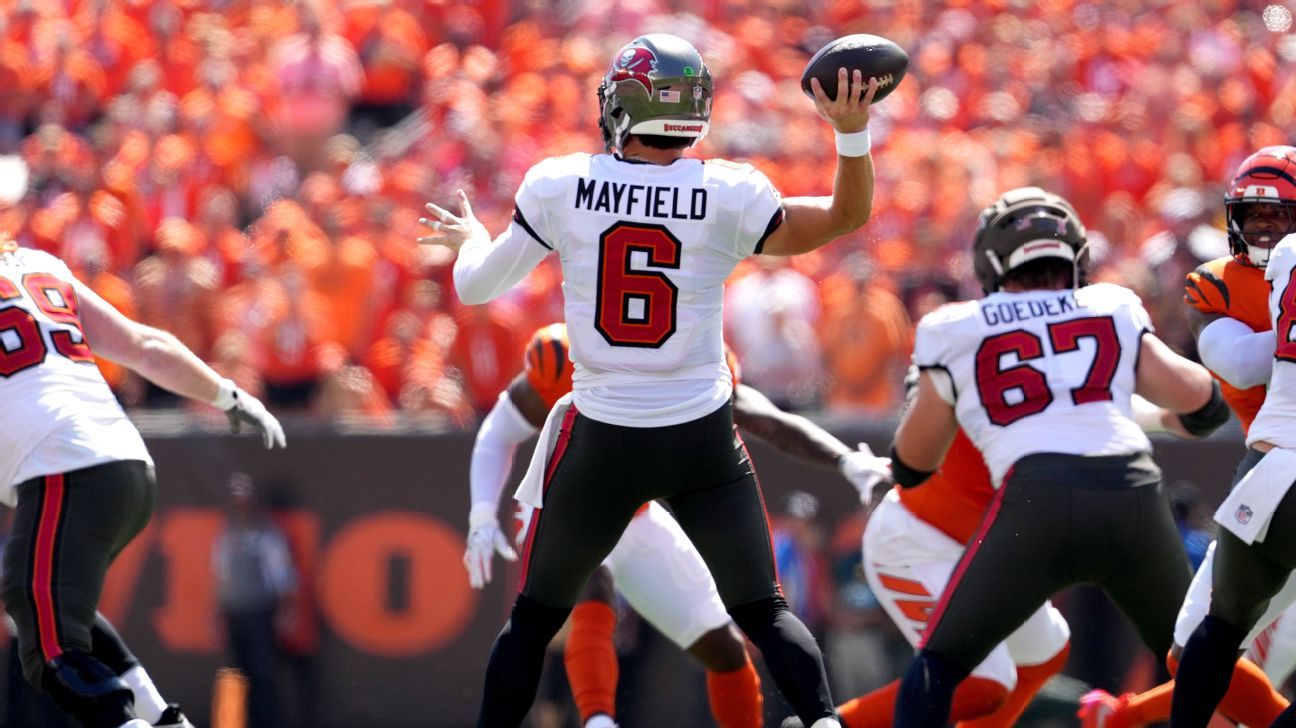
Bucs may regret the Baker Mayfield contract
Baker Mayfield’s start to the season hasn’t inspired confidence. Two games are a tiny sample, but the Bucs’ decision to extend him so soon now looks questionable. The three-year deal (effectively two years plus a substantial 2029 option) puts him near the top of the quarterback pay scale, in the company of Stafford and Lawrence on average annual value — money usually reserved for consistently elite starters.
Through two games Mayfield ranks near the bottom of quarterbacks in EPA per dropback and success rate. Even stretching the sample back to 2025, he sits in the lower half of the league. You can point to his 2024 season under coordinator Liam Coen as his peak — since then his production has waned. A big reason: he relied a lot on plays under pressure and his mobility, scrambling often to extend plays. That approach produces huge plays but also volatile results and plenty of hits; with age and accumulated damage, that dynamic can fade.
This year the Bucs have cut his scramble rate almost in half by scheming more short throws, but his sack rate is still worrying. Some of his mistakes are technical — climbing the pocket when he could stand and throw, hesitating on throws he should make — and others are schematic or miscommunication-based. There were several plays this week that illustrated these issues: concepts that should have been quick completions instead turned into sacks or missed opportunities.
The core concern: the Bucs bought a late-career quarterback who depends on athleticism and chaotic playmaking. Paying hefty guaranteed money for that profile offers high upside but makes the inevitable down stretches painful for a team. They could have waited for another season of data before sealing the deal; now they’re committed and the early returns are mixed.
Chargers are headed toward a top-10 pick in 2027
It’s hard to find 10 teams worse than the 0-2 Chargers right now. Everything about the team looks disorganized. The interior offensive line remains a mess, star tackles don’t look fully recovered from last year’s injuries, and the rushing game has no pop — the Chargers’ yards before contact per carry is among the league’s worst.
Justin Herbert is frequently under pressure, often looks uncomfortable and sometimes hesitates to take big shots downfield. Receivers are failing to consistently create separation, and the team is committing penalties and turnovers at an alarming rate. They fumbled an absurd number of times in Week 2, and overall their turnover differential has handed away win probability.
Defensively, the plan to limit explosive plays is working in a broad sense, but the Chargers are suffering small breakdowns that add up: they’re giving up more yards than they should on tight-window throws because their defensive backs aren’t consistently contesting catches. Also, the penalty of a tough upcoming schedule — Buffalo, Seattle, Denver, Kansas City, Rams, Houston, Baltimore — could turn a rough start into a lost season. Even a best-case run through those opponents would likely leave them with a losing record. If they collapse, they not only risk a high draft pick but also undermining Herbert’s trust in the organization.
Patriots’ offense is fine, even if public opinion isn’t
New England’s game against Pittsburgh was a modestly efficient performance, roughly in line with their recent averages. People are quick to use a couple of shaky games to declare Drake Maye “exposed,” but that’s reactionary. He played well last year and has shown an ability to elevate the offense; facing several top defenses in a row will make any quarterback look worse for stretches.
Turnovers were the main blemish against the Steelers: a Rhamondre Stevenson fumble that opened the door for TreVeyon Henderson to get a big run, and a Maye interception created by pressure. Still, Maye offered positive plays with his legs and hit some downfield shots despite absent top receiver A.J. Brown and poor weather. The bigger point: the Patriots have played a brutal run of opponents since last season, so critiques about “truth” versus “easy schedule” are overblown. The next test, a matchup with the Jaguars, will be telling. Maye needs a strong showing to prove the offense’s floor remains high, especially as injuries pile up.
Jalen Hurts appears to be adapting to Sean Mannion’s offense
I’m mixed on the Eagles as a whole — their offensive line and running game look worse than last season — but Jalen Hurts had a very impressive individual performance in Week 2. With the rushing attack largely neutralized, Hurts converted a boatload of third downs and delivered several high-leverage throws, including intermediate in-breaking passes between coverage levels that he previously underutilized.
One of the offense’s aims under Mannion is to open those inter-number intermediate windows more often, and Hurts’ willingness to attack that area is a positive sign. Other features of the new scheme — more under-center work and play-action — are still being installed. If Hurts continues to make plays through the air while the line and run game heal, the Eagles can limp through early-season issues and get healthier in time for a deeper push. Monday night’s matchup with the Bears is an opportunity for Hurts to keep building confidence.
Jaguars’ trenches could derail postseason hopes
The Jaguars’ offense — and Trevor Lawrence’s aggressive passing — remains exciting, but their offensive line performance against Denver was concerning. Lawrence was under pressure on nearly half his dropbacks in that game, completing far fewer passes when pressured than when clean. Denver’s pass rush earned quick wins across the front, and Jacksonville lacked consistent protection.
On the defensive side, the Jaguars don’t yet have a dominant interior pass-rush presence. They rely heavily on Josh Hines-Allen, but he was largely shut down against Denver. Overall pressure rates have been low, and the team lacks a deep, disruptive defensive tackle duo that playoff-caliber teams often have. If the Jags are to go deep in the postseason, they need to win the trench battles; otherwise opponents can beat them by collapsing the pocket or controlling the line of scrimmage. Adding a top interior rusher before the trade deadline could be the missing piece.
More Derrick Henry runs won’t fix Ravens’ late-game meltdowns
Baltimore’s recent losses when holding significant leads remain a glaring concern, and fans used to blame coaching in the past. The Ravens’ collapse against the Saints isn’t the archetypal “blown 15-point lead” loss, but it’s another close finish where late-game execution faltered. Some critics insist that more Derrick Henry carries would fix these collapses, but the real issues are a combination of offensive limitations, injuries (notably to the receiving corps and offensive line), and defensive second-half adjustments.
Henry’s presence helps in certain late-game situations, but the Ravens’ problems are broader: inconsistent pass protection, an offense too reliant on one receiver, and a defensive unit that can be out-schemed. The upcoming stretch of easier opponents gives Baltimore a chance to rebuild rhythm and confidence, but simply giving Henry more touches isn’t a silver bullet.
Aaron Donald’s retirement workout paid off
Aaron Donald flashed in his return — 32 snaps at age 35 after being out for over two years is remarkable. He looked explosive on the first step, disrupted blocking schemes and impacted the run game even if his pass-rush production was modest in this outing. He earned consistent sub-package snaps and won several reps; conditioning over a full season remains a question, but his initial form suggests his intense offseason training worked.
While the box score didn’t show many pressures, that can be attributed to game script, conservative rotation and the rust that follows a long layoff. But when Donald’s first step and quickness are present, he remains a difference-maker who alters opponents’ blocking plans and creates opportunities for teammates.
Five shorter, speculative takes
– I’m unsure what to make of the Panthers. Two weeks have produced wildly different scripts (a blowout loss, then a win against backups). Their pass-catch group looks promising, but I’m reserving judgment until we see steadier competition and quarterback play.
– The Packers’ season feels fragile. They escaped an 0-2 hole but lost key players to injury and have depth concerns; a modest bounce against the Falcons could temporarily paper over bigger issues.
– If Jayden Daniels misses extended time, the Commanders may pivot to a different long-term QB plan in 2027. He’s getting more testing and opinions on his elbow; availability will determine how the team approaches the future.
– Dexter Lawrence II has been a force stuffing runs for the Bengals — his impact deserves more recognition, and if the Bengals’ defense keeps playing like this, he should be in Defensive Player of the Year conversations.
– The Bears’ running game and Tyson Bagent’s steady backup play make Monday night a plausible upset spot against the Eagles, whose run game is currently nonexistent.
Fan Take (two sentences)
These early-week observations matter because small roster moves, health developments and coaching adjustments over the next few weeks will reshape playoff outlooks and the trade/contract calculus across the league. For fans, the season’s early volatility — from surprising upsets to injury-driven uncertainty — is both frustrating and thrilling, and it’s what makes the NFL’s narrative so unpredictable and compelling.
Source: www.espn.com