

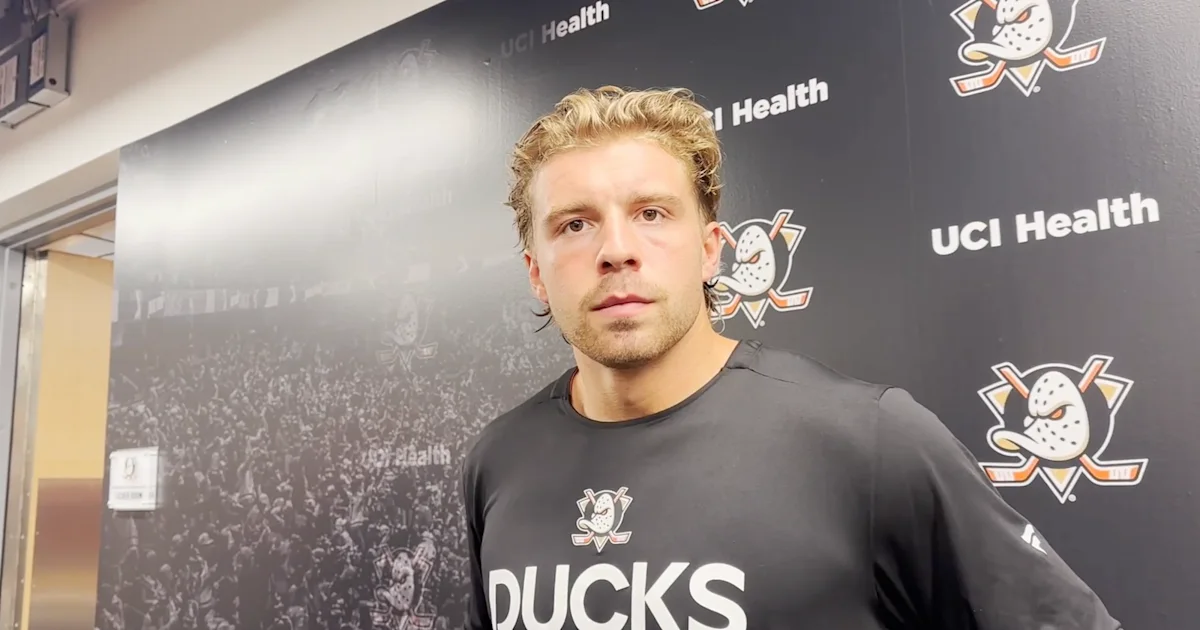
Just shy of 24 hours before the start of what promises to be the most unpredictable offseason in Anaheim Ducks history, general manager Pat Verbeek pulled off a notable move by announcing the extension of young defenseman Tristan Luneau’s contract. The team revealed that Luneau, aged 22, would be signed for six years at an average annual value of $7.2 million, with the deal taking effect starting in the 2027-28 season.
This announcement immediately sparked skepticism across the hockey community, with many questioning whether Luneau truly deserved such a significant contract given his limited NHL experience and relatively modest resume. So, who exactly is Tristan Luneau, and why did the Ducks choose to secure his services with such a long-term deal?
Luneau, who was drafted 53rd overall in 2022, was a second-round pick by the Ducks. His youth hockey days included being a first overall selection in the 2020 QMJHL Draft by Gatineau Olympiques. However, a recurring knee injury after his 2020-21 season hampered his draft year production, where he recorded 43 points in 63 games, causing him to slip into the second round. In the 2022-23 season, he rebounded strongly, posting 83 points in 65 games and earning the QMJHL Defenseman of the Year award.
The Ducks initially intended for Luneau to start his career in the NHL with possible AHL conditioning later, especially to prepare for international duty at the 2024 World Junior Championships. Unfortunately, an infection in his leg prevented him from participating, and he only played 13 games between the NHL and AHL that season. Over the next two seasons, he developed primarily with the San Diego Gulls in the AHL, racking up 95 points across 135 games, and contributed four points in 14 NHL appearances prior to signing this new contract.
Given his physical attributes—standing 6-foot-1 and weighing 211 pounds—and his versatile skill set, Luneau possesses the tools to be a top-tier defenseman in the NHL. He’s capable with the puck, displaying agility, smart decision-making, and offensive flair, along with a strong defensive game characterized by tight gap control and active stick work. Over several years, he’s steadily refined his skills and bulked up physically to match the demands of pro hockey, making him arguably as ready as any defense prospect to make a significant impact.
Pat Verbeek highlighted the importance of locking in Luneau long-term, stating, “Signing Tristan to a long-term contract was a priority as we see him as a top-four defenseman for years to come.” The move signifies Anaheim’s belief in Luneau’s potential to be a cornerstone of their defense core.
The Ducks have been highly active in the 2026 offseason, following a period of rebirth that was disrupted by an unexpected offer sheet for franchise player Leo Carlsson. This led to a wave of signings, including larger-than-anticipated contracts for key restricted free agents like Carlsson, Gauthier, and Mintyukov, alongside a roster shake-up that saw the departure of several veteranjers.
With many veteran defenders leaving, Luneau’s anticipated role on the top pairing—playing alongside Jackson LaCombe, running power play units, and contributing on penalty kills—looks poised to accelerate his development and showcase his talent. Verbeek has a reputation for being a savvy negotiator, especially with RFAs emerging from their entry-level contracts, a strategy that proved challenging in previous negotiations involving players like Zegras and Drysdale.
This time, Verbeek moved quickly, especially with Carlsson’s controversial five-year, $18 million AAV offer sheet from Philadelphia, leading the Ducks to secure Mintyukov’s extension and Gauthier’s sizable deal to prevent further roster upheaval. During training camp, Verbeek committed to being more proactive with his negotiations, aiming to lock in key young players before situations become more complicated.
Luneau’s recent extension is a clear example of this proactive approach. If he performs well in the upcoming season, especially given his age and the terms of the deal, he could easily surpass the AAV he’s earning now, potentially reaching a higher value as his career progresses. It’s a calculated investment—some might see it as an overreach, but given the rising salary cap projections, securing a young, talented player like Luneau early on could pay dividends during his prime years.
This signing shines a spotlight on the Ducks’ aggressive approach in building their future core, embracing young talent and risk to secure long-term value. For hockey fans, it underscores the growing trend of prioritizing youth and upside in NHL roster construction, signaling a shift in how teams are betting on potential rather than just proven experience.
Fan Take: This move is exciting because it shows the Ducks are willing to take risks on promising young players, which could lead to a very dynamic and competitive team in the coming years. It also highlights an evolving NHL where front offices are increasingly willing to invest early in the next generation of stars, giving fans hope for a bright future.
Source: sports.yahoo.com