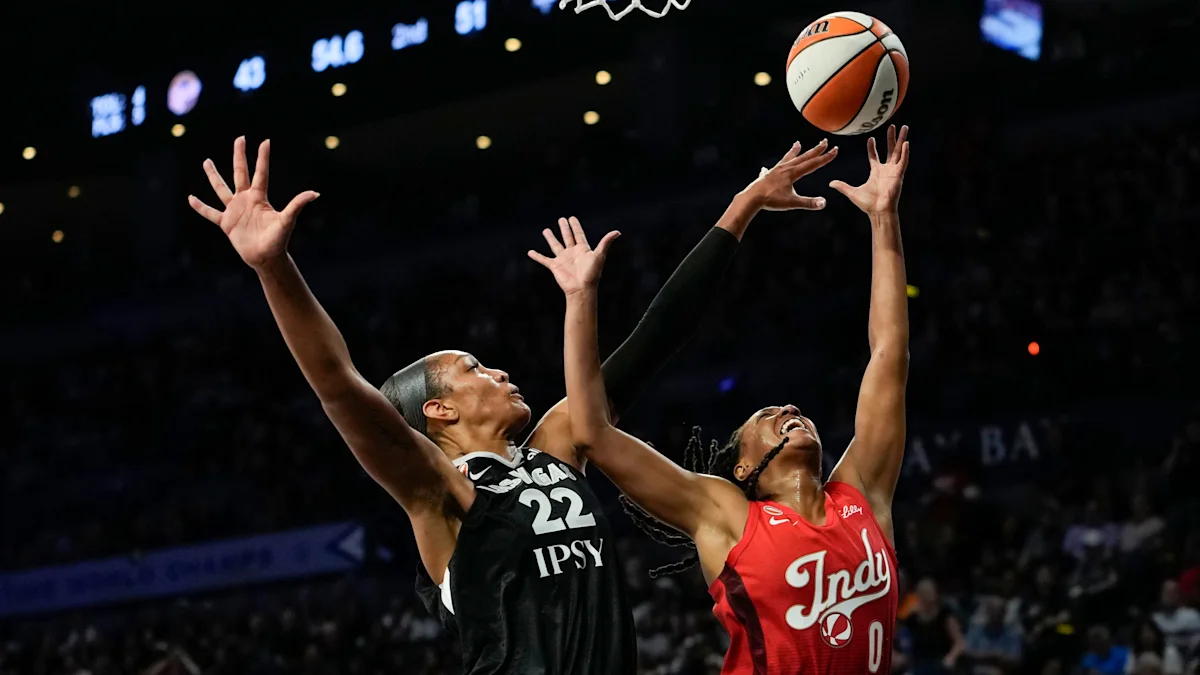
In a 20-minute end-of-season interview, Indiana Fever COO and GM Amber Cox was asked if she had any regrets about offseason decisions. She simply replied “No,” barely acknowledging the question before the next was posed. Similarly, Las Vegas Aces coach Becky Hammon, following a 99-89 Game 3 victory that eliminated Indiana in the first playoff round, denied any parallels between the Fever and the Aces teams she inherited in 2022. She stated, “No. I think that team has great potential, but… it’s different.”
The Fever’s core trio was built through the draft, selecting Kelsey Mitchell at No. 2 overall in 2018, followed by Aliyah Boston and Caitlin Clark with back-to-back No. 1 picks in 2023 and 2024. The Aces’ top three of A’ja Wilson, Jackie Young, and Chelsea Gray were already in place when Hammon arrived, supported by players like Kelsey Plum and Dearica Hamby who helped lead them to the 2020 WNBA Finals under former coach Bill Laimbeer. Gray joined a year later via free agency and was Finals MVP when Hammon guided the team to its first championship in 2022.
Though Hammon once led a trio of consecutive No. 1 overall picks similar to the Fever’s current roster, she is correct in noting the Fever must evolve further to become a consistent championship contender like the Aces. Here’s a breakdown of their similarities and differences:
Common Ground: Both teams boast strong offensive firepower and a competitive spirit. While the Fever have Boston and Clark, the Aces brought in Wilson and Young as back-to-back No. 1 picks in 2018 and 2019, achieving a Finals appearance and two semifinal runs within three seasons. Other pairs of No. 1 overall picks, like Seattle’s Jackson-Bird and Loyd-Stewart, experienced similar success by their third seasons.
Offensively, the Fever shine uniquely with Clark and Mitchell combining this season for a league-record 47 points per game while both earned first-team All-WNBA honors. In the frontcourt, Boston shares a similar pedigree with Wilson, both NCAA champions under Dawn Staley in 2018, and both earned WNBA Rookie of the Year awards.
Most critically, the Fever display the competitive edge and team makeup that have become trademarks of the dominant Aces. Fever forward Myisha Hines-Allen, a 2019 WNBA champion with the Mystics, praised the Fever’s balanced roster, highlighting their “Big 3” complemented by solid role players like 2022 No. 6 pick Lexie Hull and forward Makayla Timpson. This echoes the team-first, winning mentality Hines-Allen experienced with the Mystics — a focus on collective success over individual glory.
What Separates the Aces: Cox candidly acknowledged that the Fever need to reach the Aces’ level of championship contention. She called the Aces a “buzzsaw” and recognized the need for the Fever to learn, grow, and meet high expectations annually.
Aside from star power led by four-time MVP Wilson, the Aces’ advantage lies in their playoff experience, accumulating 184 combined postseason games among Wilson, Young, and Gray. In contrast, the Fever’s key players have just 31 playoff appearances, with Clark gaining five after missing 2025’s postseason.
The Aces’ ability to retain their core nearly intact until Plum’s trade request in 2025 shows impressive roster stability. For the Fever to close the gap, retaining unrestricted free agent Mitchell and strategically building around their Big 3 in free agency will be essential, especially as the Aces, despite injury challenges, battle the No. 2-ranked Valkyries in the semifinals.
Originally published on USA TODAY: The Fever have their Big 3. Becoming the Aces is the hard part.
Fan Take: This story matters because it highlights how difficult it is to transform raw talent into a perennial dynasty in the WNBA. For fans, the Fever’s journey illustrates the exciting but challenging road ahead as they strive to join the elite ranks, promising a thrilling evolution for the league’s competitive landscape.
Source: sports.yahoo.com