

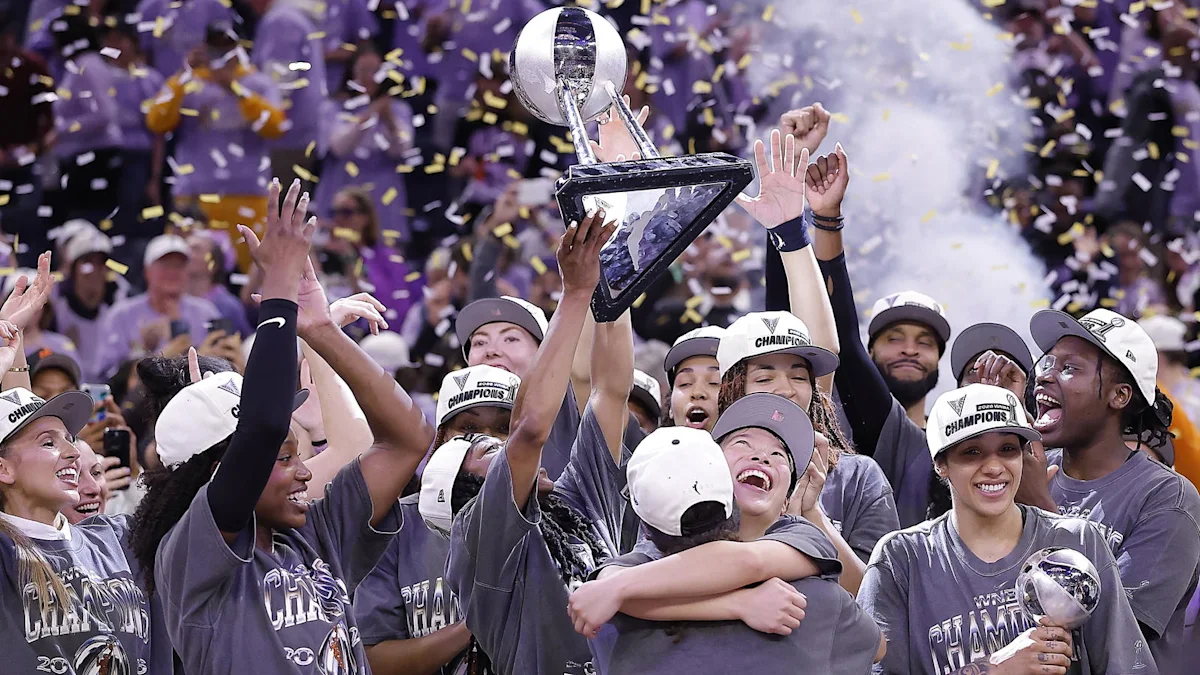
The Golden State Valkyries secured a 68-63 victory over the Atlanta Dream in a thrilling Game 7 of the WNBA Finals, attracting an estimated 3.3 million viewers on Saturday night across USA Network, CNBC, and Peacock, according to early data. Colin Salao from Front Office Sports shared the numbers Tuesday, referencing sources along with Nielsen and Adobe Analytics, with official figures expected soon.
“If these numbers hold, it would mark the highest viewership for any WNBA game — regular-season or playoffs — since the league’s inception in 1997,” Salao noted. Versant, in its first year holding WNBA broadcasting rights, aired five of the seven Finals games on USA Network and CNBC.
Versant CEO Mark Lazarus expressed satisfaction during the company’s Q3 earnings call on Tuesday, stating, “We showcased the most national WNBA games of any broadcaster, with regular-season cable viewership rising 25% compared to last year. The Game 7 final on USA Network drew a preliminary audience of 3.3 million — a tremendous achievement.”
In the game itself, the Dream struggled off the bat, missing their first nine shots at San Francisco’s Chase Center. Atlanta finally got on the board with Angel Reese’s putback at 4:41 in the first quarter, and they led 30-24 at halftime. Gabby Williams was dominant for Golden State, scoring the last 13 points of the third quarter and helping the Valkyries win that period 21-14.
In the late moments, Allisha Gray drilled a three-pointer with 34.2 seconds remaining to tighten the score to 64-60, and her free throws with 10.5 seconds left brought Atlanta within three. Williams finished with 30 points—28 of which came after halftime—and earned Finals MVP honors as Golden State captured the championship in just their second season.
“Gabby is our closer; she remained calm and focused,” Valkyries coach Natalie Nakase told The Associated Press. “To close with 30 points is just incredible.” Jordin Canada led the Dream with 18 points, but the team struggled from beyond the arc, hitting only 6 of 30 three-point attempts.
The WNBA Finals average viewership across all seven games was 1.89 million, which Salao highlighted in a follow-up post, calling it the most-watched Finals ever. The detailed breakdown was as follows: Game 1 drew 2.1 million viewers, Game 2 had 1.33 million, Game 3 attracted 1.71 million, Game 4 pulled in 1.9 million, Game 5 totaled 1.4 million, Game 6 reached 1.5 million, and the final Game 7 peaked at 3.3 million viewers.
NBC Sports declared the Game 1 audience on October 17, a Saturday afternoon tip-off, the largest ever for a Finals opener. Game 6, held at a midday Thursday slot in Atlanta’s State Farm Arena, saw the Dream win 80-69 after a strong early lead. Despite that, Golden State battled back to cut the deficit to single digits late in the game.
After Game 6, Valkyries guard Veronica Burton admitted, “Games 2 and 3 were rough, and we quit. But we didn’t give up this time.” USA Sports reported that Game 6’s audience of 1.5 million across multiple channels surpassed the 2025 Finals clincher viewership by 4%.
The Game 7 ratings nearly approached Caitlin Clark’s 2026 regular-season high, when she scored 37 points in Indiana Fever’s 113-90 win over the Chicago Sky, which drew 3.31 million viewers on NBC and Peacock. According to NBC Sports, no regular-season WNBA game had attracted such numbers since 1997.
Clark commented on the rising ratings in an interview: “It’s super cool. Even during college, you don’t always realize how many people are actually watching.” Back in 1997, NBC aired the league’s first weekend games, which remain the only regular-season contests to draw more viewers than the Fever-Sky matchup.
Three WNBA games exceeded three million viewers before 2000, including Game 3 of the 1999 Finals, where the Houston Comets secured their third straight title before 3.25 million viewers. Should the current preliminary Game 7 figures hold, this would surpass that 1999 record.
Looking ahead, 2027 will mark the second year of USA Network’s 11-year broadcasting contract with the WNBA.
Fan Take: This surge in viewership represents a major milestone for the WNBA, signaling growing fan interest and mainstream recognition of women’s basketball. For passionate followers, these numbers promise increased investment in the league, higher visibility for players, and a bright future for the sport at all levels.
Source: sports.yahoo.com
