

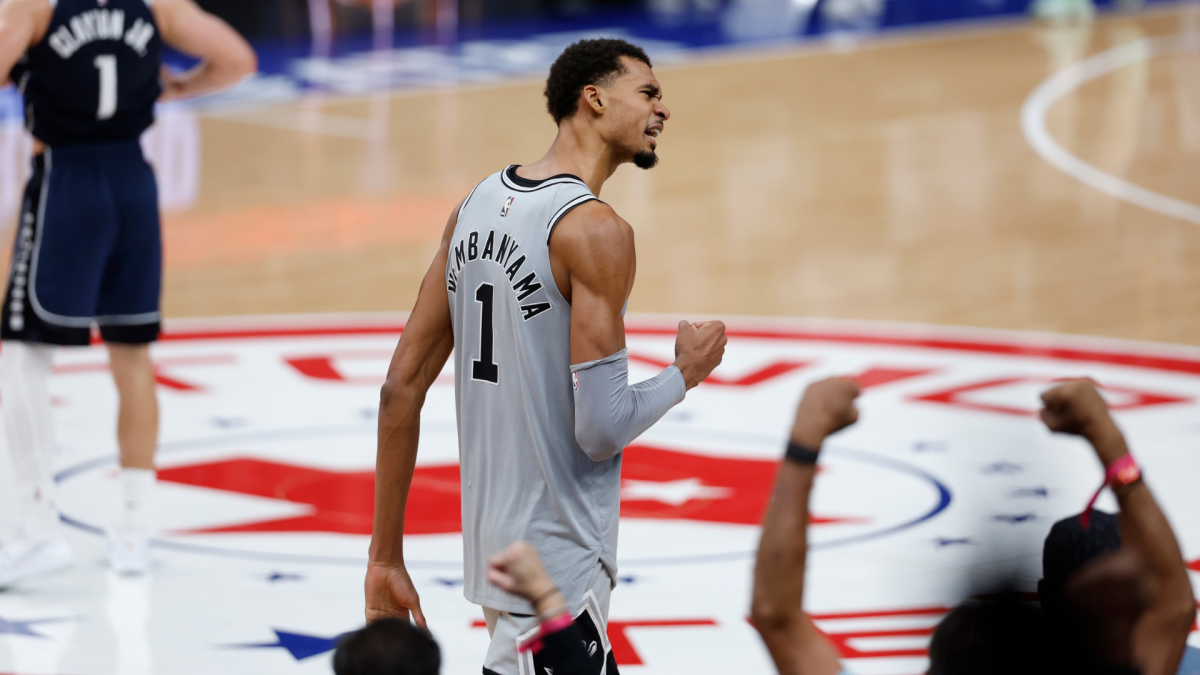
Victor Wembanyama stumbled in his season opener with a poor shooting performance, going 1-for-13 in a loss to the Thunder, which led me to declare that the San Antonio Spurs’ initial optimism was fading. While this was a dramatic statement intended to reflect the typical early-season overreactions, it contained some truth; last season, the Spurs exceeded expectations by winning 62 games, knocking out the defending champs in the conference finals, leading most of the NBA Finals, and seeing Wembanyama earned Defensive Player of the Year and finished third in MVP voting — all without high expectations. This year marks a new chapter where skepticism replaces the benefit of the doubt. After his rough start, critics questioned if he was prematurely hailed a star, citing his lack of a reliable shot or preferred scoring spot. But Wembanyama was harsher on himself, acknowledging his hesitancy and saying he needed to “go back to playing the basketball I like.” “I have no reason to hesitate, no reason not to be myself,” he admitted. “I play my best when I’m having fun.”
Since then, Wembanyama’s confidence has soared. Over his last seven games, he’s averaged 31.4 points, 12.2 rebounds, and 4.3 blocks on 52% shooting. After starting 0-2, the Spurs have surged, winning six straight games, including a thrilling 112-111 victory over the Mavericks. Despite Dallas erasing a 19-point lead late, Wembanyama was unstoppable, scoring the Spurs’ final seven points, including the game-winning free throw. His stat line—52 points, 24 rebounds, and eight blocks—was historic, marking the first time since Bob McAdoo over 50 years ago that a player reached those numbers. In fact, when considering a threshold of 50 points, 20 rebounds, and eight blocks, only Wilt Chamberlain had done so beforehand, with his numbers registering before blocks were officially tracked.
Wembanyama stands out as the only player to have multiple games with at least 40 points and five blocks before turning 23, and he’s joined an elite group featuring Hakeem Olajuwon, David Robinson, and Patrick Ewing as the fourth player ever to record at least 200 points and 30 blocks through the first eight games of two straight seasons.
While it’s clear that Wembanyama is a dominant force expected to showcase historic performances, what’s particularly interesting is the way he’s producing this season by focusing more around the basket. Last postseason, his offensive game was somewhat erratic, often relying on perimeter moves and jump shots, which, given his towering 7-foot-4 (likely closer to 7-foot-6) frame, sometimes played into defenses’ hands. Throughout the playoffs, he oscillated between operating from the outside and inside the paint. For example, during the Finals’ first two games, he took more shots outside the paint than inside, a factor that helped the Knicks take a 2-0 series lead. But in Game 3, he shifted gears, taking the majority of his shots inside the paint and leading the Spurs to a blowout win.
Although his shot selection won’t always directly correlate with wins, Wembanyama is clearly more purposeful about getting closer to the hoop this year. He’s increasing his shot attempts by about five per game compared to last year, mainly from inside the paint, now taking 42% of his shots within three feet, up from 33% previously. His average of 5.1 dunks per game puts him on course to shatter Rudy Gobert’s NBA record of 302 dunks in a season.
This evolution isn’t about posting up traditionally—something Wembanyama can’t reliably do yet—but about deliberately positioning himself near the basket by using rim rolls, crashing offensive boards, and choosing drives over more passive three-point attempts. Rather than settling for contested outside shots, he’s focusing on creating opportunities closer to the rim, where his height and length make him nearly unstoppable. The Spurs have adjusted their pick-and-roll plays to set him up nearer the basket, reducing the distance he needs to navigate and limiting defenders’ time to react.
Wembanyama makes spectacular plays near the rim, including off-the-backboard self-lobs caught around the free-throw line, giving him a vast array of scoring options. His teammates, like De’Aaron Fox, are helping him by running plays that pop him out at soft jump-shot spots near the paint, though these midrange shots remain a work in progress with just a 28% success rate.
While Wembanyama’s three-point shooting is still developing at 24% accuracy, the threat alone helps the Spurs’ spacing significantly. He’ll continue taking these shots, and as his proficiency grows, his scoring arsenal could become nearly unstoppable. Earlier in his career, when he scored a 50-point game, eight made three-pointers were a key part of his offense; in contrast, during the recent 52-point game, he took just one three-pointer, making most of his shots inside, including 19 free throws drawn.
This inside dominance reflects classic center play—controlling the paint and imposing physical presence. Wembanyama’s ability to score from anywhere is remarkable, but his growing focus on finishing near the basket is proving to be the more effective and reliable scoring method, and it’s clear he’s beginning to understand and embrace that.
Fan Take: Wembanyama’s shift toward asserting himself in the paint while maintaining his perimeter threat is a game-changer, pushing the boundaries of what a modern big man can do. For basketball fans, this blend of size, skill, and strategic growth could redefine the center position and make the Spurs an unstoppable force this season and beyond.
Source: www.cbssports.com
