

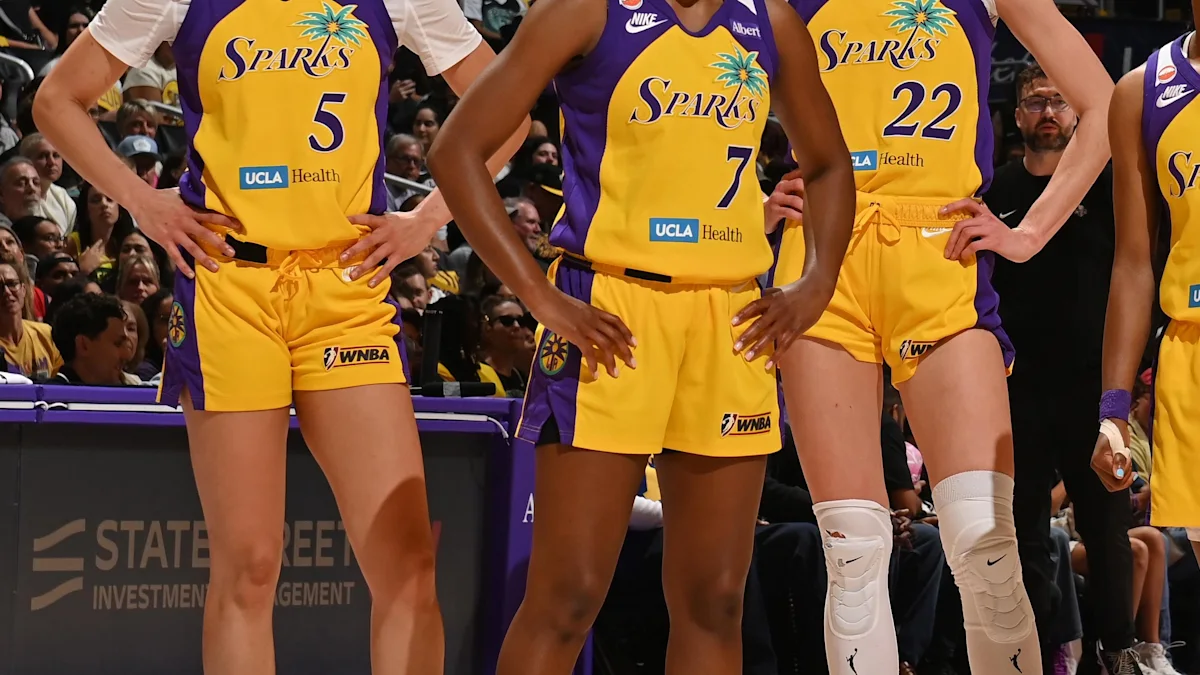
When a season’s standout moments revolve around honoring two franchise legends—one retiring and the other receiving a statue—it often signals a disappointing year in terms of on-court success.
Nneka Ogwumike undoubtedly earned every accolade she received during her final WNBA campaign, and Lisa Leslie’s long-overdue statue celebrated her legendary impact on women’s basketball. However, the focus on the past rather than current achievements highlights the struggles faced by the Los Angeles Sparks.
Eager to end a six-season playoff drought, the Sparks approached the 2026 season aggressively, exemplified by Ogwumike’s return as part of a shift toward an experienced, veteran roster aimed at postseason contention. Unfortunately, the team delivered a notably mediocre performance, culminating in the midseason trade of star Kelsey Plum—acquired before 2025 with playoff hopes in mind—which was a clear acknowledgment by the franchise that their fast-track plan had failed.
Following Plum’s departure to the Phoenix Mercury, general manager Raegan Pebley was replaced, and head coach Lynne Roberts was let go after the season. Despite these changes, the Sparks are not yet positioned for a fresh start.
New GM Ariana Andonian has been cautious, focusing on the goal of “sustained success” but offering little clarity on her vision for the team in an introductory press conference. This reticence is understandable, given recent reports that owner Mark Walter—currently under federal investigation for financial fraud—may be looking to sell the franchise for $700 million, including its new state-of-the-art practice facility.
With ownership uncertainty looming, the future direction of the Sparks remains unclear. After a forgettable season, the offseason presents the possibility of a new beginning for LA basketball—a chance either to revive one of the WNBA’s storied franchises or to continue struggling in mediocrity.
Now, let’s explore the key developments shaping the team’s path forward. Fans are encouraged to share their thoughts on Southern California’s situation, reflecting on lessons from 2026 and strategies for preparing the 2027 roster.
If the Sparks miraculously secure the No. 1 draft pick, it could resolve all their problems
Did the Sparks get a fair return for trading Kelsey Plum? The real answer will become clearer on November 15. The decision to trade Plum—an impending unrestricted free agent—during a disappointing season was prudent, as gaining any value was preferable to losing her for nothing.
Monique Akoa Makani is a decent addition, but the most valuable assets are the first-round draft picks involved. Combining their own with the Mercury’s pick gives the Sparks a 36% chance of winning the 2027 WNBA Draft Lottery on Sunday. If luck favors them, USC star and LA native JuJu Watkins could land with the Sparks, becoming the franchise’s cornerstone both on and off the court.
Such a scenario would not only provide a focal point for the team’s rebuilding efforts but might also attract potential buyers for the franchise and bolster interest in the still-open head coaching position. However, with only a 36% probability—the lowest among the six lottery teams—fans should temper expectations, perhaps hoping for league intervention to keep Watkins in Los Angeles.
Even if Watkins falls short, the Sparks will likely add two young talents with picks six and seven, such as LSU’s MiLaysia Fulwiley, Kentucky’s Clara Strack, or South Carolina’s Tessa Johnson. While these players would contribute to the rebuild, they wouldn’t represent the transformative star the franchise needs.
So, if the Sparks end up with lower lottery picks, how should they proceed? Should they draft young talent to develop gradually, or package picks in a trade to chase another star and expedite their return to competitiveness?
How will LA’s new leadership assess the current roster?
Sparks fans can imagine alternative realities where top prospects like Rickea Jackson, Dominique Malonga, Angel Reese, or Paige Bueckers brought instant excitement to SoCal. Instead, the current roster is a blend of players at varying points in their careers.
Veterans like Dearica Hamby, Ariel Atkins, and Erica Wheeler are all at least 30 years old and signed for 2027, with Hamby and Atkins carrying contracts above $1 million. Hamby’s production declined in 2026 due to reduced playing time, but her leadership and effort still make her a valuable locker room presence. However, given her age (just turned 33), the Sparks should consider trading her if a good offer arises.
Atkins, who was overburdened as a primary option during her time with the Chicago Sky, struggled with her weakest three-point shooting season. While she could regain form in a supporting role, the Sparks should not hesitate to explore trade possibilities if interest develops.
Among the younger players, Cameron Brink anchors the core, with Monique Akoa Makani and Aaliyah Nye on non-guaranteed contracts, Rae Burrell a restricted free agent, and Jihyun Park with a reserved free agent status. Despite injuries and some underwhelming moments, Brink’s potential as a versatile stretch big remains high, and unlocking her capabilities should be a coaching priority.
Rae Burrell stands out as the franchise’s biggest success during the playoff drought, developing from a raw athlete into a more polished player capable of scoring, playmaking, and defense. As a restricted free agent, the Sparks can match any offer to retain her, and it would be wise to do so unless an extraordinary trade offer presents itself.
What’s your take on the futures of these four key players? Should the Sparks be bold in trading Hamby and Atkins or hold onto their veteran presence? Do you still have faith in Brink’s development, or should the team consider moving her? And is Burrell ready to be a foundational piece for a winning squad, or does her inconsistency pose a long-term risk?
Fan Take: This crossroads season for the Sparks is crucial not only for the franchise but for the WNBA’s broader narrative about rebuilding and growth. How the Sparks navigate the draft, roster moves, and ownership uncertainty could set a blueprint for other struggling teams, ultimately affecting the league’s competitive balance and fan engagement nationwide.
Source: sports.yahoo.com
