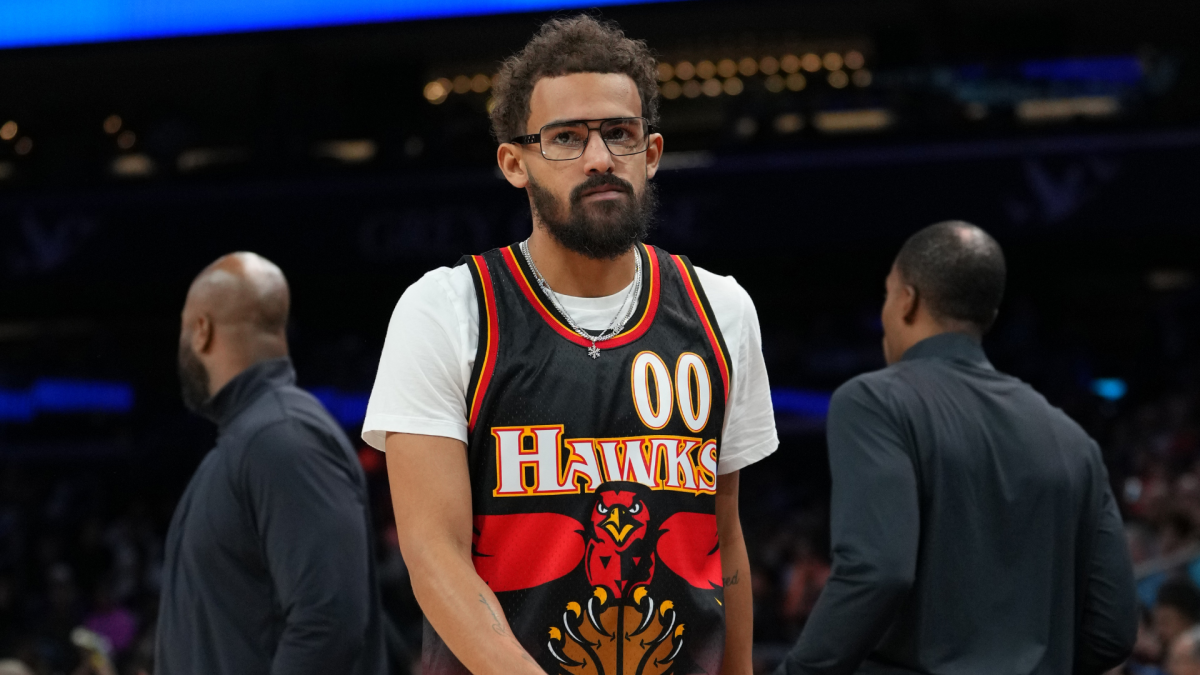
The question of whether the Atlanta Hawks perform better without Trae Young has been a hot topic this season. While definitive answers are still pending, the Hawks’ performance since Young suffered an MCL sprain has been impressive, possibly even surpassing any team lineup featuring him. Consider these statistics: since Young’s injury, the Hawks have a net rating of +2.1, nearly matching their best full-season net rating of +2.2 in 2021 when they made the conference finals. Initially, the Hawks started the season 1-3, but after Young’s early absence in the fifth game, they currently hold a 14-9 record in games he didn’t finish, a winning percentage near 61%, better than their previous 45% lifetime win rate with Young. Defensively, the Hawks are ranked 13th in the NBA post-Young’s injury, having never recorded an above-average defensive rating over a full season while he played. Offensively, though theoretically expected to struggle without Young, they rank 12th in efficiency, benefiting from their athletic wings and strong transition offense, ranking seventh most efficient in transition plays this season.
This isn’t to say the Hawks are outright better without Young but rather that this season’s team—enhanced by several talented players like Jalen Johnson, a promising backcourt partner in Nickel-Alexander-Walker, and versatile big man Onyeka Okongwu—is potentially as strong as any Young-led squad. Young’s anticipated return is marked “questionable” for the upcoming game against the Charlotte Hornets, raising questions about how his role will fit amidst the Hawks’ current style that thrives on quick decisions and ball movement. Young’s playing style, which involves high ball usage and slower play, contrasts with the team’s current fast-paced, passing-heavy approach. For Young to thrive, he must adapt by increasing his off-ball movement and three-point shooting, decreasing his ball time, and minimizing defensive liabilities.
Negotiations for Young’s contract extension stalled last offseason amid changing league dynamics and team priorities leaning toward less superstar-driven but more balanced rosters. The Hawks’ current roster depth and the acquisition of a valuable 2026 first-round pick provide flexibility and resources that reduce their dependence on Young. His return will need to demonstrate significant added value beyond just incremental improvement to justify a substantial new contract. Meanwhile, younger players like Johnson, Daniels, Okongwu, and Alexander-Walker are proving they can be long-term cornerstones. Ultimately, the Hawks are focused on building a versatile and deep team rather than relying solely on Young’s star power.
Fan Take: This storyline is crucial for basketball fans as it highlights a shift in team dynamics where great teams are built on depth and adaptability rather than singular star dominance. How Trae Young adapts to this evolving Hawks team could redefine his legacy and impact strategies for star players across the league aiming to balance personal brilliance with team success.