

Red Bull Racing is a team that has changed so much that next season can be considered the beginning of a second era in F1. The question is whether this has been reimagined and strengthened to face the challenges of the next 20 years, or whether the magic that made the team so successful has been lost.
When Red Bull co-founder Dietrich Mateschitz lost his battle with cancer in October 2022, the company’s F1 operations could never be the same, at least in the medium to long term. What’s less clear is exactly what form this change will take, but few would have imagined it would be so extreme that heading into 2026 all of the key leaders who made the team great are gone.
Mateschitz’s unique position meant it was inevitable that his absence would bring about change. He owned 49% of Red Bull, with fellow founder Chaleo Yovidya’s family owning the remaining 51%, and controlled nearly all of its activities. An autocratic leader, his vision and enthusiasm drove his involvement in motorsport and helped build Red Bull into a company with sales of more than $10 billion at the time of his death. And it has continued to grow ever since.
He was asked to rescue Minardi from a financial crisis when manager Paul Stoddart was unable to continue, and after unexpectedly adding a second team to his stable in September 2006, he gained significant influence in F1 through ownership of two teams representing 20% of the grid. Yet the power he wielded belied the low profile he maintained. Mateschitz avoided day-to-day politics in the paddock and was never a dictator in the interventionist sense. For some, such influence is a status symbol to be flaunted. For Mateschitz, it was a tool used only when necessary. As for the rest, he left the work to the “earthly pastors.”
He only occasionally made public statements, but when he did, they carried weight. His threat to resign from Red Bull was meaningful, but it was never overused, giving him political power that was wielded skillfully and helping the team transform Grand Prix racing. Never underestimate how big an influence Red Bull has had on the direction of F1. This is especially true when it comes to testing and ultimately defeating the limits of resource restriction agreements and their successors’ well-intentioned but weak attempts at cost control.
After 2022, that dynamic will no longer be possible. It was no longer Mateschitz’s pet project, but now clearly part of a more traditional global company. Writers of fiction and history throughout the ages are well aware of what the loss of such a center of power means for this type of ecosystem that once benefited from such leadership and stability.
So how did Red Bull Racing, irrevocably changed with the departure of team principal Christian Horner, motorsport advisor Helmut Marko, chief technical officer Adrian Newey and sporting director Jonathan Wheatley, go from there to becoming the fourth most successful team in Grand Prix history with 130 wins? And just how different is the “new” Red Bull?
Basically, it’s more corporate. Mateschitz’s son Mark has inherited his stake and remains heavily involved, but the team is now under the supervision of Oliver Mintzlaff, Red Bull’s CEO of Corporate Projects and New Investments. He featured prominently at a number of Grands Prix this year following Horner’s departure in July, but also oversees a number of Red Bull’s other sports facilities, including Germany’s RB Leipzig, Austria’s RB Salzburg and the New York Red Bulls soccer team. There is also a larger committee as part of that management process.
Mr. Mintzlaff is a central figure in this change. He recently said that “distractions” or the desire to get rid of them is a motivating factor. “It was an open secret that there was too much going on inside and outside of the team,” Minczarf said earlier this month. He characterized the return to form and Max Verstappen’s move to within two points of winning the drivers’ championship as a sign of the new focus brought about by change. Horner and the baggage he was carrying were clearly thought to be a big part of the problem. But Horner also had as much power and control over Red Bull’s F1 empire as the wider Red Bull company, so it would be naive to imagine that reining in this was not part of the equation.
Laurent Mekies, who replaced Horner as CEO and team principal, holds the same title but does not have the same powers. How could he, considering Horner has built the team and woven himself into every aspect of its operations? Mekies is a very astute engineer and intellectual with extensive management experience at Racing Bulls and Ferrari, where he was previously deputy team principal. However, he is more focused on the engineering side and his role goes beyond that, but compared to Horner, he is much more of an executive. This is not meant as an insult to his abilities, just that the corporate shackles that Horner has shaken off are still firmly attached to him, if they were there to begin with. Although it was Horner’s company, Mekies was a company employee and his power was limited.
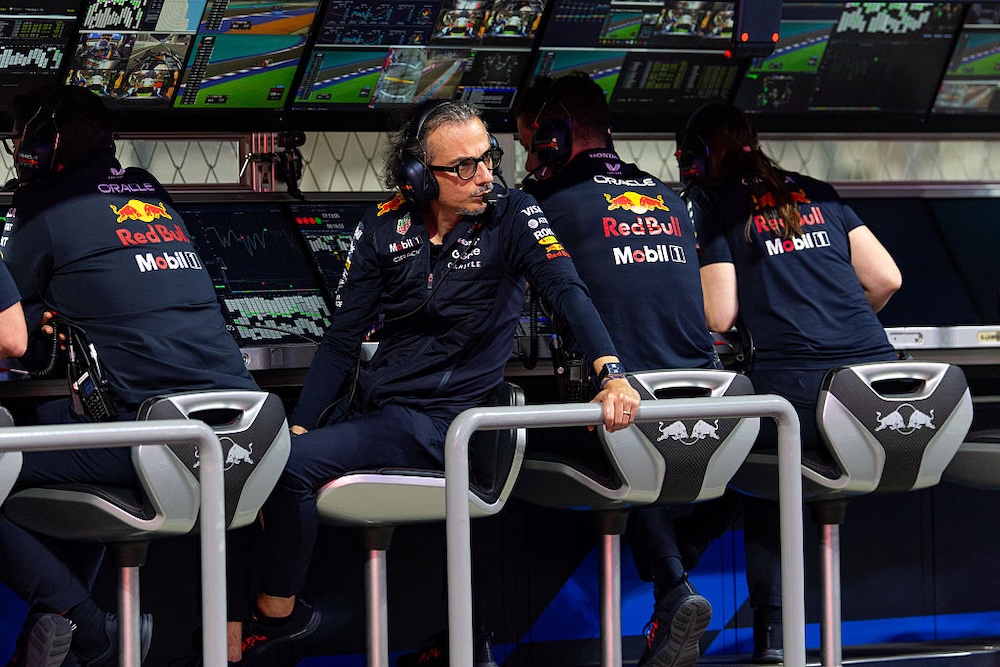
Team leader Laurent Mequise is more engineering-focused than his predecessor Christian Horner, but has far less political power. Kim Ilman/Getty Images
The risk here is not only that Red Bull F1 may no longer be the same player politically. Please remember that the multiple companies that currently make up Red Bull F1 include serious power unit manufacturers. Horner was a skilled operator, had close relationships with all key players, and had decades worth of combat vehicles in various off-course wars. Mekies has been under the radar, and while he could grow into that role, his job is more about keeping his head down and making the team work as well as possible. There’s no chance Mintzlaff can do what Horner did politically, but he may need to do so from time to time if Red Bull’s more corporate approach doesn’t give him enough authority in the day-to-day role. He says it needs to be done, but saying it and doing it are two different things.
The technical aspects of the team have remained largely unchanged. Pierre Wasch was in charge, and Adrian Newey’s departure was a huge loss, partly because he was seen as undervalued and marginalized in his eyes, but that was already on the way before Mateschitz’s death, even if he didn’t realize it yet. The facility remains top-notch, with a brand new, state-of-the-art wind tunnel scheduled to be operational in 2026. It will replace a facility that, while well-equipped, was too temperature-sensitive because its structure was a “relic of the Cold War.”
There have also been personnel changes within the garage, with the latest being Max Verstappen’s long-time race engineer Giampiero Lambiase moving into a different role. However, while Wheatley’s move to join Sauber as team principal is a loss as he has, ironically, failed to find a promotion within Red Bull, the team continues to do well trackside. The main question is whether it can get worse over time, and to what extent the 25-year car’s troubles have been made worse by a set-up approach that never worked, and by overreliance on the simulation tools that prepared it in such a direction.
Marco’s resignation is the clearest sign of a shift toward greater corporate responsibility. The unsubstantiated claim that Kimi Antonelli deliberately missed Lando Norris at the Qatar Grand Prix, which sparked abuse on social media, was certainly a decisive blow to his departure, but realistically it would have happened otherwise. His approach is understood to be out of step with modern society’s expectations and there were aspects of his approach that did not seem to fit with Red Bull as a whole.
But don’t be fooled by the way it’s worded. This is about Marco getting kicked out, and it wasn’t Marco’s idea, as the press release claims. The level of autonomy he was used to, and in many ways the level he was leveraging so well, simply couldn’t continue, given how important he was in turning Red Bull from a team that wasn’t taken seriously to a dominant one. The problem is that while he had many negatives, Red Bull also lost the positives he brought.
Another question is what will happen to the Racing Bulls? Despite a much-hyped but badly executed rebrand in early 2024 that shoehorned Visa and CashApp into the name, the F1 team remains a second-rate F1 team. Despite the rhetoric in recent years that it is no longer a junior team, it can only be a second team. It moved much of its design and aerodynamic testing from creaky, substandard facilities to its own area of the Red Bull campus in Milton Keynes, a city just over 80 miles northwest of London. This has resulted in improved facilities and the rest of the team continues to operate in Faenza, Italy, just outside Imola.
The logical move is to sell it. Valuations for F1 teams are currently skyrocketing, and there are no shortage of vultures looking to acquire them. Even a small team that relies on getting key parts from Red Bull Racing would be a multi-billion dollar team today. Not only would it make sense for Red Bull to cash in on this, but it would also be good for F1 as a whole, as two teams owned by the same company competing against each other is bad for the integrity of the sport in any sport. How that works out is another matter, but in the long term it will probably lead to the team being moved back from Milton Keynes. However, it would be surprising if the team remained part of Red Bull’s portfolio indefinitely.
A clean slate in 2026 will be the first opportunity to evaluate this new Red Bull. The car was entirely conceived in the post-Adrian Newey era and has been run by a new regime from the start, although there have been some hangovers, including a chaotic driver development strategy that meant the introduction of Isaac Hajjar after an impressive single season with the Racing Bulls. A good start will lead to a period of stability, but a bad start and rumors about a fugitive Verstappen will have the opposite effect.
This is a new era for Red Bull in many ways. A central question underpinning whether the glories of the past two decades can be repeated over the coming decades will be whether Red Bull itself fully accepts the fact that if it wants its F1 team to succeed, it doesn’t need to be completely free to roam, but needs to be kept on a long, loose leash.
F1’s history shows that excessive corporate oversight and winning are mutually exclusive.