
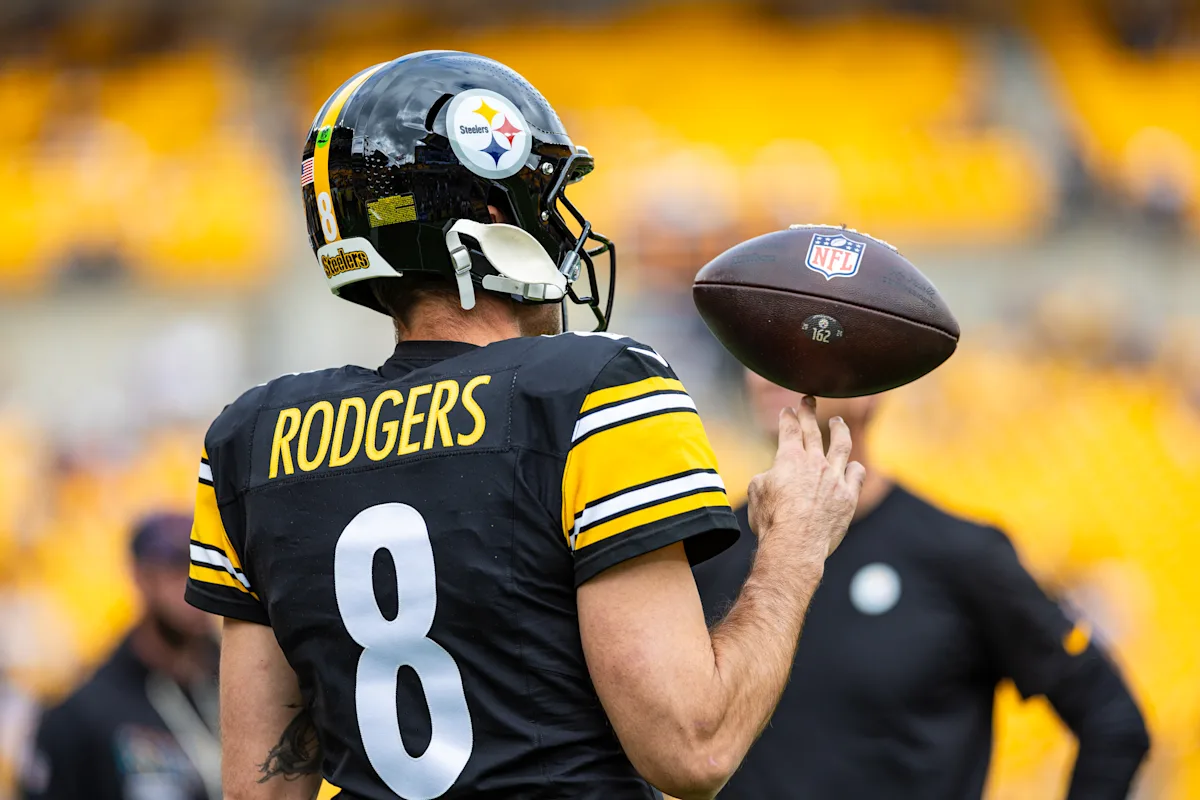
Aaron Rodgers arrived at Week 18 sounding far from certain about his future.
His one-year contract with the Steelers was about to expire, Mike Tomlin’s job had become a public topic of conversation, and Pittsburgh’s regular-season finale against the Ravens felt like a playoff-or-go-home situation. With so much unresolved, Rodgers nevertheless spoke to reporters as if he wasn’t ready to accept an immediate end to his playing days — unless that’s what he ultimately wanted. He noted he was focused on the present but reminded everyone he’s 42, on a one-year deal, and will be a free agent when the season ends, meaning he could choose to continue his career if the desire and opportunities align. He laughed off the idea that options would be endless, but suggested at least one or two real possibilities might exist if he decided to keep playing.
Rodgers also praised his time in Pittsburgh, saying the experience had exceeded his expectations and that teammates and everyone around the organization had been great on and off the field.
The Steelers did beat Baltimore to reach the playoffs but were knocked out in the Wild Card round by the Houston Texans. The season felt like it delivered more than many had anticipated from Rodgers, Tomlin and the roster. Then Tomlin unexpectedly resigned, surprising ownership — and perhaps complicating Rodgers’ thinking about a return, since he had tied part of his decision to whether Tomlin remained in charge. That resignation suggested one fewer path for Rodgers to stay in Pittsburgh.
On Saturday, Pittsburgh moved in a different direction than usual and hired 62-year-old Mike McCarthy, a veteran coach who brings two potentially competing strengths: proven quarterback development and the ability to try to win now with an older, reasonably talented roster. It will be a tough balancing act for McCarthy to both coach for immediate success and also groom the franchise’s next long-term QB without a reliable bridge starter already in place.
One solution would be a veteran QB familiar with McCarthy’s system — or a younger passer on the Steelers’ roster who has shown enough to be worth investing in. That description hints at 24-year-old Will Howard, who spent a season in Pittsburgh’s QB room, flashed in limited preseason action, and has front-office backing as a developmental prospect.
That scenario could keep the door open for Rodgers: McCarthy’s arrival might revive the possibility of a 2026 reunion that seemed to fade after Tomlin’s departure. But McCarthy wasn’t necessarily hired specifically to re-sign Rodgers. Owner/general manager Omar Khan has made finding a long-term starter a priority, a mission that likely wouldn’t have changed even if Tomlin had stayed. The central 2026 question remains whether Pittsburgh already has their future QB in-house (Howard), or whether they’ll pursue one through the draft, trade market, or free agency.
McCarthy’s track record of turning quarterbacks into starters makes his hiring sensible if the team plans to develop a young passer. If Rodgers wants to keep playing year-to-year and is willing to play for McCarthy again, a short-term reunion would also make practical sense. Sources close to both men have told Yahoo Sports that Rodgers and McCarthy have spoken positively about each other in recent years and have reconciled past frustrations that contributed to McCarthy’s 2018 firing in Green Bay.
Still, mutual interest doesn’t guarantee anything. Even if Rodgers wants to play and McCarthy wants him back, league-wide changes over the next few weeks could alter the market for veteran quarterbacks. A Super Bowl run or retirements elsewhere could shift options dramatically; for example, if Matthew Stafford were to retire after a Rams title run, that would create ripple effects in quarterback-needy teams. The Vikings — a club that showed strong interest in Rodgers last offseason — will also be evaluating their quarterback situation and competition for starters such as JJ McCarthy.
Looking ahead to the draft, some names have been floated as potential fits for Pittsburgh’s draft slot. Indiana’s Fernando Mendoza is viewed as the top immediate starter among early prospects, while Alabama’s Ty Simpson might be out of reach at No. 21. Beyond those two, several intriguing developmental quarterbacks could be available later: Mississippi State’s Trinidad Chambliss, and previously hyped talents who underwhelmed late in the season such as LSU’s Garrett Nussmeier, Miami’s Carson Beck, Penn State’s Drew Aller, and Clemson’s Cade Klubnik. Most evaluators see many of these prospects as multi-year projects rather than instant Week 1 starters.
If Pittsburgh chooses a developmental quarterback, McCarthy’s ability to coax starting-level play out of young signal-callers would be a big reason to be optimistic. And if Rodgers remains open to a one-year deal and to playing for McCarthy, a short-term partnership still fits logically for both sides. But the situation is fluid: Rodgers won’t know all his options until the league’s offseason moves and retirements clarify the landscape.
Fan take: This story matters because Aaron Rodgers’ next move — whether he retires, re-ups for a short-term reunion, or moves elsewhere — will ripple across the QB market and influence how teams approach bridging veteran play with rookie development. For NFL fans, Pittsburgh’s McCarthy hire signals a pragmatic path forward: they could pursue immediate competitiveness while still leaving room to draft or develop the next young franchise quarterback.