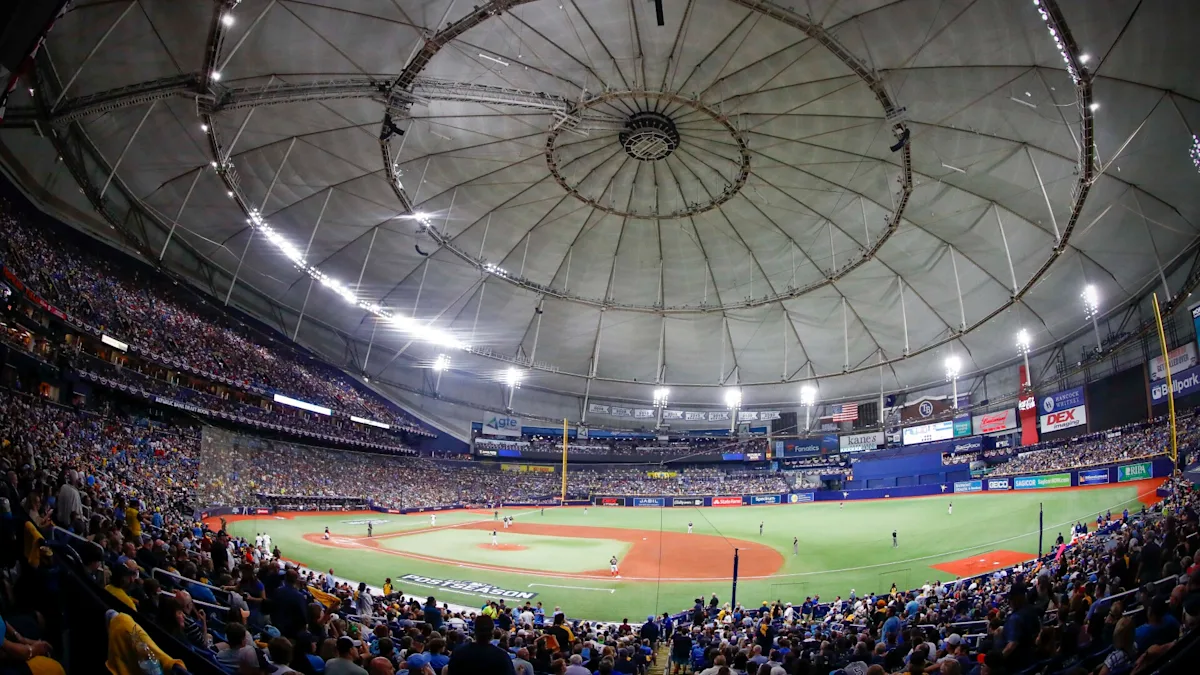
FORT LAUDERDALE, Fla. (AP) — Since their inaugural game nearly 28 years ago at the St. Petersburg Dome, the Tampa Bay Rays have been on a persistent quest for a more modern and financially favorable stadium contract.
Tropicana Field, located across Tampa Bay from the larger city of Tampa, has long struggled with low attendance throughout most seasons.
Originally named the Tampa Bay Devil Rays, the team joined Major League Baseball as an expansion franchise alongside the Arizona Diamondbacks. Over time, they dropped “Devil” from their name and established themselves as a competitive small-market team despite limited payrolls and paltry fan turnout.
Repeated talks about replacing the outdated Tropicana Field have periodically surfaced and fizzled out. These included a failed stadium relocation proposal to Tampa’s Ybor City and a previously promising effort to remain in St. Petersburg—until Hurricane Milton hit in 2024, shifting local priorities and causing the Rays to withdraw from a $1.3 billion stadium deal with the city last March.
Now, with new owners and new ambitions, stadium negotiations have restarted, though details remain scarce. Recently, the Rays signed a non-binding memorandum of understanding with Hillsborough College in Tampa to build a multi-purpose stadium on 113 acres along Dale Mabry Boulevard. This location is near Raymond James Stadium, home of the Tampa Bay Buccaneers, and close to George M. Steinbrenner Field, the spring training site for the New York Yankees.
The team has not disclosed many specifics about the new stadium, including whether it will feature a roof—something considered nearly essential to shield fans from Florida’s heavy rains and summer humidity. Discussions with Tampa officials continue, with the deal allowing six months of negotiation time.
Previously, the Rays had been negotiating with St. Petersburg and Pinellas County to build a new ballpark next to Tropicana Field but pulled out due to the hurricane’s impact and rising project costs. During the 2025 season, the team played at the small-capacity Steinbrenner Field in Tampa, hosting 61 sellout games with 786,750 total fans—down from 1,337,739 in 2024—ranking them 28th in MLB attendance, ahead of only Miami and Oakland. By 2025, the Rays fell to 29th, just above the Athletics, who play temporarily in a minor league park but plan to move to a new stadium in Las Vegas in 2028. The Athletics drew 768,464 fans that year.
Tropicana Field took a major hit from Hurricane Milton in October 2024 when the storm destroyed its roof. This damage forced the Rays to spend the entire 2025 season at Steinbrenner Field. Repairs, which took about 120 hours after the Yankees’ spring training finale, are underway, with plans for the Rays to return to St. Petersburg in 2026 under a lease lasting through at least the 2028 season.
The combination of storm damage, escalating repair expenses, and construction costs led former owner Stuart Sternberg to pull out of the St. Petersburg stadium deal last year and ultimately sell the franchise.
Opened in 1990 at a cost of $138 million, Tropicana Field boasted the world’s largest cable-supported dome roof, featuring translucent Teflon-coated fiberglass panels held up by 180 miles of cables attached to structural stanchions.
Details on the new stadium proposal remain limited. It’s unclear how much money the ownership group will contribute, the amount of public funds requested, or the exact terms of the arrangement.
The Rays’ new leadership envisions a venue similar to Atlanta’s Truist Park, surrounded by retail, dining, residential, and work spaces to create a vibrant community outside the stadium. The memorandum with Hillsborough College also includes enhancements to campus facilities.
Rays CEO Ken Babby commented that there is still significant work ahead but expressed optimism about developing a premier live-work-play environment in Tampa Bay.
Despite parking and access challenges at the proposed site, the team says plans are underway to prioritize these issues through collaboration with local authorities and experts.
Florida Governor Ron DeSantis has stated the state will not directly fund stadium construction but has agreed to assist with relocating a juvenile justice facility on the site, likely supporting infrastructure improvements like sewage and roads.
The Rays were sold last September to a group led by Florida real estate developer Patrick Zalopski, whose net worth Forbes estimates at $1.4 billion. Zalopski, CEO of Dream Finders Homes, serves as managing director and co-chair alongside Bill Cosgrove, CEO of Union Home Mortgage. The team’s new CEO is Ken Babby, who also leads Fast Forward Sports Group, owner of the Triple-A Jacksonville Jumbo Shrimp and Double-A Akron Rubber Ducks.
Former owner Stuart Sternberg took control in 2005, guiding the team’s rebranding following the 2007 season. Under his leadership, the Rays won the AL East in 2008, 2010, 2020, and 2021, reaching the World Series twice but losing to the Philadelphia Phillies in 2008 and the Los Angeles in 2020.
Fan Take: This stadium saga highlights the challenges faced by small-market MLB teams balancing fan experience, finances, and community relations. A new, modern ballpark could not only boost attendance and local support for the Rays but also set a new standard for integrating baseball venues into vibrant, multipurpose neighborhoods, benefiting the sport’s future growth.