Newcastle United received another stark reminder of what it’s like to face Liverpool at Anfield, and this match was no exception. Football has its ups and downs, but there’s a particular psychological challenge Newcastle seems to face every time they set foot on Liverpool’s historic turf.
This match was expected to be the moment they broke their unfortunate streak. For the first 40 minutes, Newcastle not only held their own but looked stronger. They pressured Liverpool’s defense, showcasing determination fueled by Anthony Gordon’s inspired play. However, just as they’ve experienced time and again, they crumbled. The unraveling was swift, dramatic, and entirely predictable.
Newcastle’s dismal record at Anfield dates back to 1994—a staggering reminder of over three decades of disappointment that continues to haunt their efforts at this venue.
Hope Derailed Once Again
Throughout most of the first half, Newcastle demonstrated impressive control, leaving Liverpool struggling. Eddie Howe’s strategic setup applied effective pressure on Liverpool’s makeshift defense, and Gordon’s goal gave the impression that the curse might finally end.
Yet, if Anfield represents Liverpool’s sacred ground, Newcastle embodies the fragility of human determination. Right before halftime, everything unraveled in an instant.
A deflected shot from Mo Salah landed poorly for Ryan Gravenbirch, who quickly set up Florian Wirtz. Despite the presence of three Newcastle defenders, nobody managed to intervene as Wirtz provided an assist for Hugo Ekitike to equalize. A moment of confusion led to a tangle of legs, leveling the match.
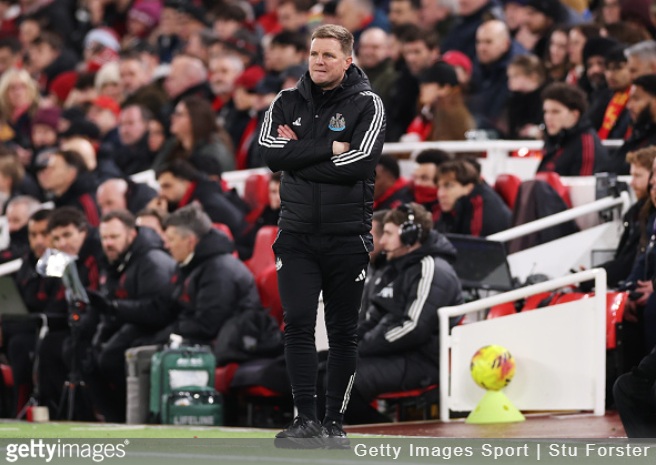
Howe’s reaction was telling. Usually composed, he displayed visible frustration, gesturing animatedly and cursing at Jason Tyndall, embodying a manager all too familiar with this narrative.
Two Minutes of Chaos that Altered Everything
With the score tied just before halftime, Newcastle needed calm. Instead, they introduced confusion.
Their typical corner fell flat, leading to Milos Kerkes launching a long ball that found Ekitike in the attacking half. Sandro Tonali was in pursuit, and Malik Thiau had the positioning to cover. Yet, unexpectedly, Tiau simply slowed down to a jog, allowing Ekitike space to shoot past Nick Pope with an audacious finish.
In that fleeting moment, Thiau seemed to mimic the nonchalant style of Virgil van Dijk—but he would need to remember he’s not yet at that level.
In those unforgivable five seconds, Newcastle didn’t just lose their lead; they surrendered the emotional momentum of the match. Howe stood on the sidelines, his expression a mix of disbelief and resignation, reflecting a man who had witnessed potential victory slip away. He crouched on the ground shortly after, clearly grappling with his choices as he reflected on the historical struggles at this venue.
An Inescapable Disappointment
Before the match, some Newcastle fans jested that a 4-1 loss felt inevitable, a darkly humorous way to cope with an annual disappointment.
And, of course, it ended 4-1.
Thiau’s blunder led to Liverpool’s third goal, echoing his previous mistake on the second. The fourth arrived when the usually dependable Nick Pope mishandled a simple cross, resulting in a goal that bounced across the net after deflecting off Dan Byrne.
If one were to script a farcical goal that epitomizes 32 years of anguish, this would be it.
Liverpool not only defeated Newcastle; they thoroughly exposed their vulnerabilities. What began as a promising advantage crumbled into disarray. This was no fierce rivalry; it became a reiteration of a long-standing tragicomedy.
A Manager Out of Answers
Eddie Howe is not naïve; he understands the psychological and structural nuances of the game. Yet, something about Anfield seems to dismantle Newcastle’s focus, turning seasoned professionals into nervous amateurs. Despite numerous chances over four years, he seems as perplexed as those who came before him.
Since 1994, 16 permanent managers have failed at Anfield, alongside twelve different Newcastle captains who sought to break the curse. What they share is not the system or tactics but a mentality that crumbles in this venue.
Howe’s Newcastle is not inherently weak; they have excelled against top European teams and made significant strides. However, Anfield consistently undermines their progress.
Why This Loss Stings More
Newcastle has faced defeats at Anfield before, but this one felt particularly painful. They played well, seized an early lead, and manipulated Liverpool’s defense, only for the game to descend into chaos.
Newcastle embodied confidence, only to see it fade away. Their defense lacked discipline, transitions faltered, and decision-making dissipated under pressure. The calmness that defined the first portion of the match quickly devolved into panic and confusion. This was not merely a loss; it was self-sabotage.
This match served as a stark reminder that, despite the strides Newcastle has made under Howe, they still harbor a vulnerability that emerges when the stakes are highest.
Fan Take: This match emphasizes the psychological barriers teams face against historical rivals, particularly in high-pressure environments. For soccer fans, it highlights not only the unpredictability of sport but also the need for mental resilience, making it a vital discussion point in the broader context of competitions.