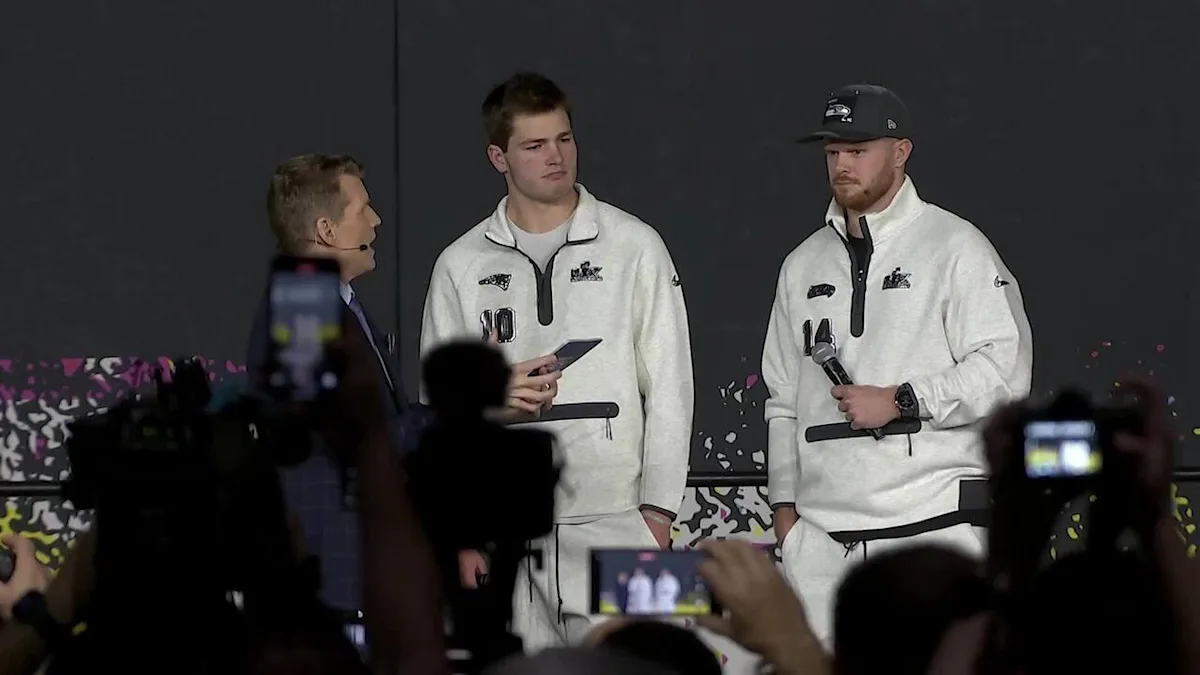
Drake Maye’s career path couldn’t be more different from Sam Darnold’s, even though both were taken with the No. 3 pick in their drafts. Maye broke out in his second season after a solid rookie year, while Darnold’s early struggles had many ready to write him off by that same point in his career.
Maye said he doesn’t know every detail of Darnold’s climb to Super Bowl LX, but he admires what the Seahawks quarterback has accomplished. He noted that Darnold hit a low point when the Jets moved on, spent years largely off the field, then seized a backup opportunity and made the most of it — a turnaround Maye called inspiring and emblematic of what makes the league special.
Darnold’s story stands out because it’s rare for a quarterback who looked like a bust early on to wind up starting in the Super Bowl. Not long ago he wasn’t even guaranteed a starting job in Minnesota; he was brought in as a short-term solution while rookie JJ McCarthy recovered. When McCarthy was injured, Darnold stepped in, played well, and eventually landed in Seattle, where he helped guide the team to a 14-3 regular season and the NFC Championship in the first year of his three-year, $100 million deal — an outcome few predicted.
At 28, Darnold still has time to add to this unlikely résumé. He says he’s learned to embrace failure and use mistakes to improve, treating each setback as a lesson that propelled him forward. He insists he takes every experience with him — from being drafted by the Jets to his stint with Carolina, to learning as Brock Purdy’s backup in San Francisco under Kyle Shanahan, and then to Minnesota — viewing each stop as part of his development.
Comparisons to past quarterbacks with winding careers are inevitable. Jim Plunkett is a frequent reference point: a former top pick who struggled early, moved teams, and eventually won multiple Super Bowls with the Raiders but still didn’t get the full acclaim of other champions. Other QBs — like Terry Bradshaw, Doug Williams and Rich Gannon — also had unconventional trajectories to greatness, though each story differs in timing and context. Darnold’s path is unusual in that he was a high first-round pick who faded, bounced around, and then reemerged as a Super Bowl starter.
Darnold was on the 49ers’ Super Bowl roster two years ago as a backup, a role that often leaves top draft picks relegated to the background. This time, however, he’s the central figure, talking this season about trusting teammates, avoiding overexertion under pressure, and continuing to learn about himself as a player. His perseverance — weathering criticism, absorbing lessons from multiple teams and coaches, and capitalizing on an opportunity — has put him one win shy of joining a small group of memorable starting quarterbacks who’ve won Super Bowls.
Fan take: Darnold’s resurgence matters because it proves quarterbacks’ careers aren’t always linear and that perseverance plus the right situation can revive a stalled trajectory. For NFL fans and front offices, his story reinforces the value of patience, good coaching fits, and the potential payoff of reclamation projects at quarterback.