
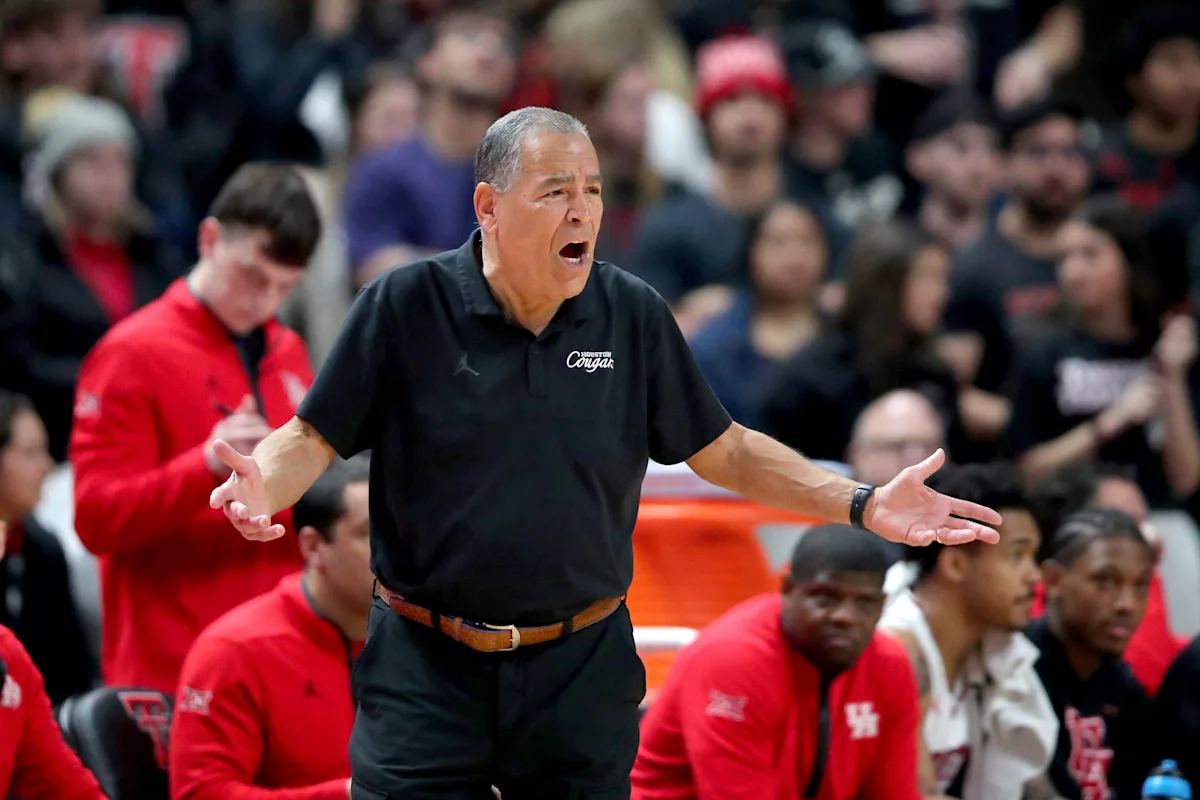
Over the last ten years, Kelvin Sampson has transformed Houston men’s basketball into a powerhouse. The program consistently competes for national titles, marking its most significant success since the celebrated Phi Slama Jama era of the 1980s.
Sampson believes this achievement came despite facing considerable, often unavoidable challenges.
In the postgame press conference after Houston’s 79-55 victory over Central Florida on Wednesday, Sampson expressed frustration about the university’s position within the costly landscape of college athletics. He spoke candidly about player retention and the program’s impressive performance, even describing Houston’s athletic department as “very poor.”
“We’re poor,” Sampson stated. “We were poor when I arrived, and we still are. Our budget is likely the lowest among the Power Four conferences. Given our recruiting efforts, we need to pause at some point because we simply don’t have the funds to continue bringing in many talented players. It’s not easy for us.”
According to the 2024 USA TODAY Sports Database, Houston ranks 56th among Division I public universities in total sports revenue. These figures came from when the Cougars were in the American Athletic Conference. Since joining the Big 12 before the 2023-24 season, the program has seen revenue growth due to the conference’s more lucrative media rights deals. However, Houston remains last among the Big 12’s 13 public universities in revenue. Baylor, BYU, and TCU are private schools, so their financial details are not publicly available.
Compounding these issues is Houston’s location in Texas, where it competes for players and attention with well-funded programs like Texas State and Texas A&M. Even Texas Tech has emerged as a strong contender in the era of name, image, and likeness agreements, largely due to support from billionaire booster Cody Campbell.
Houston does benefit from a major donor in Houston Rockets owner Tilman Fertitta, who contributed $20 million in 2017 toward a $60 million renovation of the school’s basketball arena, now named the Fertitta Center.
After falling short in the national championship game last year, Sampson’s team continues to be among the nation’s best, holding a 20-2 record and ranked No. 8 in the latest USA TODAY Sports Coaches Poll. The roster features standout players like freshmen Kingston Flemings and Chris Cenac Jr., both anticipated to be first-round NBA Draft picks and ranked among the top 20 recruits for the 2025 class. The 2026 recruiting class already includes 7-foot-1 center Arafan Diane, who is the nation’s No. 16 prospect.
Despite financial limitations, Sampson confirmed that Houston’s top players are well compensated.
“They are not going hungry here,” he emphasized. “They’re receiving exactly what the market demands.”
Houston’s football program also shows strength in recruiting, with Keayshawn Henderson—ranked the top quarterback in the 2026 class by 247Sports—committed to the Cougars. Henderson hails from nearby Spring, Texas.
One of the major challenges Sampson faces is assembling a balanced basketball roster. Based on his experience, programs eventually hit a financial ceiling that restricts further player additions.
“The teams with the best recruiting classes usually have the most money,” Sampson explained. “That’s the reality today. Who else we can sign depends on our budget. It’s not about who we want to sign but who we can afford.”
Since the 2017-18 season, Houston has posted a 263-46 record, qualified for the NCAA Tournament each year, and reached the Final Four twice—in 2021 and 2025. Last year, Sampson ranked as the 16th highest-paid men’s college basketball coach, earning $4.6 million per year, according to USA TODAY Sports’ salary database.
This article originally appeared on USA TODAY: Kelvin Sampson says Houston’s athletic department is ‘very poor’
Fan Take:
This revelation highlights the stark financial disparities within college basketball, showing that sustained success can come despite limited resources. For fans, it’s a testament to Sampson’s coaching excellence and Houston’s perseverance, hinting at the evolving dynamics of the sport where talent development can rival budget size.