

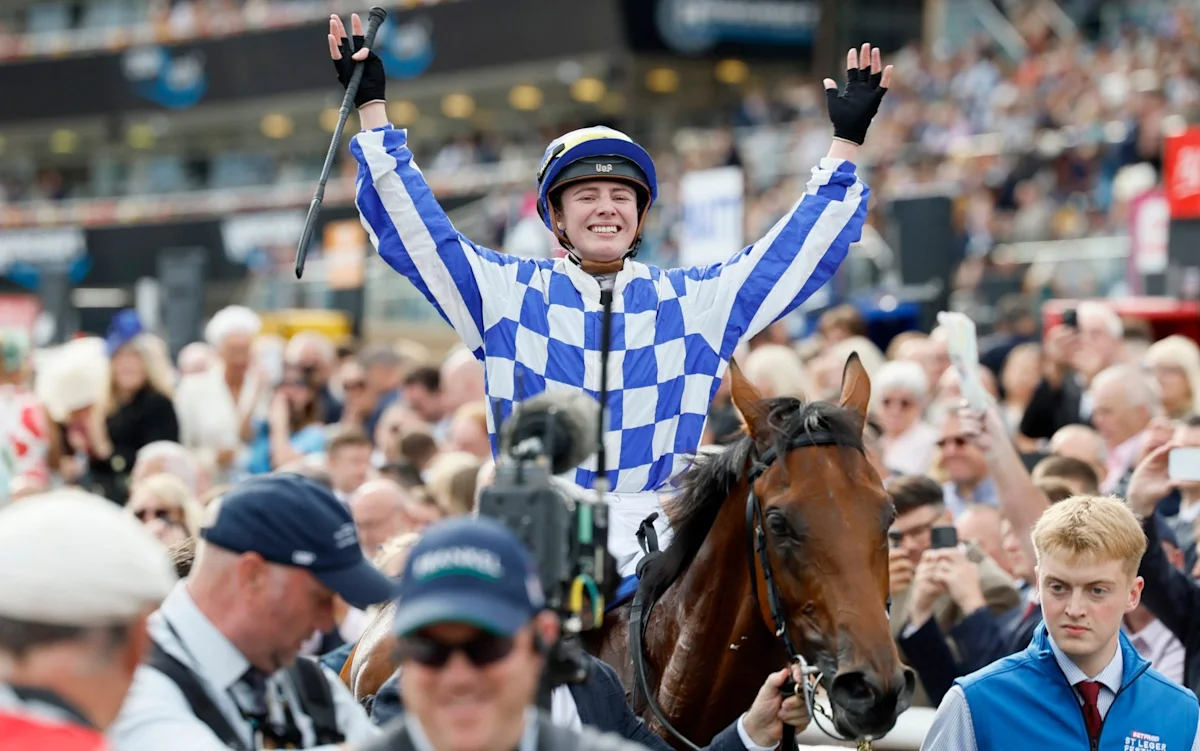
Last Saturday at Doncaster, Saffie Osborne made racing history just moments after Hull City scored against Chelsea in the Premier League—a coincidence made all the more notable because two of her brothers were at Stamford Bridge watching the match. Her father, Jamie Osborne, recounts how her brothers, enthusiastic Chelsea supporters, celebrated Hull’s goal only to realize it was Saffie who had just won the St Leger, leaving them to explain the significance of the race to curious onlookers.
The St Leger is among the five British Classic flat races, prestigious events for three-year-old horses, alongside the 2,000 Guineas and the Derby. On this historic weekend, nearly 50 years after women first competed as professional jockeys, Osborne broke a longstanding male dominance by becoming the first female jockey to win a domestic Classic—claiming victory aboard Highwayman in the 250th running of the St Leger.
To appreciate Osborne’s feat, it’s important to note that over 1,150 Classics have run since the Leger’s inception in 1776, underscoring the rarity of her accomplishment. At 24, Osborne appears poised to become a standout figure in British Flat racing, blending youthful ambition, mental toughness, and experience. Notably, her relatively light riding weight of 8st 2lb gives her an advantage over many male jockeys who struggle to make 8st 9lb. She is strong, stylish, and tactically savvy—a promising combination for future success.
None of Osborne’s family were at Doncaster to witness the moment live. Jamie Osborne, a former top jump jockey, was at Bath races; her mother, equine artist Katie O’Sullivan, attended Cornbury House Horse Trials; and her brothers, Wolfie and Hubie, watched football. Despite their absence, though, family support has been key throughout her career, with horse riding deeply embedded in her life from an early age—she was riding ponies before she could walk. Jamie describes her as having “won the genetic lottery,” growing up as the youngest among three tall older brothers who didn’t hold back from keeping her sharp and confident.
This upbringing helped cultivate Osborne’s mental resilience, evident during her teenage years. At 14, she persuaded Lord Blyth to buy a pony named Indian Little Feather during a casual gathering, then went on to compete on that pony at the 2018 European Under-16 Eventing Championship, where she led after cross-country and faced immense pressure in show jumping. Despite nervousness from her father, she remained composed, a toughness that has since defined her approach to high-stakes competition.
Osborne agrees that while eventing skills don’t directly translate to racing, the mental strength gained has been invaluable. “From a young age, I was exposed to high-pressure situations. It makes my life easier now because I have no doubt I can handle it,” she says.
In her late teens, Osborne made the pivotal decision to switch from eventing to racing, leaving school midway through her A-levels without notifying her mother. Jamie recalls her sudden announcement that she wouldn’t return to school, having secured a job at Ballydoyle stables in Ireland. This bold move marked the start of her focused commitment to becoming a jockey.
Her determination took her from Ireland to Australia, where she worked with top trainer Ciaron Maher. She speaks of this experience as crucial in teaching her about pace and maturity, noting, “I grew up pretty quickly.” Reflecting on her start in racing, Jamie remembers her first ride at Wolverhampton at age 18, which, while not victorious, showed promise. Since then, Osborne has flourished, winning races like the 2022 November Handicap and the 2023 Chester Cup on Metier, as well as the Victoria Cup on Hickory in 2025. She also led teams to victory in the Shergar Cup and topped the Racing League in 2022. Until the St Leger win, she had yet to capture a Group One or Classic race — achievements she now holds together.
Osborne prefers to downplay her gender in what remains a male-dominated sport, citing “riding like a boy” as the highest compliment she’s received. Still, becoming the first female Classic winner fills her with pride, joining ranks with trailblazers like Hayley Turner, the first female Group One winner, and Hollie Doyle, the first female European Classic winner.
Her career hasn’t been without setbacks; a serious fall at Windsor in 2020 resulted in multiple injuries, yet her resolve to continue racing has been unquestionable. Jamie acknowledges the dangers of eventing but feels relieved she chose racing, where her daughter’s focus and mental strength set her apart.
As a former jockey, Jamie offers perspective and guidance: success hinges more on mental grit than raw ability, including the capacity to handle pressure and maintain consistency. His advice to Saffie emphasizes enjoying the privilege of riding quality horses, given the likely brevity of a jockey’s career, especially for women who might someday choose to start families. This mindset of savoring every moment has clearly resonated with her.
In a heartfelt moment post-Leger, Osborne recalled a phone call from her father telling her it was the proudest day of his life.
Fan Take:
Saffie Osborne’s groundbreaking St Leger victory is a monumental moment for horse racing fans, signaling a new era of inclusivity and excellence. Her rise demonstrates that talent knows no gender, and her success could inspire more young women to pursue careers in a sport traditionally dominated by men, potentially transforming the future landscape of British Flat racing.
Source: sports.yahoo.com