
Seth Walder — analytics writer for ESPN and frequent contributor on betting coverage — Sep. 18, 2026
The opening game of the 2026 NFL season was a stark reminder: backup quarterbacks usually don’t move the needle — until they do, and then they matter a lot. Early injuries thrust several reserves into action: Sam Darnold’s exit in the Seahawks’ opener sent Drew Lock onto the field, and when Kyler Murray left Week 1 with a concussion the Vikings inserted Carson Wentz. Both teams won with their backups, largely because their defenses performed well; had the offenses stalled with the substitutes under center, those outcomes could have been very different. The Falcons’ recent experience — starting their third-stringer Cooper Rush with Tua Tagovailoa and Michael Penix Jr. unavailable — underscores how fragile depth can be.
Because backups are already influencing results this season, I ranked every team’s designated No. 2 quarterback. This is a difficult task: for many clubs the sample size is tiny, some backups haven’t taken a meaningful regular-season snap in years, and several young reserves have little to no NFL track record. That uncertainty increases the margin for error, but teams still must choose backups with limited information, so it’s worth evaluating them the same way.
Notes on methodology: I included Carson Wentz and Drew Lock among the No. 2s. For Atlanta I treated Michael Penix Jr. as the team’s backup for the list (while noting where Cooper Rush — currently starting because both Tagovailoa and Penix are out — would rank if he were the true No. 2).
Las Vegas — Mendoza
This was the clearest pick. While Mendoza hasn’t taken a regular-season snap yet, being the top overall draft selection gives him enormous upside and places him at the summit of this group. If you needed a backup to win a handful of games right now, he’s the one I’d pick. Two years ago Drake Maye occupied this slot; the Raiders would certainly welcome Mendoza following a similar trajectory. Ironically, last year’s No. 1 on this list was Kirk Cousins, who sits ahead of Mendoza on Las Vegas’ depth chart.
Washington — Marcus Mariota
If a team needs to survive a few contests without its starter, few veterans are more dependable than Mariota. He started eight games (11 appearances overall) for Washington last season when Jayden Daniels was sidelined, posting a 50.4 QBR and a 57.4 QBR since 2022. The Commanders landed good value re-signing him on a one-year, $7 million deal this offseason; at 32 he’s still a very serviceable insurance policy.
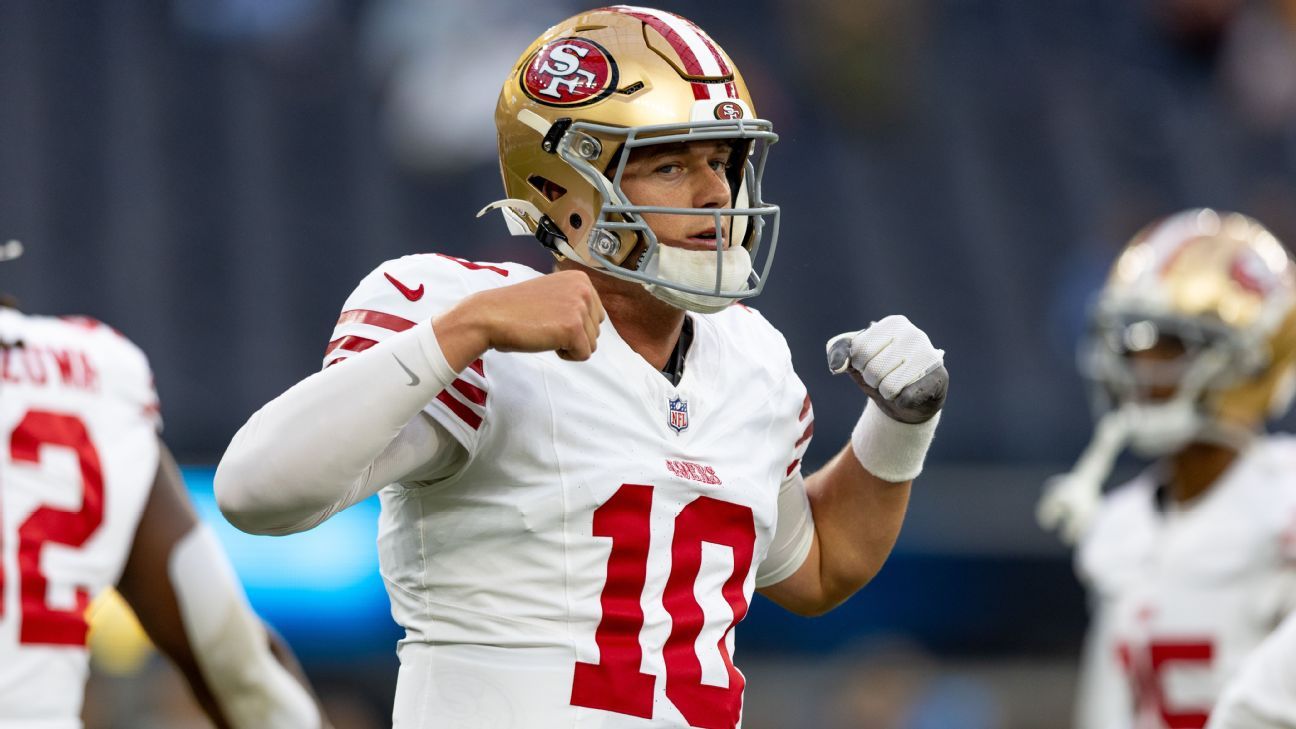
San Francisco — Sam Jones
Under Kyle Shanahan’s tutelage — the same system that helped Sam Darnold — Jones boosted his stock while filling in for Brock Purdy across eight games, producing a 62.7 QBR and a +3% completion percentage versus expectation (per Next Gen Stats). Those numbers look starter-caliber, but his 2022–24 resume (a 37.6 QBR during stints with the Patriots and Jaguars) tempers expectations and suggests some of his improvement may be scheme-driven rather than purely personal development.
New Orleans — Jalen Rattler
Despite a 1–7 record in his starts last year, Rattler showed clear progress from his 2024 rookie season. His QBR rose to 50.8 (from 37.1), his completion percentage versus expectation improved by about 13 percentage points, and his off-target rate dropped substantially. He’s still young and possesses upside; it wouldn’t be surprising if he gets a real chance to compete for a starting job within the next couple years, whether with the Saints or elsewhere.
Atlanta — Michael Penix Jr.
If Penix ultimately ends up behind Tua rather than starting, he’d rank very highly among backups. He’s had an up-and-down career but has only 12 NFL starts and remains close to a top-10 draft pedigree. His 55.7 career QBR and a low sack rate (4.1%) are encouraging. Accuracy has been a concern — a 21% off-target rate and a –4% completion percentage versus expectation — and he’s recovering from a torn ACL last November, his third ACL tear overall, but his youth gives him room to develop.
New York Giants — Jameis Winston
Winston has transitioned into a high-end reserve role. His play tends to be boom-or-bust: over the last four seasons he’s posted a high turnover rate (3.9%) but still managed a 49.7 QBR, largely because he consistently attacks downfield. Since 2022 he’s averaged 9.6 air yards per attempt, more than any qualifying passer last season.
Tampa Bay — Jake Daniels (undrafted rookie)
This might look like a reach on paper, but an undrafted player earning a real backup job is a stronger signal than a mid-round pick landing a similar role because of draft capital. Daniels beat out Jake Browning for the spot, which matters. His preseason tape showed excellent mobility and downfield throwing ability; he’s riskier and less useful on a Super Bowl contender looking for a safe veteran, but his upside could pay off.
Tennessee — Mitch Trubisky
Trubisky saw limited action backing up Josh Allen in Buffalo over the past two seasons, but had seven starts earlier in his career. Over the last four seasons he’s produced a 54.7 QBR and a +4% completion percentage versus expectation. If the Titans had to name him a starter, their Football Power Index would actually improve relative to naming Cam Ward.
Green Bay — Tyrod Taylor
Taylor’s age (37) requires factoring in decline, but in short-term replacement scenarios he’s a perfectly acceptable option. Across the past four seasons he’s logged a 49.9 QBR and a +2% completion percentage versus expectation. He also mixes in deep attempts (13% of his throws travel 20+ air yards) and scrambles enough to create variance and keep defenses honest.
Baltimore — Tyler Huntley
Huntley’s stock dipped in 2024 when he bounced between teams, but after returning to the Ravens in 2025 he saw meaningful action, including two starts, and played very well — an 81.1 QBR in that limited sample — earning a new deal with $3.5 million guaranteed from Baltimore.
Pittsburgh — Mason Rudolph
Rudolph originally won the Steelers’ backup job seven years ago, left the team, then returned last season and remains the backup even after a coaching change. He’s been steady overall, producing a 53.6 QBR over the past four seasons. Rudolph prefers shorter throws (6.5 air yards per attempt) and doesn’t push past the sticks often (only 36% of throws), but his aggregate numbers are reliable.
Chicago — Tyson Bagent
Since Caleb Williams arrived in Chicago in 2024, Bagent has mostly been a preseason figure, but his 2023 stint (five games, four starts) was encouraging: a 51.8 QBR, a higher interception rate (3.6%), and limited downfield usage (6.0 air yards per attempt), but a very low sack rate (3.0%). As a former Division II QB, it will be intriguing to see how he fares if he gets snaps in Ben Johnson’s scheme.
Seattle — Drew Lock
Lock played well in relief in Week 1, posting a 79.9 QBR in Seattle’s 13–10 victory over New England. Still, his four-year numbers are less flattering: a 46.9 QBR and a –4% completion percentage versus expectation, although dropped passes have been a notable problem. Lock’s reputation is for willingness to throw deep, but his metrics show only 7.1 air yards per attempt and just 34% of throws going past the sticks — both below average.
Cincinnati — Joe Flacco
At 41, Flacco remains a credible veteran backup. He isn’t mobile, but he can still produce big stat lines: last season he had a 342-yard, three-touchdown game in a win over Pittsburgh and a 470-yard, four-touchdown outing in a loss to Chicago, posting mid-70s QBRs in both. Since 2022 he’s had a 44.1 QBR overall.
Minnesota — Carson Wentz
Wentz helped fuel Minnesota’s Week 1 comeback, including a 39-yard TD pass to Justin Jefferson, finishing that game with a 58.9 QBR. Despite the encouraging performance, his longer-term numbers are mixed: a 43.7 QBR and a –2% completion percentage versus expectation since 2022. Still, Minnesota values a quarterback who can consistently throw deep to Jefferson, and Wentz fits that profile.
Arizona — Gardner Minshew
A year ago both Minshew and Jacoby Brissett were among the top backups; now they’re teammates with Brissett listed as the starter and Minshew as the primary reserve ahead of rookie Carson Beck. Minshew excels at quick releases and short passing (48% of his attempts come within 2.5 seconds; 6.7 air yards per attempt). He earned a sizable contract after a strong 2023 with the Colts but showed limitations afterward; he’s proven to be a reliable, if non-starting, option.
Miscellaneous notes
Several other teams’ backups were grouped together in the original list: Detroit, Cleveland, Kansas City, Philadelphia, Los Angeles Rams, Carolina, Miami, Dallas, Denver, New York Jets, Indianapolis, Houston, Buffalo, Los Angeles Chargers, New England, and Jacksonville. Also worth noting: Cooper Rush — Atlanta’s third quarterback who’s currently starting while Tagovailoa and Penix are sidelined — would slot around 30th on this list, just behind Kyle Allen, if included.
Fan Take:
Backup quarterbacks are more consequential than fans often credit — their performance can determine whether a team survives a short injury stretch or falls out of contention. As injuries and game-day absences continue to shape seasons, teams that invest wisely in experienced, adaptable backups will have a measurable competitive edge.
Source: www.espn.com