

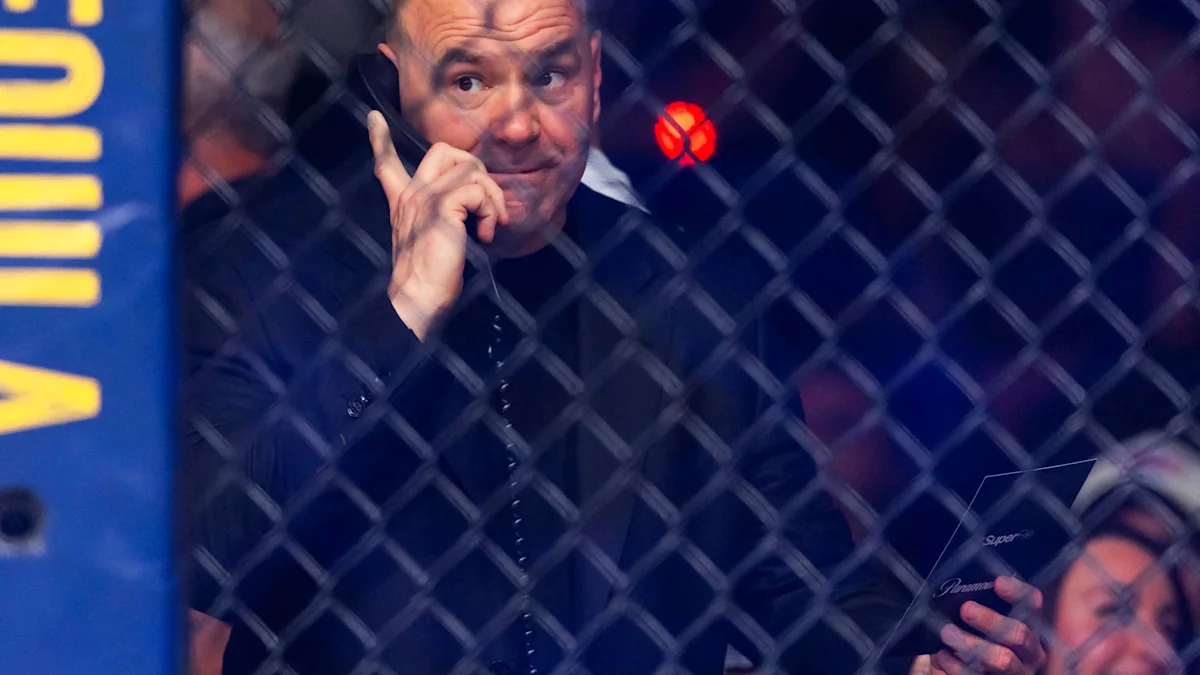
UFC President Dana White has expressed his agreement with California State Athletic Commission Chair Andy Foster’s recommendation to prohibit oblique kicks to the knees in MMA. White shared his thoughts during the Week 7 post-fight press conference for Dana White’s Contender Series, praising Foster as the most influential figure in athletic commissions worldwide and acknowledging their shared view on the matter.
Foster first raised the idea of banning these knee strikes following UFC 331. As discussions heat up among commissions and the UFC regarding the potential rule change, it’s worth examining the impact of these “lateral kicks to the knee” and whether such a ban is warranted.
One of the most famous practitioners of the oblique kick is Jon Jones, the former UFC light heavyweight and heavyweight champion. Although he did not invent the move, Jones popularized it during his reign, using it effectively to manage distance and confuse opponents thanks to his wrestling background and impressive reach. In a VICE Sports “Fight School” series, Jones and his former coach Mike Winkeljohn highlighted the strategic value of the strike, with Winkeljohn pointing out the irony that fighters accept blows to the head risking brain injury but are concerned about knee strikes. Jones defended the technique as a controversial yet fair countermeasure when facing dangerous opponents.
Several recent fights underscore the debates around oblique kicks. At UFC 331, Brunno Ferreira used the move against Edmen Shahbazyan, who protested during the bout, though he ultimately won via unanimous decision and was medically sidelined due to a fractured foot unrelated to the kicks. Similarly, UFC flyweight champion Joshua Van heavily employed oblique kicks in his June 2025 fight against Brandon Royval, who later revealed he suffered a torn MCL needing rehabilitation.
A notably severe case involved Shavkat Rakhmonov, whose UFC 310 bout with Ian Machado Garry included numerous oblique kicks that contributed to significant knee injuries—meniscus and ACL damage—from which Rakhmonov is still recovering. Once considered a future welterweight champion, the Kazakh fighter’s injury-induced hiatus has caused him to drop out of rankings despite an undefeated record, with expectations of a 2027 return.
In an extreme instance at UFC Fight Night 191 in 2021, Khalil Rountree’s stomp on Modestas Bukauskas’s knee led to serious ligament injuries. Despite this, Bukauskas defended the legality of the technique, referring to it as legitimate fighting, and later returned to achieve a solid UFC record.
When it comes to rule changes, the situation is complex. The Unified Rules of MMA are governed by the Association of Boxing Commissions and Combative Sports (ABC), not by the UFC directly, and each state commission decides which rules to enforce. Foster’s suggestion has to navigate the ABC’s committee processes and gain widespread adoption—a path that previously stalled after the Rountree-Bukauskas incident. Referees also face challenges in consistently identifying and enforcing a ban due to the rapid and chaotic nature of fighting exchanges, making instantaneous judgment calls difficult.
Foster has proposed refining foul classifications beyond the current intentional/unintentional binary to include “incidental,” “reckless,” or “malicious,” which could aid post-fight assessments but not real-time officiating. The severity and intent behind these kicks often blur lines, as both minor and devastating impacts look similar under the existing rules.
While Dana White’s support carries weight in the MMA world, he does not have regulatory authority. Foster’s proposal remains under consideration, requiring thorough medical review and precise rule wording before any ban could be implemented. Until then, oblique kicks remain legal, and fighters are expected to continue using them amid ongoing debate and safety concerns.
Fan Take: This development is crucial for fight fans as it highlights the ongoing balance between fighter safety and combat strategy. If oblique kicks are banned, it could significantly alter striking tactics and fighter dynamics, potentially reducing career-threatening injuries without compromising the sport’s intensity.
Source: sports.yahoo.com