
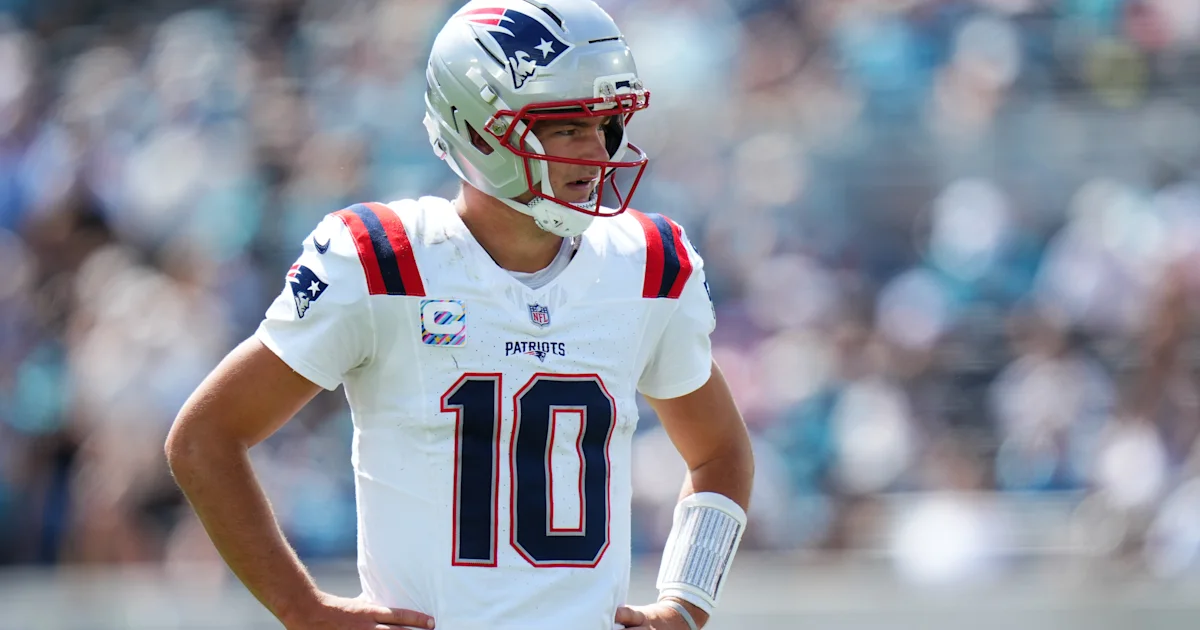
After scoring 490 regular-season points and making an unexpected — perhaps premature — Super Bowl run in Mike Vrabel’s debut season and Drake Maye’s sophomore year, New England’s offense looks much more ordinary through the first three weeks of 2026. Analysts and fans have pointed to many causes: a tougher early slate, a young quarterback supposedly being figured out by the league, stagnation from returning players, and new additions who have either disappointed or been sidelined by injury.
As with most football problems, responsibility is shared — everyone involved in the Patriots’ offense carries some blame for the slow start, just as multiple people would get credit if things were clicking. Spoiler: as October arrives, nearly everyone in New England has a slice of the blame. (All data referenced is from TruMedia unless otherwise noted.)
Clearing up myths about Maye
First up, Maye. He’s still one of the youngest starting QBs in the NFL and came into 2026 following a breakthrough season that included second-team All-Pro honors and an MVP runner-up finish. Skeptics have pointed to lukewarm playoff showings and an easy regular-season schedule as reasons to temper expectations. But the defenses he faced last season were mostly around league average in pass defense — not exactly cupcake opponents.
Some pundits claim Maye struggles against certain coverages, especially Cover 6 (a split coverage mixing Cover 2 and Cover 4). That’s not supported by the data. Numbers have been skewed by multiple matchups against the Seahawks, a team that leaned on Cover 6 heavily and was one of the NFL’s best defenses last year. Aside from Seattle — and a second matchup with Buffalo — Maye has shown little trouble reading defenses. Including those Seahawks games, his dropback success rate against Cover 6 since the start of last year is 46%, slightly above league average (45.4%), comparable to several established QBs. His explosive pass rate against those looks is near average, too.
Maye’s in-game decision-making has mostly held up despite a messy start. Among 28 quarterbacks with 50+ pass attempts, he ranks 12th in dropback success rate, even while playing arguably the league’s toughest defensive schedule per FTN’s DVOA. That 46% success rate sits ahead of notable veterans like Matthew Stafford and Joe Burrow — players nobody is calling “off” this year.
Turnovers: why they jumped
Where Maye’s production has suffered most is turnovers. Fumbles are likely an ongoing risk — he has relatively small hands (just over 9 inches), plays aggressively both throwing and running, and has led QBs in fumbles lost after being sacked (eight) since entering the league.
His interceptions this season, however, tell different stories. Each one reflects different problems: a young quarterback pressing, ill-timed aggressiveness, and an offense that often looks predictable and lacking true game-changing talent — made worse by injuries and questionable usage of certain players. Here’s a quick autopsy of the six picks:
– Interception 1: A forced throw when a checkdown was open.
– Interception 2: A brilliant read and play by veteran defensive back Julian Love, who betrayed the throw by reading the route concept and Maye’s eyes.
– Interception 3: Route confusion after Mack Hollins released inside, collapsing the concept — Maye should have thrown it away.
– Interception 4: Multiple problems — pressure up the middle (Maye has been pressured on 42% of dropbacks this year), and Hunter Henry failing to locate his route.
– Interception 5: A poorly designed play that defenders recognized in advance; Jaguar Travis Hunter said the crew practiced it and knew what was coming. The play also featured mismatches — Rhamondre Stevenson (not a speed threat) running a wide horizontal route, Hollins failing to pick up a blocker, and Efton Chism III stumbling on his route — and ended with a classic example of piling errors on top of each other.
– Interception 6: The defensible read, but Kyle Williams was five yards short on a stutter-step route, letting the corner undercut the throw.
Bottom line: quarterbacks must protect the football and avoid compounding mistakes. Maye’s EPA is depressed by this turnover surge, but small-sample variance and bad plays can distort those advanced metrics — other QBs have started seasons poorly in EPA and recovered (e.g., Joe Burrow, Trevor Lawrence in 2023, Dak Prescott in 2018). Maye’s high scramble rate and sack rate are more understandable given chronic pressure and the lack of reliable downfield targets; his scrambling has been efficient (9 of 10 scrambles successful) and he loses relatively little yardage per sack (second-best at 4.2 yards lost per sack).
Maye still has to make big downfield throws to create explosive plays, and in this offense that often means he must be near-perfect — because the scheme and personnel rarely produce easy chunk plays. So far this season, most of Maye’s successful throws for 15+ yards require substantial air yards: his average air yards per 15+-yard gain is 21.4, the highest in the NFL. By comparison, Joe Burrow’s comparable number is 15.9 and Patrick Mahomes is 12.0. That illustrates how much Maye is being forced to generate big plays himself, increasing volatility.
Supporting cast and schematic problems
Beyond the QB, the Patriots’ scheme and skill group have been underwhelming. Hunter Henry — steady but never fleet — has shown declining burst and route-speed metrics over the last two seasons, and he’s been less dependable. The rest of the receiving corps has offered almost no yards-after-contact juice: per Next Gen Stats, the Patriots’ receivers have forced zero missed tackles this year, while other individual players around the league have already done more.
There is optimism on the injury front: A.J. Brown (limited to just over a half before landing on IR with a high-ankle sprain) and rookie tight end Eli Raridon (battling a thigh injury and dealing with a personal tragedy) could return in the coming weeks, which should help. But usage and play design have been puzzling with current players.
Take Romeo Doubs, another off-season addition. In Green Bay he excelled on breaking routes at the short-to-intermediate levels, especially on outbreakers. New England has largely used him on vertical patterns, increasing his percentage of “go and stop” routes and cutting his outbreaker usage roughly in half compared to 2025. That’s a mismatch with what made Doubs productive previously: when targeted on outbreakers this year, he has three catches for 100 yards. Recasting him into the wrong role is wasting his strengths.
DeMario Williams is another example of miscasting: in the NFL he’s been shoehorned into isolated vertical roles, whereas in college he produced plenty from the slot (143 slot routes in his last two college seasons, much more productive than when he lined up outside). Williams showed slot potential in New England before (a 72-yard touchdown on an over route from a condensed split last season); it’s odd not to experiment more with formations that could create space and open up the offense.
The line and run game aren’t helping either. Seattle exposed the Patriots’ protection schemes in recent meetings, and injuries on the right side plus center Jared Wilson’s struggles have complicated matters. New England has tried pocket-movement protections like Dash Pass to give Maye space, and there have been creative plays that worked — TreVeyon Henderson’s long TD versus the Steelers came on a tackle-pull, a tendency-breaker that paid off. The problem is a tendency to revert to basic, predictable concepts too often.
The Patriots run a lot of the duo run concept, which is generally a sound play in today’s NFL. Their duo run success rate is above average, but those runs rarely produce big plays: they average only 3.5 yards per carry on duo runs and have been stopped for no gain or negative yardage more than any other team. They also use motion sparingly on early-down runs (45.6% with motion overall, but only 26.3% at the snap — both bottom of the league), which would help mask personnel deficiencies if used more.
And when New England does try certain high-concept plays, they sometimes telegraph them. An example: “Hoss Juke” versus the Jaguars — a concept designed to isolate a top receiver against a linebacker — was easily countered by Jacksonville dropping nine into coverage, and the play ended in a drop by DeMario Douglas. Those kinds of predictable looks erode trust in creative calls.
Why a rebound is plausible
There are reasons to be optimistic. The schedule softens somewhat, injured playmakers (Brown, Raridon) could return in the next few weeks, and the Patriots’ defense has been solid (ranking first in EPA against the pass and fifth in pass defense success rate). The offense has moved the ball before turnovers and costly penalties; it’s not utterly broken. Using a combined metric of success rate and explosive plays (a homebrew called SUPLEX), the Patriots sit just below league average at 21st — not great, but far from the worst.
Looking at Maye’s career through the lens of larger samples is also encouraging. Including his rookie year and the odd Jerod Mayo season, Maye ranks very highly among QBs with at least 1,000 dropbacks through their first three seasons since 2013 — top-three or top-five in several measures depending on whether you count playoff games — alongside names like Mahomes and Brock Purdy. He’s been one of the most efficient scramblers and ranks high in completion rate and dropback success. Those indicators suggest the ceiling is real.
So, while turnovers and schematic issues have lowered Maye’s current floor, the underlying indicators and matchup improvements ahead give reason to expect the Patriots and their young QB to stabilize. The task now is to shore up protection, use personnel in roles that fit their strengths, and add schematic variety before things slide further.
Fan take (two sentences):
This matters because how the Patriots respond will shape not only Drake Maye’s development but also the wider QB market — teams are watching whether a promising young passer can overcome a flawed supporting cast and schematic rigidity. If New England fixes protection, uses players like Doubs and Williams correctly, and reduces turnovers, it could become a blueprint for building around a high-upside QB rather than abandoning them after a rocky start.
Source: sports.yahoo.com