
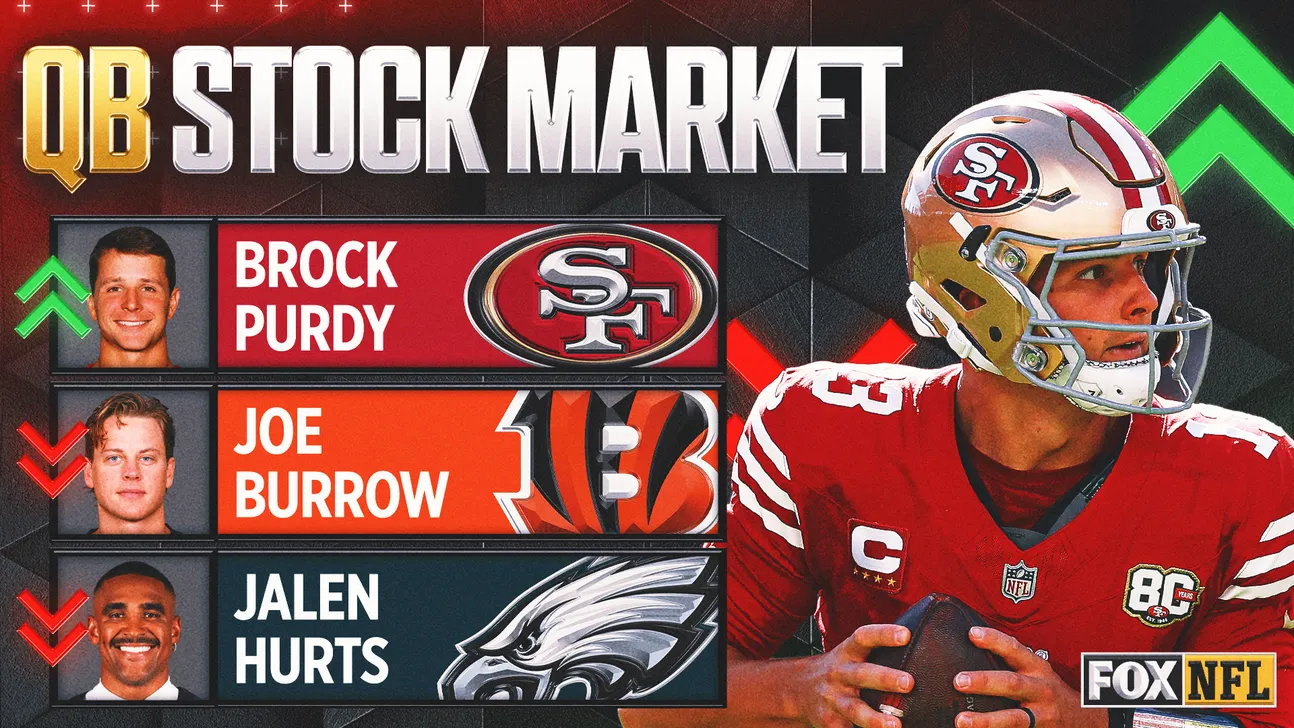
Around the league there’s still skepticism about Brock Purdy’s breakout season. I’m not buying it — I consider him the top quarterback right now. Jalen Hurts is drawing more doubt than ever, which I understand, but I expect him and the Eagles to sort things out. The most fraught debate is over Cam Ward, and that one’s more complex — worth a deeper look.
Welcome back to the QB Stock Market.
This series isn’t a standard ranking list. It tracks how starters’ stock rises and falls as the season progresses. No QB’s status is fixed — even Purdy can slip, and even Athan Kaliakmanis can climb fast. The key question: what are you doing for your team lately?
Cam Ward
Ward’s play splits opinion. Through 21 appearances he’s thrown for 3,895 yards with 18 TDs and nine interceptions, completing 60.4% of his attempts for a meager 5.9 yards per attempt, and Tennessee is 3-18 when he starts. Still, some metrics are trending the right way this year: completion rate, yards per attempt, sack rate, QB rating and QBR have improved. Those are small, encouraging signs — but they’re hard to fully trust given how often the Titans are trailing in games.
On film you see the same inconsistencies as in his rookie year: Ward will make a difficult play look effortless and then struggle with something routine. That gives both his supporters and skeptics ammunition. Even his calm demeanor at the podium now sparks debate; people interpret his pocket composure as either poise or a lack of urgency.
There’s valid criticism to be made, but given he was drafted No. 1 overall as a developmental project on a poor roster, the Titans shouldn’t abandon him quickly. This was always going to be a multi-year experiment. Ward needs time — and he has to clean up the error-prone moments so the polished parts of his game can’t be disputed.
Jalen Hurts
Third down was the Eagles’ undoing against the Rams. Hurts went 1-for-7 for five yards and posted a 39.6 passer rating, facing a 90% blitz rate that forced him to escape the pocket repeatedly. Even with extra time (about 4.02 seconds), he couldn’t create because the Rams were tight on Philly’s receivers, and Hurts doesn’t consistently snap his body around to make tough cross-field throws into coverage. He looked flustered.
There were missed chances — like third-and-14 in the second quarter when Makai Lemon was wide open — and baffling play calls, such as asking veteran Zach Ertz (who missed camp and is only on his second game back) to win a crucial one-on-one on third-and-short. Hurts finished 12-of-27 for 93 yards, two TDs and faced 19 pressures. It’s somewhat miraculous he only took four sacks, but the Rams’ blitzing left him unsettled for long stretches and limited his willingness to attack the middle or take aggressive downfield shots.
Despite that, I believe the Eagles will get this fixed. Saquon Barkley and DeVonta Smith should regain full health, Lemon is improving, and Jameis Winston is currently the NFC East’s leading QB1 — all reasons to think Philly still reaches the playoffs.
Deshaun Watson
Watson is once again complicating Cleveland’s QB picture. He’s played well enough to keep his job in 2026, and the Browns sit at 3-1, but he’s not a long-term answer. Injuries and inconsistent play should have led to a clearer move away from him earlier, but his contract has limited Cleveland’s decisions — and if Watson helps the team make the playoffs this year, that could complicate their draft plans for a true franchise quarterback.
He’s mostly a pocket operator who can run Todd Monken’s scheme and has helped get the ball into promising young pass-catchers, though he tends to over-target Denzel Boston at times and hesitates on deeper throws. Bottom line: Watson can facilitate now, but the Browns likely won’t — and shouldn’t — build around him beyond this season.
Kirk Cousins
Cousins is enjoying a late-career resurgence under Klint Kubiak, playing some of the best football of his career despite a weak rushing attack and no dominant WR. He’s become an effective distributor — a reliable “point guard” — but that’s always been his ceiling: a quarterback who thrives when surrounded by playmakers. The Raiders can win in the regular season with him, but when matched against teams with superior talent — especially at QB — they’ll struggle in critical moments. If Vegas can add playmaking talent (and get Francisco Mendoza ready), Cousins’ system-friendly strengths could be amplified next year.
Joe Burrow
The Jaguars’ defense is elite, and Burrow was the latest signal-caller to feel that heat. He threw two interceptions in Week 4 as Jacksonville generated pressure on 34.5% of his dropbacks. Under pressure, Burrow completed only 52.9% of attempts; without pressure that number was 81.1% — a huge split that mainly explains the upset. Ja’Marr Chase’s absence compounds the problem because a quick, reliable primary target shortens reads and helps beat the rush. Still, Burrow’s overall metrics aren’t catastrophic — he’s been good this season — but those two INTs were costly, and in a tight AFC race they could matter a lot.
Josh Allen
Drake Maye outplayed Allen in their recent matchup, but Allen’s performance wasn’t bad overall. The decisive moment was Allen’s interception with under a minute left: he was pressured, held onto the ball too long, and forced a throw into coverage that safety Craig Woodson intercepted. Part of the blame also goes to Joshua Palmer, who was ineffective and even dropped a deep ball in the game (though a holding flag would have nullified it). Allen finished 23-of-33 for 253 yards, a passing TD and the costly pick, plus a rushing score. It’s hard to fully credit a QB’s outing when his final drive undid him.
Brock Purdy
I think we’re overcomplicating Purdy’s season. He’s playing at an elite level. Against Denver he completed 19 of 30 for 218 yards, two TDs, no turnovers and no sacks, and he scrambled when necessary. That’s the gameplan that beats the Broncos: patient, efficient, and methodical.
Yes, critics pointed to some errant throws — a missed early pass to Jacob Cowing, off-target throws to George Kittle and Brandin Cooks that drew apologetic DPI appeals, and a cross-body miss to Mike Evans in the end zone. The Evans miss was explainable, though; the safety was in position to make a play on the ball, so Purdy placed it behind the big receiver.
His game-winning dime to George Kittle was essentially a short-target play (depth of target of -1 yard), but Kittle turned it into six with his run after catch. Purdy doesn’t have a classic “MVP moment” yet — those single, jaw-dropping game-to-win-the-season plays that swing voters — but he’s done the steady work every week, attacked downfield when possible, created a moment of improvisation on a TD to Deebo Samuel, and consistently moved the chains despite an ordinary running game and banged-up supporting cast.
He’s perhaps the best QB in the league against the blitz, and while he may not grab MVP hardware, he’ll remain in the top-tier conversation and is leading a legitimate Super Bowl contender. The takeaway: stop overthinking what’s obvious.
Fan Take:
This matters because quarterback play ultimately shapes the NFL’s biggest storylines — playoff races, draft plans and contract decisions — and the swings in opinion about guys like Purdy, Hurts and Ward highlight how quickly a QB’s stock can rise or fall. For fans, these debates are meaningful: they affect who we expect to see in January, which franchises will rebuild or double down, and how the league’s next generation of stars is judged.
Source: www.foxsports.com