
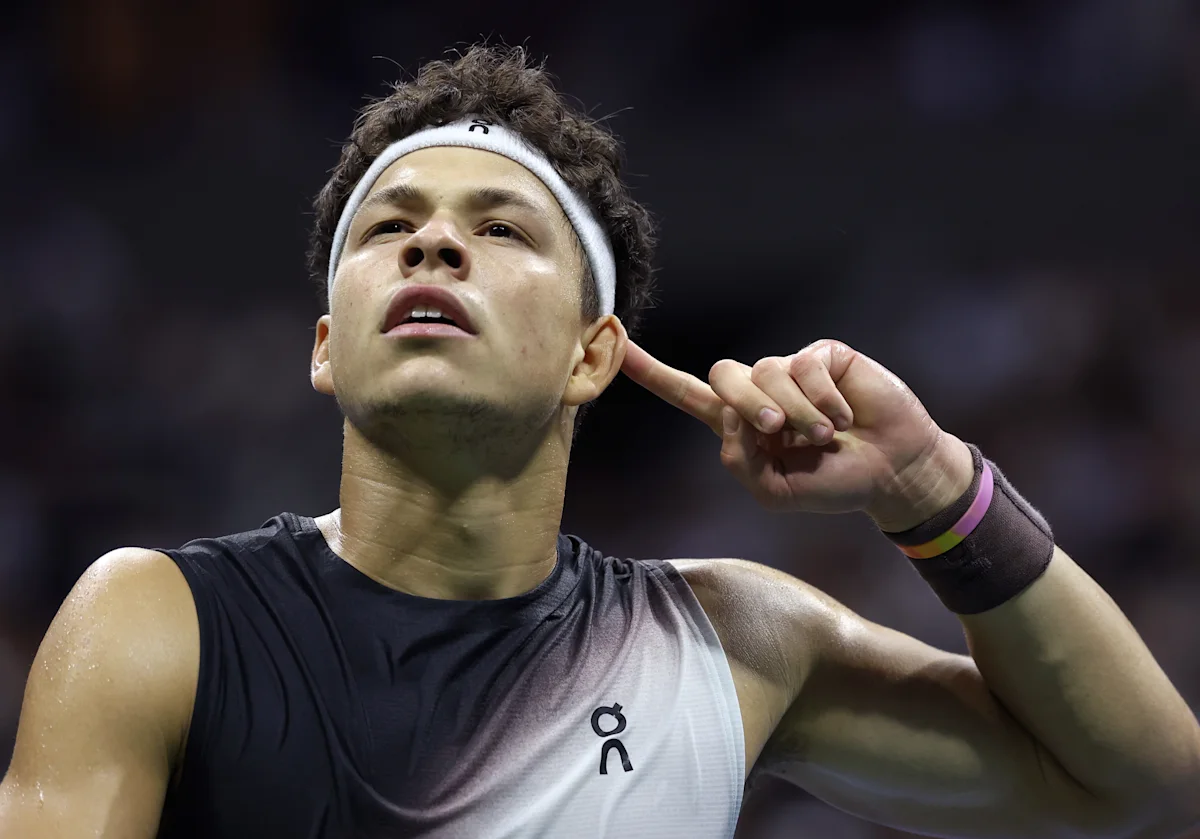
When Ben Shelton takes the court at the 2026 US Open final Sunday, with all of Arthur Ashe Stadium behind him, he will represent the USA’s best chance at ending a 23-year men’s Grand Slam drought since the retirement of Andy Roddick.
In his way will be Alexander Zverev, the tournament’s No. 1 seed and the consensus third-best player in the world. A man playing his third straight Grand Slam final, who is 24-0 against players not named Jannik Sinner and Carlos Alcaraz in majors this year.
Advertisement
Let’s get into what to expect when the two face off at 2 p.m. ET on ABC.
How Shelton and Zverev got here
Shelton: The American has played the far more interesting matches this tournament, especially his last two contests.
Few Americans were able to stay up for his quarterfinal classic against Alcaraz, but it was a major step forward for a player whose potential has always been visibly apparent. Shelton went blow-for-blow with a seven-time Grand Slam winner — who, to be fair, was playing his first tournament in more than four months — and came out on top.
Then came a semifinal against his good friend and countryman Frances Tiafoe. He appeared to have some nerves early on, committing 14 unforced errors in the first set, but locked in early in the second set and overwhelmed Tiafoe for a four-set win.
His full path:
Advertisement
Semifinal: No. 11 Frances Tiafoe, 4-6, 6-3, 6-3, 7-5
Quarterfinal: No. 2 Carlos Alcaraz, 6-7, 6-1, 6-3, 1-6, 7-6
Fourth round: Stefanos Tsitsipas, 6-2, 6-3, 6-4
Third round: Denis Shapovalov, 7-6, 6-7, 6-3, 6-4
Second round: Hubert Hurkacz, 6-3, 5-7, 7-6, 7-5
First round: Tallon Griekspoor, 1-6, 6-1, 7-6, 6-2
Zverev: It’s hard to remember an easier path to a Grand Slam final than the ride Zverev has taken to this Sunday afternoon.
Actually, no, that’s wrong. We can think of a path just as easy. It was Zverev’s path to the Roland-Garros final this year, which he won against No. 10 seed Flavio Cobolli.
Like he did in Paris, Zverev has not faced a single player with a seed higher than 20 in Flushing Meadows over the past two weeks. The highest seed Zverev has faced is No. 21 Luciano Darderi, a clay-court specialist with a losing record on hardcourts in his career.
Pillow soft doesn’t even begin to describe this run of opponents, but for all we know it could work to Zverev’s detriment. Shelton is multiple levels above anything he has experienced at Flushing Meadows this year, and that could take some adjustment. It also wasn’t an incident-free path, as Zverev got taken to a fifth set in his first two matches, a first for a Grand Slam top seed.
Advertisement
He hasn’t dropped a set since then.
Semifinal: Karen Khachanov, 6-3, 7-6, 7-6
Quarterfinal: Botic van de Zandschulp, 6-2, 7-5, 6-1
Fourth round: No. 21 Luciano Darderi, 6-2, 6-2, 7-6
Third round: Alejandro Tabilo, 6-2, 7-6, 6-2
Second round: Quentin Halys, 6-4, 4-6, 7-6, 6-7, 6-3
First round: Lorenzo Sonego, 6-4, 3-6, 6-7, 7-5, 6-4
It can be plainly said: Shelton has had a better tournament than Zverev so far, both in form displayed and in strength of schedule. Zverev will need to reach a level he really hasn’t this tournament, and hasn’t needed to, to walk out of Sunday with a win.
What Shelton and Zverev are playing for
Shelton: Let’s see. Win a first career Grand Slam? That would be nice. Become the first American man to win a Grand Slam since Andy Roddick’s triumph at the 2003 US Open? A nice bonus.
Establish yourself in the club of elites at the top of the sport at 23 years old, with all of the bonuses that come from being the best American player since Roddick? Bring it.
Advertisement
Zverev: Let’s talk about that Roland-Garros title again. It is … definitely a Grand Slam title. Has the label and everything.
Zverev had to deal with the “best player to never win a Grand Slam” title for so long, and yet it was anticlimactic when he finally got over the hump. Like in this tournament, every notable contender on his side of the bracket was out of the tournament after a few rounds. He might be a Grand Slam winner, but he is still looking for legitimacy, to prove it wasn’t a fluke.
Winning this Grand Slam could help. Shelton is better than anyone Zverev played in Paris, but we know which two players are the real measuring stick for any player hoping to be remembered in tennis history.
How their past matches have gone
Zverev first faced Shelton at Cincinnati in 2004 and dropped the first set. He has won 10 straight sets against the American since then.
Advertisement
If Shelton wants to make history, he’s going to have to overcome an 0-5 career head-to-head record against Zverev. On the optimistic side, Shelton was 0-3 against Alcaraz until earlier this week.
Their last meeting was at last year’s ATP Finals, and it wasn’t particularly close. Zverev won 6-3, 7-6 while winning 44-of-54 service points and 16 of Shelton’s 21 second-serve points.
There’s a big reason for why this matchup has been awful for Shelton. He is a left-hander with a huge forehand and a backhand that comes and goes. He is used to overwhelming opponents on balls to his left side, but Zverev brings one of the best backhands in tennis to the table. The German loves getting into crosscourt exchanges with that two-hander and slowly turning up the heat until a mistake is made or an opportunity presents itself.
Shelton has shown off a more developed game recently, especially against Alcaraz and Tiafoe, but this is going to be a new challenge. He’s going to need be patient in moments where he’s used to going for winners.
Advertisement
When Zverev is serving
This is where the match will be decided.
Zverev is one of the best servers in tennis and has been particularly dominant with that shot lately. Regularly sitting his first serve in the 130 mph range and his second serve around 120 mph range, he has been broken only once since the second round of the tournament.
In their 11 sets together, Shelton is 1-for-5 on break points. Total. Return of serve has always been the biggest weakness of Shelton’s game. His 14.0% of return games won this year ranks near the bottom of ATP, and now he’s facing one of the leaders in service games won.
Advertisement
However, it’s that return game that has helped fuel Shelton’s leap forward. During this hardcourt season — which includes his Masters 1000 title in Montreal — he has held up very well against big servers like Tiafoe, Hubert Hurkacz, Brandon Nakashima and Jakub Menšík.
At the very least, we should have a good idea of the run of play early here. Shelton benefited well from taking a step back and to the right against Tiafoe after dropping his first set. He might need to go even further against Zverev.
When Shelton is serving
Shelton’s serve is similarly dominating, but he’s facing a pretty good returner in Zverev.
Advertisement
Because of the reasons laid out above, there’s going to be a considerable amount of pressure on Shelton to rack up holds lest he find himself in the kind of match Zverev is very likely to win.
This is where that backhand comes up so big for Zverev. Shelton is among the best in tennis at racking up both aces or forehand winners off his opponent’s return. Zverev and his big frame are hard to ace, and the safest version of Shelton’s forehand goes into Zverev’s strong side.
Also, here’s a fun game. Try counting the number of times Zverev bounces the ball before his serve in big moments. We had him at 24 bounces at one such point during the second round. He swears he’s not trying to reach a specific number in his head, but Shelton might have reason to invoke the serve clock like he did against Tiafoe.
The X factor
It’s not serve vs. return or forehand vs. backhand. It’s Zverev’s mind vs. Arthur Ashe Stadium.
Advertisement
Zverev is not known for keeping his cool under pressure. Few players are as adept at berating their coach’s box or blaming some form of equipment when things aren’t going their way. In the quarterfinal, we saw Zverev nearly get into it with an umpire after finding a spare racket was missing during a changeover. The umpire calmly asked if he had left in his bag. He had.
Imagine a player who so often bristles over his place in tennis, in a stadium full of people screaming for his abject failure. The second the momentum is against him, he is going to feel it, and his response might determine if it’s still a match going forward.
Source: sports.yahoo.com