

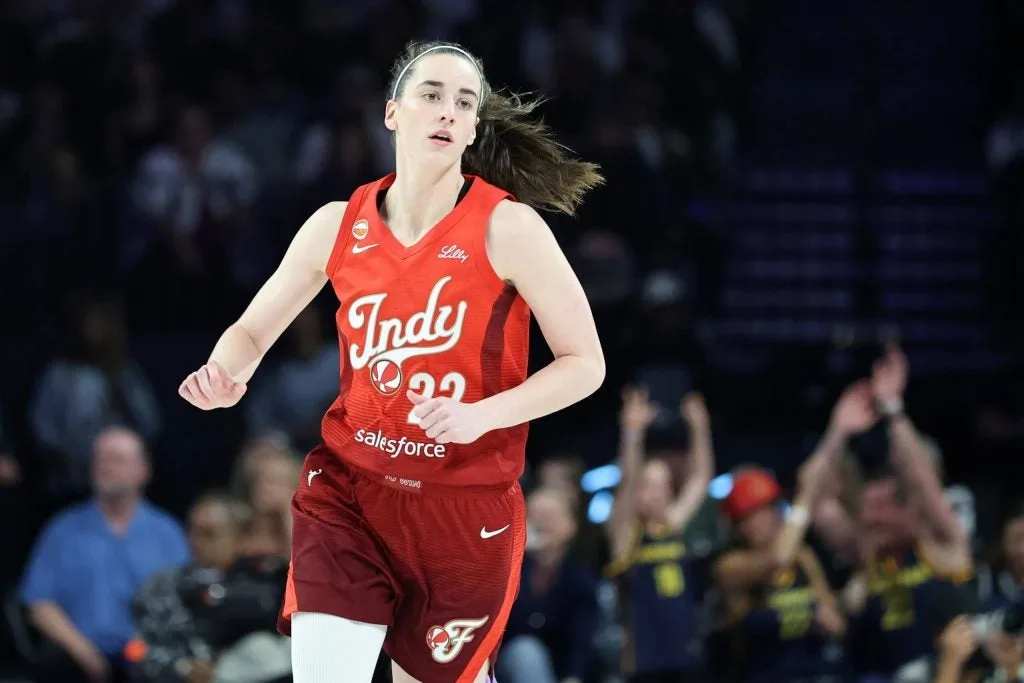
LAS VEGAS — At about 10 a.m. on Thursday, the Indiana Fever arrived on the court. A staff member urged everyone to keep quiet as head coach Stephanie White addressed the media. Despite the request, some players played with a prize wheel tucked in the tunnel, chatting during warm-ups and clapping enthusiastically during their pre-shootaround huddle—one coach even danced for a late clap.
Then, White, the commanding figure behind the Fever, gave a longer-than-usual speech, though it was inaudible outside their circle in the mostly empty Michelob Ultra Arena. For a rare moment, the team was silent, just hours ahead of another critical moment in a season filled with them.
“WHOOOOOO!” Caitlin Clark shouted right as White finished. “Come on!”
There’s always a hint of lightheartedness to balance out the intense pressure—a feeling that hit full force after a striking start in Game 3 against the Las Vegas Aces gave way to a tough grind. After a gruesome loss by 94-83, which ended their first-round playoff run, new challenges and expectations have begun to take shape.
The Fever, led by the WNBA’s most renowned player, Clark, are simultaneously close to greatness and far from it. Having a superstar like Clark alongside All-Stars Aliyah Boston and Kelsey Mitchell suggests championship potential—a fact underscored by the team that knocked them out two years running: the Aces.
The Aces exemplify what the Fever aspire to be. By Thursday’s end, Clark was reflecting on how Las Vegas ended their season, noting her team probably played a “C” game despite coming close. “It hurts, but there’s a lot to be proud of too,” she said.
Indiana’s downfall came in fits and starts. They scored 31 points in the first quarter, but Clark went over 21 minutes without a field goal. Mitchell made half as many shots as she took, while A’ja Wilson dominated with 36 points and 10 rebounds. Though the Fever rallied in the fourth, it wasn’t enough—Las Vegas’s star decided the game. Notably, she doesn’t play for Indiana.
Clark remains the focal point of everything surrounding the sport because she holds the power to change outcomes. In her rookie season, she led the Fever back to the playoffs. Last year, injury sidelined her during the postseason. This season, she put up an MVP-worthy performance but drew an impossible matchup against a dominant champion. Still, their first-round exit wasn’t a foregone conclusion; Clark’s leadership in Game 2 gave them a genuine chance against the Aces—a pivotal moment signaling their potential.
Expectations have always loomed large for Clark and will only intensify in her fourth year. Winning a championship remains the ultimate goal. “Everyone expects me to win a title immediately,” Clark said. “That’s definitely my goal, and I think this team can get there.”
Those hopes, however, rest on factors beyond her control. Clark cannot alone add the athleticism and defense needed within salary cap constraints, nor can she negotiate Kelsey Mitchell’s contract, as Mitchell will become an unrestricted free agent following arguably her best season. Still, Mitchell’s commitment to the Fever was clear when she referred to the team as “we,” expressing determination to keep fighting despite disappointment.
White confirmed Mitchell is the team’s offseason priority.
This urgency highlights the challenge before general manager Amber Cox and the front office. Retaining Mitchell alongside Clark and Boston means Indiana has a strong core built for championship contention. Veteran forward Myisha Hines-Allen emphasized, “With how Amber put this team together, it’s championship or bust. We have everyone we need to get the job done.”
However, the path forward is complicated. Assuming Mitchell signs a maximum deal and Clark signs a lucrative extension like Boston’s, the trio could consume approximately 60% of the $7 million salary cap projected for 2027. Building the right complementary roster within these financial limits will be crucial.
Developing young talent like Raven Johnson and Mikayla “KK” Timpson offers cost-effective growth potential. Yet, deciding the fate of veterans Monique Billings and Lexie Hull—both protected but with mixed impacts—will be tricky. Then, there’s Sophie Cunningham’s situation: a fan favorite with solid shooting numbers and strong merchandise sales, but 30 years old, a free agent with a subpar on/off rating, and recently embroiled in controversy over comments on transgender athletes.
Ultimately, the future pivots on Clark. Whatever best supports her career and growth will guide decisions on coaching and team structure. If Clark endorses White, White stays as coach; if not, changes may follow.
Had Thursday’s game ended differently, present and future might have seemed one and the same. Instead, the Fever are like their unfinished performance center—a sprawling 108,000-square-foot facility filled with promise but still under construction. Soon, it will feature state-of-the-art training spaces, but for now, exposed concrete and dust remain.
The Fever have enormous potential but haven’t reached it yet.
“Championships take time,” White said before the game.
Clark, still just 24, jiggled her teeth during her postgame press conference. This was her fifth playoff game and second first-round exit. For now, these moments are simply early chapters in the Fever’s story. Everything Clark and the team dream of is still attainable—and fans will be waiting eagerly for it to come true.
“Last season I didn’t play much, but this year I had my best season yet. I still have so much room to improve, and that’s the exciting part,” Clark said. “I love the work and being in the gym. I might get kicked out for a bit, but we’ll get back to it.”
This article originally appeared in The Athletic.
Fan Take: This update is vital for WNBA fans because it shows how the Fever, led by a transcendent talent like Caitlin Clark, are on the cusp of greatness yet face the harsh realities of team-building in a salary-capped league. Their journey highlights the growing pains of a rising franchise and underscores the importance of smart roster management to fulfill the WNBA’s championship potential and increase the league’s competitiveness.
Source: sports.yahoo.com
