

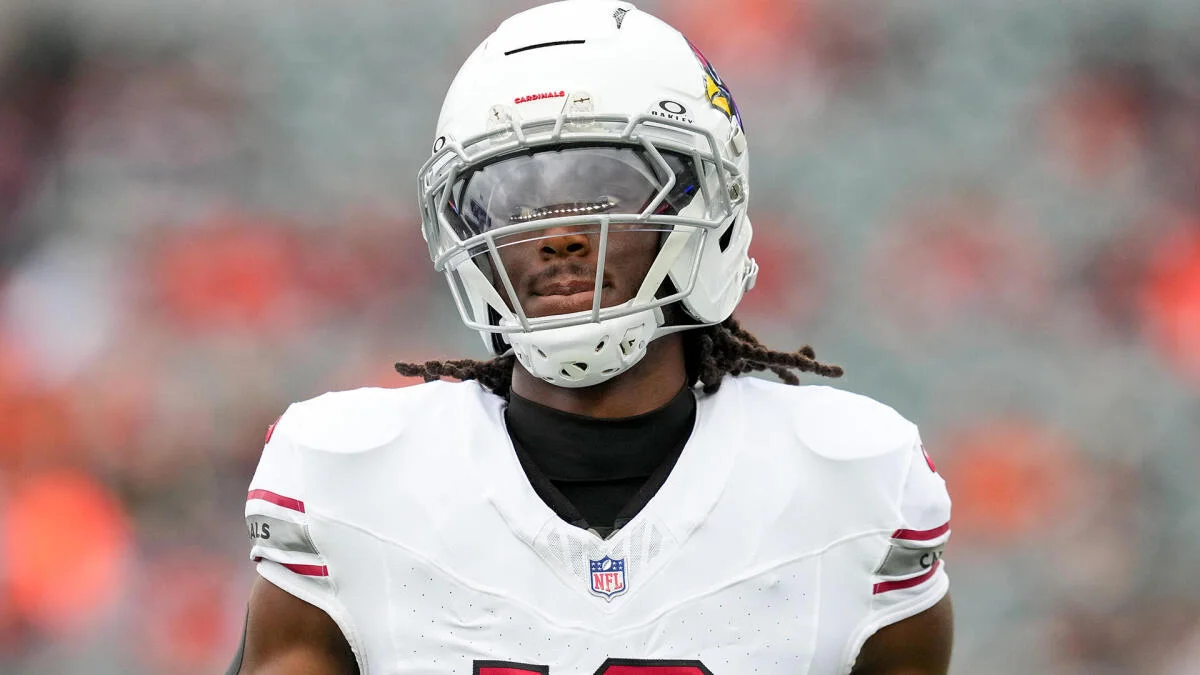
Through Arizona’s first two games of 2026, rookie wideout Marvin Harrison Jr. has managed only one reception for 33 yards. Five Cardinals players — including both running backs — have more catches than him. Quarterback Jacoby Brissett has targeted Harrison just four times over those two outings, a total that ties him with running back Tyler Allgeier for fifth on the team. Fellow wide receiver Kendrick Bourne, listed as the team’s No. 3 option, has been sent the ball 11 times and has caught 10 passes.
The counting numbers are poor, and the efficiency metrics are worse. Among the 103 receivers who have run at least 25 routes this season (per TruMedia), Harrison sits 100th in target rate at 6.5%. He’s behind lesser-known names in per-route targeting, and he ranks 92nd in yards per route run at 0.52, meaning a number of other young receivers are producing more on a per-route basis.
Given who he is — the son of Hall of Famer Marvin Harrison, a top-5 draft pick and one of the most-hyped receiver prospects in recent years out of Ohio State — this slow start is particularly striking. Harrison already struggled during his first two NFL seasons, so this sluggish opening raises real concerns about whether he’ll ever live up to his billing.
Harrison’s role in the offense helps explain some of the volume issues. Of that group of 103 receivers with 25-plus routes, Harrison’s average target depth is the deepest, at 12.83 yards downfield, per TruMedia — a number that would have led the league last season. He’s being deployed as a vertical threat. Out of the 62 routes he’s run so far, 19 have been go routes (about 30.6%, fifth-highest among those receivers), and his post routes account for another 12.9% — together those deep patterns make up 43.5% of his work. He’s been targeted just once on those 27 deep routes, and that single target produced his lone 33-yard catch.
Put differently, Arizona is using him as a sacrificial X: aligned on the line to clear out space on the perimeter more than as a primary receiving option. That assignment inherently reduces how often he sees the ball.
But scheme isn’t the whole story. Harrison has already dropped a catch and film shows multiple routes where he appears to be running without full intensity — lacking sharpness, burst and separation. Cutups from Week 1 and repeats in Week 2 against Seattle highlight moments where he seems disengaged or makes little effort to influence the play. That’s problematic whether or not a pass is intended for him: receivers must run each route like the ball could come to them, and they have to block when the run game requires it. Poor effort hurts both individual opportunity and the teammates who rely on him to clear space.
Another major reason he’s not getting looks: other Cardinals pass-catchers have simply earned more trust. Tight end Trey McBride has been a target hog, leading tight ends this year with 23 targets and 17 catches and ranking fourth at the position with 136 receiving yards; he was the top tight end in targets, receptions, yards and TDs last season. Michael Wilson has also outplayed Harrison in recent months, stepping up when Harrison missed time last year and receiving seven targets in each of Arizona’s first two games. Coaches have said they envision Wilson in a Puka Nacua–style Z role while Harrison slides into an X role similar to how Davante Adams is used — a plan that so far has translated into more opportunities for Wilson and McBride than for Harrison.
Fan Take: This matters because a high-profile rookie underperforming forces teams and fans to confront how much draft status and pedigree matter versus on-field production; if Harrison can’t turn things around, it’ll reshape evaluations of rookie development and scouting. For the NFL, it underscores that drafting star potential isn’t a guarantee of immediate impact and that player usage, effort and surrounding talent often determine whether a prospect becomes a star or a disappointment.
Source: www.cbssports.com