Do movie montages and action-film logic make us expect learning to be quick and tidy? Think about films like The Karate Kid, Whiplash, or Spider-Man: Into the Spider-Verse: the protagonist faces a huge challenge, trains, and then shines in one big moment. In real life, skill-building is rarely shown accurately — practice clips hide how inconsistent progress can be. Improvement often comes in fits and starts, and sometimes a single moment suddenly makes everything click. A few NFL teams still haven’t found that click yet.
The Chargers: miscommunication and schematic trade-offs
A hindsight thought: Justin Herbert has long been labeled a methodical, almost robotic quarterback — he methodically runs reads and makes calculated throws. Mike McDaniel’s offensive approach, by contrast, feels more instinctive and experimental. That personality gap could make precise communication between quarterback and play-caller harder, and the early evidence points to a collective failure rather than a single-player problem.
Team tendencies have changed noticeably:
– Pre-snap motion: 50.0% (2025) → 73.8% (2026)
– Play-action rate on early downs: 32.0% → 42.5%
– Plays per game: 64.4 → 56.5
The Dolphins-style heavy motion and play-action are meant to get receivers up to top speed and free up deeper shots — Herbert’s overall passing aDOT is up 19.4% to 9.2 air yards, and on play-action it’s 10.6. But more pre-snap movement and longer routes chew up the clock, reducing total plays and therefore opportunities. That tradeoff matters when you assume efficiency gains will outweigh fewer chances.
Putting Herbert’s raw results in context:
– aDOT (using Play Action): 8.0 (2025) → 10.6 (2026)
– Pressure Rate: 48.5% → 65.0%
– CPOE: +1.57% (2025) → -6.24% (2026)
Asking the QB to push the ball farther and do so under heavier pressure makes completion efficiency drop — not a shock. Additional context:
– (Early Down) Pass Rate Over Expectation: +1.91% (2025) → -10.5% (2026)
– Adj. Yards Before Contact per Att.: 0.68 → 0.75
– Yardage Needed on Third Downs: 6.7 → 8.5
Run-blocking inside hasn’t noticeably improved, so drives often require a couple more yards on third down. Add three early drops by receivers, and it’s easy to understand why Herbert has begun favoring shorter, safer throws instead of letting it rip late in games. Until Herbert and McDaniel settle into a rhythm, the offense will mostly produce flashes rather than consistent execution — Ladd McConkey (when healthy) and Omarion Hampton are among the few reliable starters right now.
Bucs: searching for consistency after a roller-coaster start
I circled back to Tampa Bay after their surprising loss to Cleveland to look for signs the offense can stabilize. With three players drafted in the top 100, some offensive steadiness would be welcome. Tampa has been nearly balanced on early downs (-1.27% PROE), so Bucky Irving’s effectiveness matters as much as Baker Mayfield’s play.
Running results swung wildly in the past two games:
– (Early-Down) Rushing Success Rate: 62.5% (at CIN) → 37.5% (vs CLE)
– Forced Missed Tackle Rate: 62.5% → 12.5%
– Third-Down Yardage Needed: 6.0 → 9.2
That dramatic drop isn’t solely about the opponent — Irving’s adjusted yards per contact plunged, and the offense was often left chasing longer third downs, putting more pressure on Mayfield. There are favorable matchups coming through Weeks 4–9 that should help Irving and, by extension, the passing game — but Mayfield can also do his part by leaning into a steadier short-to-intermediate plan.
Quarterback/play-action splits show the problem:
– Passing aDOT (early downs, play-action): 6.0 (at CIN) → 11.3 (vs CLE)
– Passing Success Rate: 47.8% → 38.5%
– Pressure Rate: 18.5% → 34.6%
Against Cincinnati, play-action on early downs frequently converted; against Cleveland, Mayfield’s aDOT ballooned and efficiency fell. When the Bucs used shorter passing efficiently — Week 1 had multiple targets with 8+ YAC per catch — drives extended and Mayfield stayed protected. If Tampa can find consistent chemistry between Mayfield and his interior receivers, the offense and fantasy outlook improve.
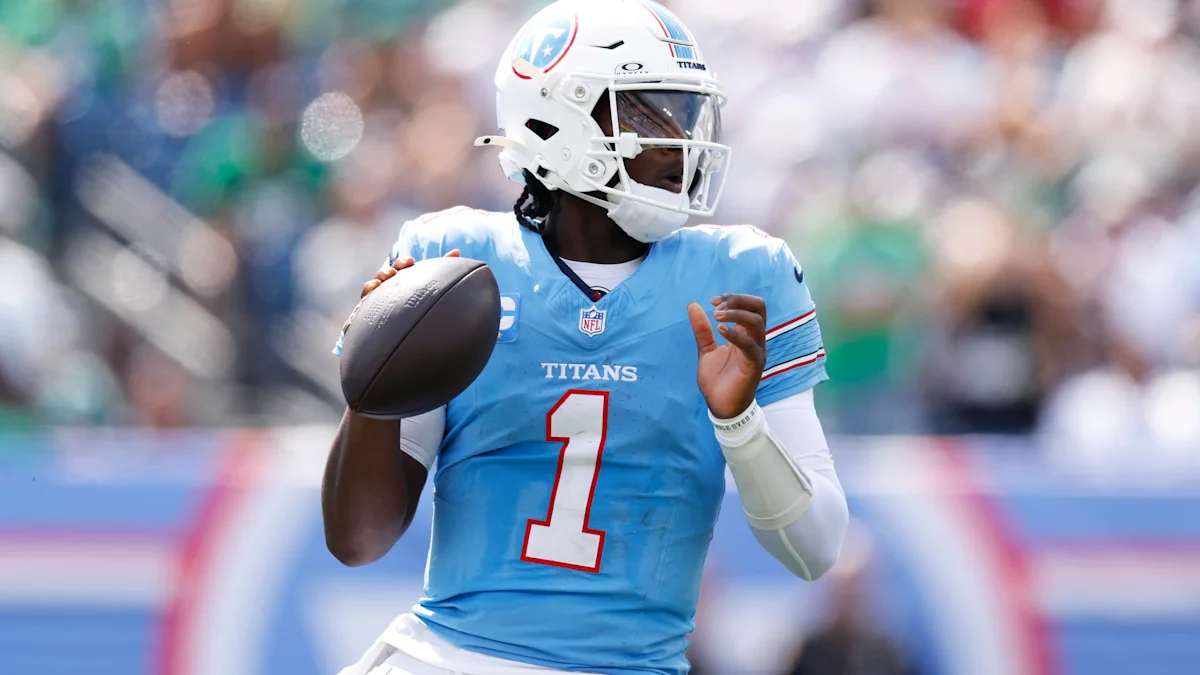
Titans: Daboll’s tweaks and signs of life from Cam Ward
I initially started the Eagles defense in a fantasy league expecting them to exploit Cam Ward, but Tennessee’s Week 2 adjustments made me pause. First, Brian Daboll showed the ability to game-plan against Philadelphia’s weaknesses. Tony Pollard posted his first solid rushing success rate (50%+) against a stout run defense since last season, and Tyjae Spears also contributed meaningful all-purpose yards. The Eagles were a league-average run defense late last year and opened 2026 vulnerable to RB first downs, and Daboll attacked that.
Scheme shifts and play-calling changes:
– PROE: +5.4% (Week 1) → -20.1% (Week 2)
– Pre-Snap Motion: 45.7% → 63.6%
– Under-Center Passing Rate: 8.6% → 27.3%
Tennessee’s adjustments helped limit Eagles possessions and maximize their own, averaging over 25 yards per drive in Week 2. That brought a healthier offensive balance and also allowed Cam Ward to show more effective pocket play.
Ward’s passing profile has improved — he’s throwing less to the boundary and letting receivers generate after-the-catch yards:
– CPOE: -5.6% → +3.4%
– YAC per completion: 3.9 → 7.7
Elic Ayomanor produced chunk plays on intermediate targets, Spears averaged 14.0 YAC per reception, and Pollard added 8.0. Carnell Tate’s overall yardage was modest, but his shorter aDOT (9.8) and 29.4% team target share signaled a shift in usage. With friendlier matchups ahead, Tennessee is worth monitoring.
Seahawks: new play-caller, same results — and a rookie RB to watch
Seattle sits 2-0 with a +27 point differential, so the change at offensive play-caller hasn’t derailed them. Jaxon Smith-Njigba has been outstanding — he leads in catches, yards, and touchdowns and has thrived under OC Brian Fleury as Drew Lock starts. Fleury has also leaned more heavily into the run game, and that’s where rookie Jadarian Price has flashed.
Seattle’s run usage has jumped:
– Team rushing usage: 33.5% (2025) → 48.3% (through two weeks)
Price’s early splits and usage:
– Rushing Rate: 50.0% (Week 1) → 57.5% (Week 2)
– Routes per Dropback: 26.0% → 32.5%
– Goal-line Share: N/A → 25.0%
Price shows the burst and contact balance to succeed in outside-zone schemes, but workloads have been shared — he’s competing with George Holani and Emanuel Wilson, and Zach Charbonnet’s impending return could complicate things. Even so, Price’s efficiency numbers are strong:
– Adj. Yards After Contact per Att.: 3.96 (8th of 39 qualifiers, min. 30% team rushing rate)
– Forced Missed Tackle Rate: 30.4% (7th)
– Explosive Run Rate: 13.0% (T-4th)
PFF charting suggests he’s been reliable in pass protection, too. In his only full game he took half the carries and ran routes on 40% of dropbacks; with his shoulder not expected to linger, he’s an intriguing buy-low option for managers seeking a low-end RB2 with upside.
Fan Take (two sentences)
NFL trends matter because schematic shifts — like more pre-snap motion and heavier play-action — can change which players and positions produce consistently, affecting both wins and fantasy value. Watching how teams and coaches adapt (or fail to) over the next month will reveal whether these changes are sustainable strategies or short-term experiments that simply expose personnel weaknesses.
Source: sports.yahoo.com