The UEFA Women’s Champions League has returned!
The initial matches of the league phase have occurred, revealing intriguing outcomes. Barcelona and OL Lyonnes delivered commanding wins, while the other fixtures were notably competitive.
Chelsea narrowly secured a 1-0 victory against Austria Wien, who were making their Champions League debut, despite an early advantage; meanwhile, Arsenal struggled offensively and needed a late penalty to clinch a 1-0 win over underdogs HB Køge. Manchester City faced a stiff challenge, drawing 2-2 with Bayern Munich, and their first goal was met with controversy.
There were also fascinating draws, notably between Real Madrid and Paris Saint-Germain, as well as OH Leuven versus Roma.
What do ESPN’s analysts Emily Keogh, Alex Kirkland, and Shubi Arun think, aided by VAR insights from Andy Davies? Here are some pressing questions.
Why is Arsenal having difficulty scoring goals?
Arun: Arsenal’s forwards seem to be facing a confidence crisis, which appears to be creating mental barriers. The increasing discussions about their struggles—only scoring three goals in four matches this season—are clearly affecting the players, as evidenced by the anxious atmosphere at matches.
The relief felt at Meadow Park when Chloe Kelly scored early against HB Køge turned to despair as VAR disallowed the goal, reawakening their anxieties. The fact that Arsenal only managed two shots on target highlights their forwards’ lack of belief; Germany’s Selina Cerci was the only one who seemed unfazed, winning the late penalty that Mariona Caldentey converted for their win.
It’s noteworthy that the Gunners’ struggles have predominantly occurred at home. Their upcoming three matches are all away, which might actually benefit them.
Keogh: Arsenal’s goal-scoring woes can be traced back to playing their top striker, Alessia Russo, out of position. Despite being a world-class striker, manager Renee Slegers continues to use her in midfield to fit Stina Blackstenius in front, resulting in an ineffective tactical setup that limits Russo’s goal-scoring potential.
It’s similar to how Manchester City’s Khadija “Bunny” Shaw would struggle if frequently shifted away from her preferred position. By playing Russo in an unfamiliar role, Arsenal’s wingers’ crosses often go unanswered, presenting a predictable strategy for opponents.
While moving Russo back to her best position won’t solve all of Arsenal’s problems—given their overall lack of finishing—it would mitigate some tactical issues that hinder their attack.
Will this year’s UWCL be more competitive?
Kirkland: It’s too soon to make definitive statements, and we should await more match data, but early signs suggest increased competitiveness. This is promising for the tournament’s overall quality, even if it results in fewer goals.
Seeing too many lopsided matches, like last season’s 39 goals on Matchday 1—featuring results such as Barcelona 7-1 Bayern—detracts from the prestige of the Champions League, which should showcase the best teams in high-quality matches.
Hopefully, these tighter scorelines signify a trend rather than a fluke.
Keogh: The introduction of the Swiss format has tightened the competition significantly. The Champions League is no longer so predictable or straightforward for Europe’s traditional powers, and this was evident in the opening matches.
Chelsea had to endure sustained pressure from a resilient Austria Wien, while Arsenal struggled until late against HB Køge due to their poor finishing. Manchester City managed a hard-fought draw against Bayern, showing the newfound intensity of these matches.
Meanwhile, teams like Roma and OH Leuven are gaining confidence and building on their European experience, suggesting that the divide between the established giants and emerging clubs might be closing. Even Paris FC surprised Barcelona with an early lead.
This leads to a tournament that feels increasingly unpredictable, filled with dramatic moments and closely contested games that will test even the strongest teams.
Was Manchester City’s first goal valid?
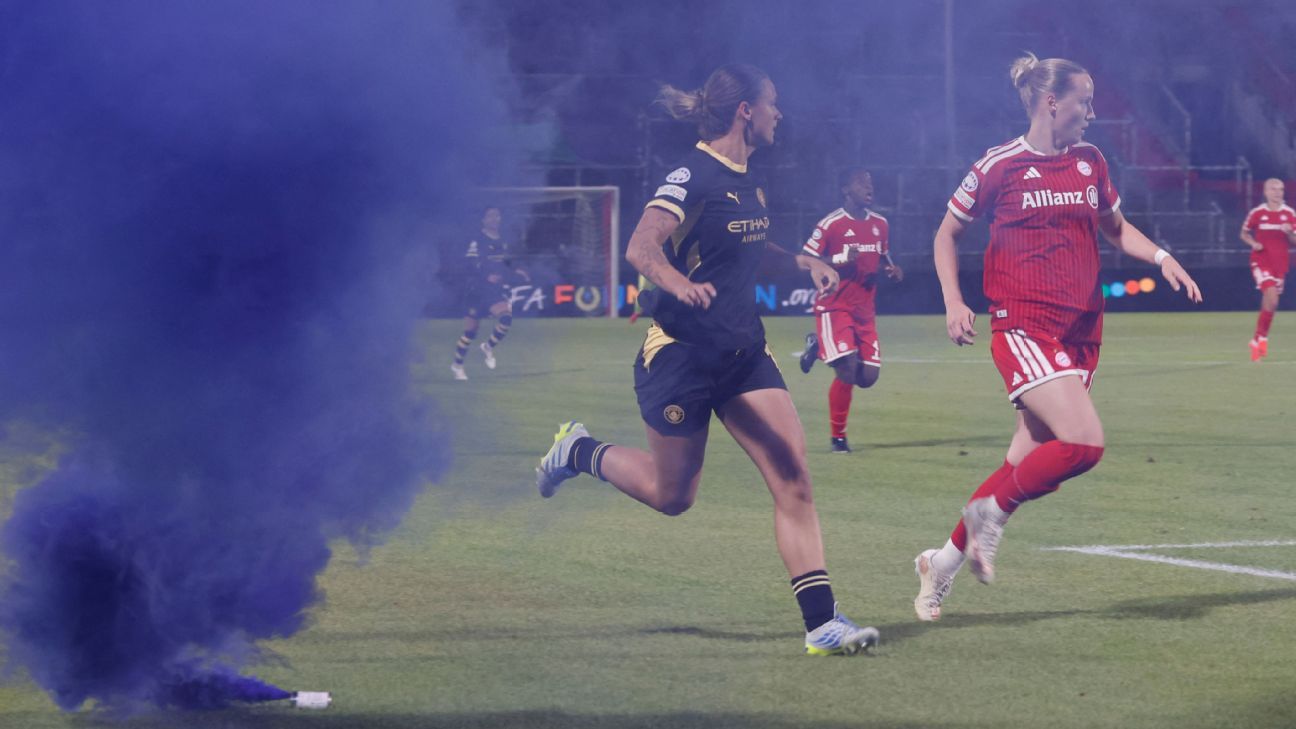
Keogh: The circumstances surrounding Manchester City’s first equalizer were quite unusual. After trailing 2-0, defender Kerstin Casparij dashed down the right side as a flare was thrown onto the field, yet she crossed the ball, leading to a goal by Beth Mead.
This decision has sparked significant debate.
Reportedly, the flare was linked to a protest by unhappy fans of local club SpVgg Unterhaching, unhappy about Bayern Munich acquiring their stadium for their women’s team, leaving the men’s side to remain as tenants.
At first, fans inside the stadium seemed unfazed by the flares, more focused on the match, but once the referee allowed City’s goal, the atmosphere shifted dramatically, with boos and jeers directed at both the officials and City.
The environment became charged, and Bayern’s manager José Barcala appeared visibly frustrated with the referee’s decision during halftime.
Davies: The officiating by Spanish referee Olatz Rivera Olmedo and her crew was questionable, especially concerning their choice to let play continue. The referee should prioritize the safety of players and officials in such situations.
Per UEFA’s Safety and Security Regulations, play should stop if a flare lands on the pitch, which was clearly the case here.
However, according to IFAB’s Laws of the Game, if a flare does not affect play or pose a danger, the referee can allow play to continue, making their discretion crucial. Given that the flare landed very close to active players, play should have halted immediately.
What caught your attention on Matchday 1?
Kirkland: I was particularly impressed by Felicia Schröder during Real Madrid’s 1-1 draw with PSG. Watching the teenager live was a treat; her potential was evident, though her missed chances overshadowed her performance.
There was considerable excitement around her signing, and while it’s early days, I believe she can blossom into a star while teaming up with Linda Caicedo.
However, for Madrid to advance beyond the quarterfinals, she’ll need to sharpen her finishing skills.
Arun: Austria Wien’s spirited display against Chelsea was a standout. Following an early goal by midfielder Wieke Kaptein, their resolve surprised many, and they began to push back against Chelsea.
Their physicality and attacking intensity in the second half were notable, as they ended the match with more shots than Chelsea. Striker Modesta Uka made a significant impact as well, nearly equalizing with a striking effort that hit the post late. Chelsea’s win was hard-fought, and Austria Wien will likely pose challenges for other teams.
1:21
Unconvincing Chelsea frustrated by UWCL performance
Keogh: It seems OL Lyonnes manager Jonatan Giráldez has finally identified his strongest lineup and found a way to effectively utilize the vast individual talent at his disposal.
With a squad brimming with international stars, inconsistent performances plagued them last season. Giráldez spent much of his first year finding a balance that would allow their talent to shine collectively.
Many questioned the team’s cohesion during critical moments last season, particularly in important matches. However, following a decisive 8-0 win over Servette and a strong start in their French league campaign—scoring 22 goals in three matches—it looks like Giráldez may have developed a winning formula.
The challenge revolved around not the lack of talent but finding the right structure to maximize the potential of players like Melchie Dumornay, Lily Yohannes, Ada Hegerberg, and Marie-Antoinette Katoto together. Early results suggest Giráldez is making progress, posing a potential threat to rivals across Europe.
This resurgence of competitiveness in the UEFA Women’s Champions League is crucial for soccer fans as it hints at a more thrilling and unpredictable tournament. The rise of smaller clubs and tactical evolution among teams could reshape the landscape of women’s soccer, making every match significant and fostering a broader appreciation for the sport.
Source: www.espn.com