

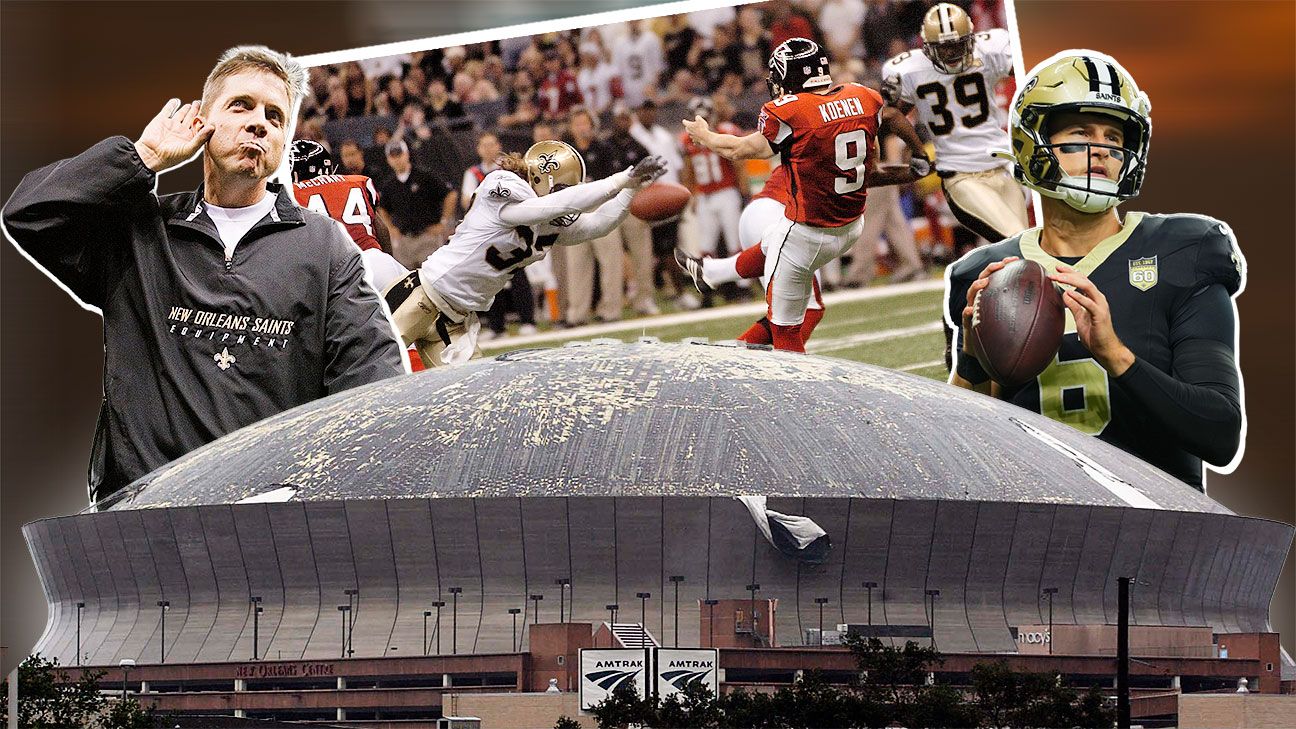
NEW ORLEANS — When the Saints and Falcons face off at the Caesars Superdome on Monday night (8:15 p.m. ET, ESPN), they’re doing more than rekindling a divisional rivalry — they’re honoring a pivotal moment in New Orleans history.
Hurricane Katrina struck the Gulf Coast on Aug. 29, 2005, killing over 1,300 people and leaving massive damage across the region. The Superdome, used as an emergency shelter during the storm, suffered severe roof damage and remained closed for more than a year. It reopened to fans on Sept. 25, 2006 for a “Monday Night Football” matchup between the Saints and Falcons, complete with ceremonies, celebrity appearances and concerts intended to mark the city’s comeback.
The evening’s defining play came less than two minutes into the game, when special-teamer Steve Gleason charged through to block Michael Koenen’s punt. Curtis Deloatch recovered the ball in the end zone for a touchdown, and the crowd’s roar — captured on TV and seared into the city’s memory — set the tone for a 23-3 Saints victory. Gleason’s block became an enduring image of renewal for New Orleans, later memorialized by a statue outside the Dome called “Rebirth,” and it’s routinely cited as one of the franchise’s most consequential moments.
That season’s momentum carried the Saints all the way to the NFC Championship Game, and the franchise eventually captured Super Bowl XLIV in the 2009 season. For Atlanta, the 2006 game added fuel to a rivalry that has remained intense ever since. Gleason, diagnosed with ALS in 2011, has remained a beloved figure in New Orleans; he credits that play with the way it cemented his place in the city’s story.
Teams, coaches and fans continue to treat Saints-Falcons games as marquee events. The league intentionally scheduled this prime-time matchup to coincide with the 20th anniversary of the Dome’s return; the 10th anniversary also received a Monday night spotlight. Both teams enter the contest at 1-2, each with something to prove in the NFC South — the Saints narrowly favored after a loss to the Raiders, and Atlanta coming off a solid win over Green Bay.
The rivalry’s history is littered with memorable moments — more blocked punts, broken goalposts, heated exchanges, performances that shifted seasons and countless on-field and off-field antics. Current players who didn’t live through 2005-06 still understand the significance. Saints quarterback Tyler Shough called the matchup “one of the last really cool rivalries in the NFL,” while Falcons teammates and coaches acknowledged the Dome’s electric atmosphere and the emotional weight the franchise’s return carried for the city.
Saints coach Kellen Moore has actively taught younger players about Katrina and the Dome game, showing footage and recounting stories to connect current rosters with the city’s history. That mirrors what then-rookie Saints coach Sean Payton did in 2006, when he had the team watch a pregame video detailing the devastation so players would appreciate the bigger context before kickoff.
Veterans and staff who lived through the reopening recall mixed emotions — disbelief that a football game could be played amid such recent hardship, followed by an overwhelming sense of unity when the Dome filled again. Players, coaches and observers have all described the noise and energy that night as unlike anything they’d experienced. Drew Brees compared the sound of Gleason’s block to a shotgun blast, followed by the release of 70,000 voices that had waited more than a year to be heard.
The game reached a national audience, with nearly 15 million viewers tuning in. The significance of that night still draws attention: for Monday’s anniversary broadcast, Eli and Peyton Manning will host the game on ESPN2’s ManningCast, with Gleason and Payton among the planned guests.
Gleason’s legacy goes beyond a single play. He’s used the visibility of that moment to champion ALS awareness and advocacy, and teammates, opponents and coaches praise his character and impact. Many who followed the Saints say that even after the Super Bowl and other big plays, Gleason’s blocked punt remains the franchise’s defining historical moment — a symbol of the city’s resilience and the team’s bond with its community.
Players who weren’t in New Orleans for Katrina nonetheless feel the responsibility of representing a city that used that game as a touchstone for recovery. Saints and Falcons participants alike describe the matchup as more than a divisional contest — it’s a cultural event for fans, a reminder of hardship overcome and a yearly charge for bragging rights.
NFL reporters from multiple outlets contributed to this coverage.
Fan Take: This game matters because it ties sport to community healing — a reminder that football can carry real cultural weight beyond wins and losses. For the league, moments like this underscore how a single play can become part of broader civic identity, keeping rivalries meaningful and the sport connected to more than just competition.
Source: www.espn.com
